




We outline how to win at chess with strategies, tactics and some psychology tips to rattle your opponent.
Chess is one of the most complicated games there is. It starts with the fact that an initially completely unmanageable amount of the most varied and colored pieces of wood are on a board. If you have become friends with these figures to the extent that you recognize a certain order, the next shock awaits: Almost all figures move or jump differently. It is not a strictly structured game like checkers or Connect-4.
There are so many different ways to start and continue the game that the beginner may soon be confused. But while he probably can’t defeat somebody like world chess champion Magnus Carlsen, even the beginner or the inexperienced player has a chance of winning even against clever tournament heroes.
How to win at chess: the endgame
The aim of every player is to checkmate the opponent, so you win the game. In chess, the opponent can also give up the game, with the same effect. There is a draw, i.e. a tie:
- when both players have agreed on it.
- when there are only two kings left on the board.
- if, apart from the two kings, there is only a maximum of one minor piece (bishop or knight) on the board, because a mate is then no longer possible.
- if 50 moves no pawn has been moved and no piece has been captured ( 50-move rule ).
- if the same position is achieved on the board 3 times , one time including the move of white and black
- a stalemate, including a tie, is also reached when a player is not in check but no longer has the opportunity to move a piece .
How to win at chess: the 9 rules
- Make the right moves at the start
The purpose of your first few moves for how to win in chess is to establish control of the board. The most important part of the board is the center. With your pieces and pawns in control of the center, you can dictate the direction of the game. In the position below, the two pawns are perfectly controlled by the board, while Black gives no effect.
2. Don’t just give up the pieces
Exchanging pieces is the normal thing in chess, but you should only exchange numbers of the same value. Many players lose because they simply release their shapes and paws. At the same time, as a key strategy for how to win chess, you need to grab all the numbers that the opponent gives you a gift (just beware of the traps).
- Be strategic with active positions.

Before you can get to the king, you must position your pieces to attack. This means that when attacking, when you attack, you need active positions that have many options.
- Coordinate the attack on your opponent’s king.
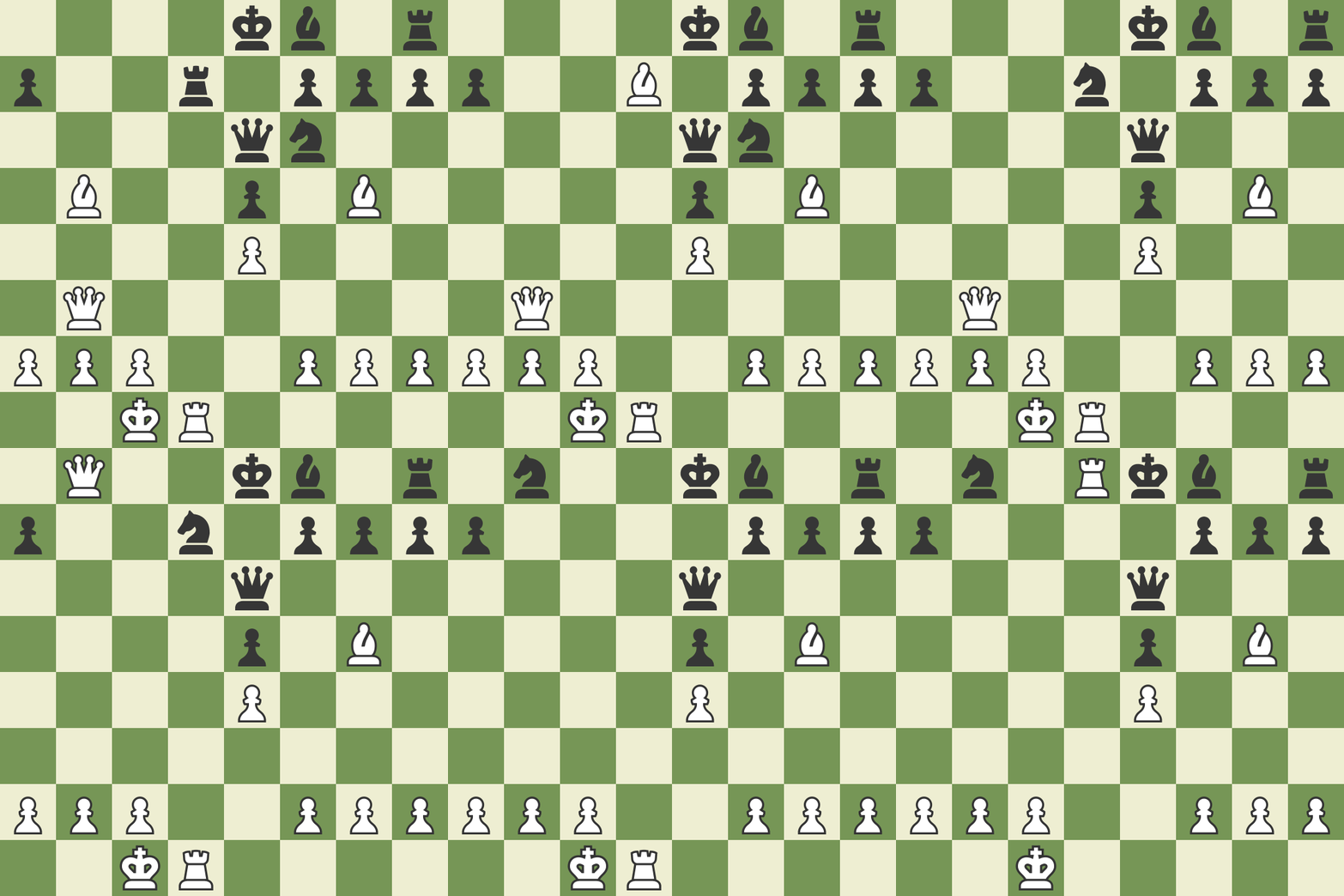
This requires several figures to work together. Most of the time, you need a figure that will corner the king and at least one figure that will protect your attacking figure so that the king cannot take it. Sometimes you even have to sacrifice multiple pieces to break the opponent’s defenses.
- Take care of your king’s safety

Sometimes the players so focus on the opponent’s king they just forgot their own king. Remember that your opponent is also playing and will attack your king too. Be sure to follow the threats your opponent creates, which leads to the next step. One of the best ways to protect your king is to place it behind several pawns who will be defending him. In the position below, the white king is comfortable and secure, and on the black king it is easy to attack.
6. Don’t move the queen too early.
The queen is so precious that any threat forces the queen to waste moves on salvation instead of developing positions. Give priority to knights and bishops instead. Once that’s done, then you can develop the queen’s position. Of course, there are positions in which you need to develop the queen early, but mostly exceptional cases.
7. Don’t move the guard pawns unless you have to
There is a rule of “don’t move the pawns guarding your king when you don’t have to. ” Always try to find an alternative way to eliminate the problem without deteriorating a pawn structure, especially if your king’s safety is endangered.
8. Don’t play your knight near the edge
The knight (horse) is weak at the edge of the board. This is because it slimits the number of squares he can control. General rule – try to develop knights as close as possible to the center of the board. Remember: knights in the middle, bishops by the edges.
9. Always be polite
Regardless of whether you won or lose, congratulate or thank the opponent for the game. Victory, like lesions, are part of the game. Even the best players in the world often lose. So, even with an unsuccessful game, be kind and grateful, and after the game just think about how it would play better next time.
How to win at chess: the winning endgame strategies
You can play a billion different moves in chess. When you are a novice player it is always difficult to determine how good your course is. In fact, there is no common rule that allows you to determine the force of your stroke with 100% accuracy. It is time to list the endgame winning strategies. You may know some of them, but this list keeps them organized in your head.
- Activate and centralize your king (you probably already know that the king is a valuable piece in the endgame that you can use to call pawn and rival pieces as well as protect your own. Very often the party with the more active king wins the party. It is important not only to use the king as a weapon, but it is also important to do so on time. You should be careful that the numbers remaining on the board do not create a threat to him.)
- Don’t move the pawn unless you really need to. Of course, when you see you a pawn move and do it, there should be a reason behind it. However, if you don’t see a way to move it safely or to advantage, the best solution will be to keep it back to strengthen your king’s position. Remember, pawns are not returning once they move forward.
- Have a spare space or move in store for the pieces — this is another reason why you should not always being going forward with the pawns. If you have additional pawn movements you can make, then you often win.
- Create a large majority with the pawns. This is very important. For example, if you have 2 pawns against 1 on the queen’s flank, you can get a passing pawn that can move up to be turned into another piece.
- Use a moving pawn as a sacrifice to keep your other pawns safe and get them in better positions. Tthis is what happened in the example above, but it can be done with any pawn. IMAGE
- Look as deeply as possible as potential next moves and the ones after that. (Of course, this strategy applies to any part of the game, but in closing it’s especially important as there aren’t that many shapes and options. Define whether you’re wasting the pieces and where you really want them to go.
- Choose the correct strategy to suit the pieces on the board as you approach the endgame.
- If the position is open and there are pawns on both flanks, the bishop is stronger than horse
- When the position is closed, the horse is better
- If your rival has more pawns, it makes sense to end up with both bishops, in which there is a high probability of taking some of those pawns.
- When you have more pawns, you should leave the elephant of the same color as the opponent for the reason described above
- When you have an extra pawn, keep the opponent’s king away from your pawn
- If you’re pawnless, consider keeping your king closer to your rival’s pawn
Using psychology on your opponent
First of all, a general note that must be observed for manipulation using psychology. Chess is a game of concentration. The inexperienced player usually has less of his ability to concentrate because he cannot analyze the game properly. While the tournament player needs the concentration to constantly compare the various standard situations that he has in his head as a pattern for the game currently being played and to search the theory he is familiar with for possible solutions that are favorable to him. So it is important for the beginner to disturb their opponent; if possible, even to dissuade him completely. Find more leisure guides, tips and advice.
- It is beneficial to play without a time limit right from the start. Therefore, the beginner definitely rejects a chess clock. Only in this way is it possible to gamble for time without mercy in really hopeless cases. Pure moxie has often triumphed when the opponent gives up completely exasperated because he has to catch the bus to work or has made an appointment to keep it he has to break off the game. As I said, this is the last resort.
- Concentrating on the game is more useful to the experienced player than to the inexperienced, so it is paramount to prevent the player from concentrating. It would of course be an advantage if you knew beforehand what is bothering your opponent most. Of course, this will only be the case in very few cases. But don’t worry, everyone is sensitive to a number of disorders. First, try brittle sweets, for example. If they are nibbled conscientiously, the degree of disturbance is very considerable. Anything that crackles is also good. Unfortunately, a lot of sweets are no longer packed in the popular cellophane. On the other hand, almost all types of potato pastries are extremely crispy, and in my experience the top one is the pork crackling.
- But there are also unexpected difficulties. For example, if the opponent is hard of hearing. But this case is not hopeless either. If you notice it early enough. Sneezing is almost always successful.
- Especially as a smoker you still have some particularly unusual methods of influencing a game. Years ago, when I was still smoking, I had some very good results with cigars. Even if you only smoke cigarettes, you should always have cigars with you when you play chess. The worst aroma is just right, unless you are allergic to cigars yourself. At that time I had developed a technique for which heavy cigar smoke was just right. The non-inhaled smoke was blown in a gush directly onto the chessboard, where it was literally sucked in and clouds formed. This trick was possible with so much smoke that the board and the pieces could no longer be seen. The opponent was dismayed.
- There is also a very simple, psychologically very well-founded way of upsetting your opponent. One method that works when the player is very good and has a lot of theoretical knowledge is the following. Build yourself solidly in the center at first. When the game has developed to such an extent that it has become practically inscrutable for the weak player, so that it doesn’t matter what you draw anyway, you proceed as follows:
- The opponent wants to move. At that moment, when he touches the figure, you start to grin. You nod your head deliberately and imperceptibly. This should increase during the execution of the move, as soon as the opponent has let go of his piece, you execute your move as quickly as possible. Anything, it just has to be very quick. Then the other person will sink into long and deep brooding, from which he will be torn out again and again by the fact that you jumped up after the train, happily running back and forth and whistling. Really, it’s very successful.
How to win chess in 4 moves
The mate in 4 moves (also known as shepherd mate ) is by far the most common end of a game of chess. Almost every chess player has won or been defeated in this way.
But you don’t need to be afraid of it! If you know the right defense, White will ultimately only be left in a bad position after the attack is fended off.
Four move mate can be achieved in several ways, but following the basic pattern White moves 1. e2-e4, then develops his bishop on c4 to attack the f7-pawn and finally moves the queen on h5 (or f3). If Black does not defend adequately, White wins with 4.Qxf7 #Four-Move Checkmate
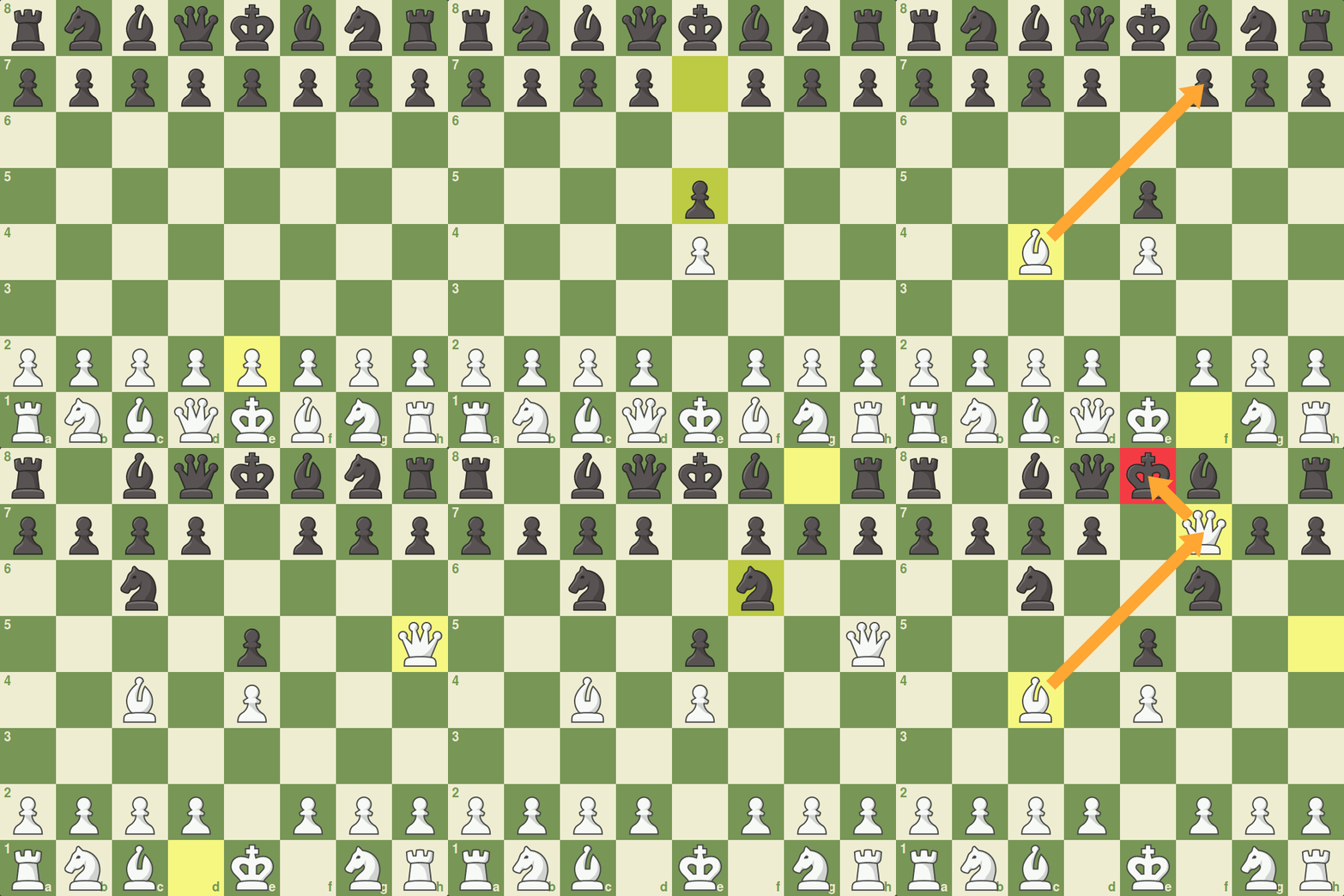
So how does Black best defend against this attack? There are 3 possibilities: … Qe7, … Qf6 and … g6 are all acceptable moves to stop White’s mate threat.
Defending the 4-move checkmate.
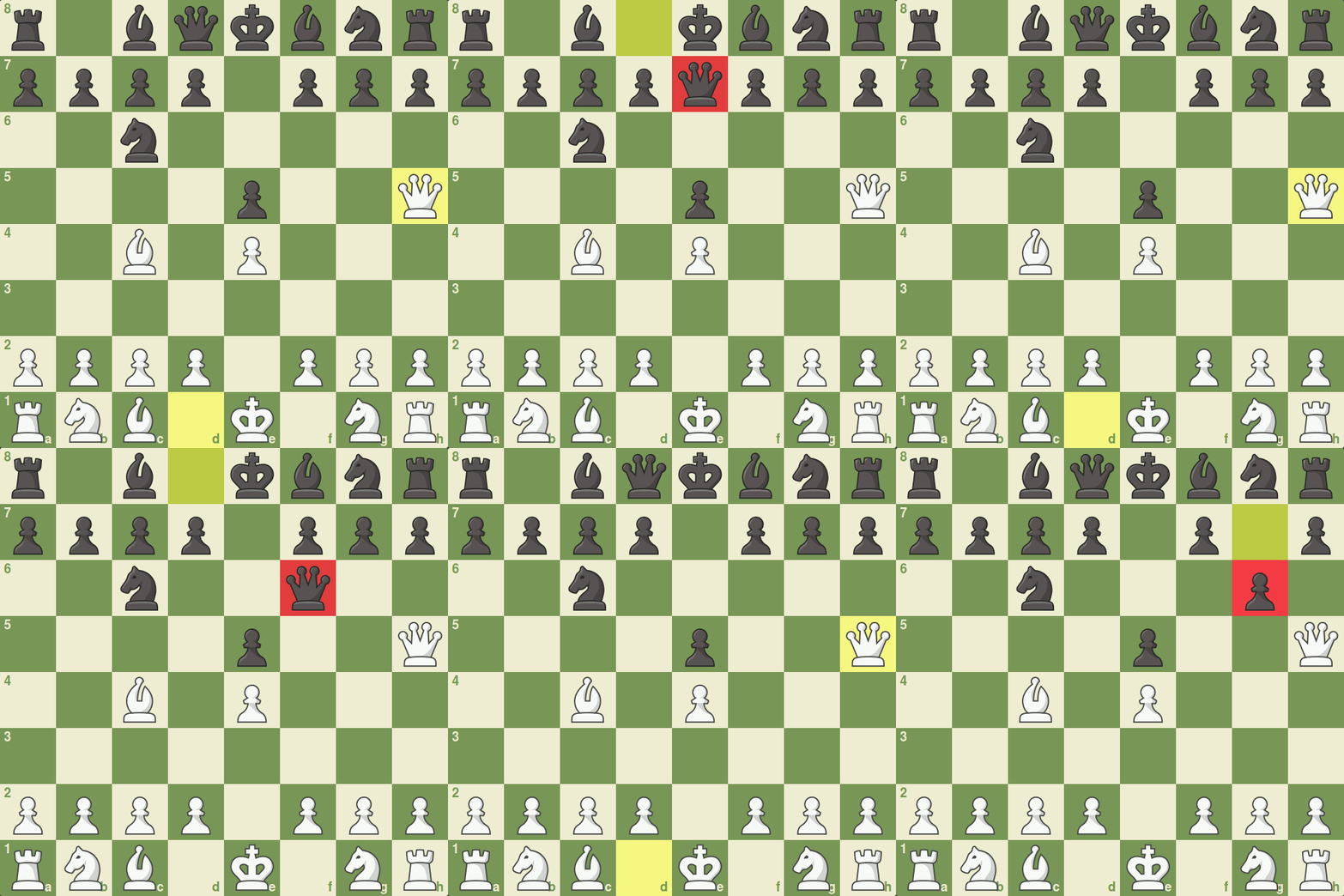
As soon as Black defends mate, the white queen is often attacked in turn. Black should try to develop his pieces by threatening the white queen.
How to win chess in just 2 moves
There are endless possibilities to decide a game of chess for yourself. But did you also know that it is possible to win a game in just two moves? Here we show you how this extremely short game works. You can win a game of chess in just two moves. Do not you believe us? We show you how it works.
Your opponent is playing white and you are playing black. White begins.
If your opponent moves one square forward with the pawn in front of the bishop next to his king, then you make your first move with the pawn immediately in front of your king.
If your opponent now moves two squares forward with the pawn in front of his right knight, then you are already certain of winning the game.
Simply move your queen diagonally forward to the edge of the chess field. Now your opponent can no longer get his king to safety and you have won the game.
