


What are the best ways to use promotion instead of advertising? Our guide outlines how promotion beats advertising, and how to target it correctly.
Find more business guides, tips and advice
The proportion of advertising in magazines and newspapers is an average of 20 percent, that’s every fifth page . For this, advertisers pay billion of dollars per year. You can guess how much of it is left unprocessed by our brain if you observe yourself reading a magazine.
Promotion campaigns, on the other hand, are paid much more attention to by the target group, especially if the campaign is well done and does not only include handing out dumb (and dull) flyers. This article explains why this is the case, how to use promotion instead of advertising, and how a successful promotional campaign must be structured.
How to use promotion instead of advertising
1. What are promotions?
All classic advertising measures such as print, radio and television advertising but also online marketing measures are always one-sided in their direction of communication. That is, it is sent and the advertiser pays for this broadcast of the advertising message. Whether this is seen, heard, absorbed, understood and ultimately internalized? Who knows!?
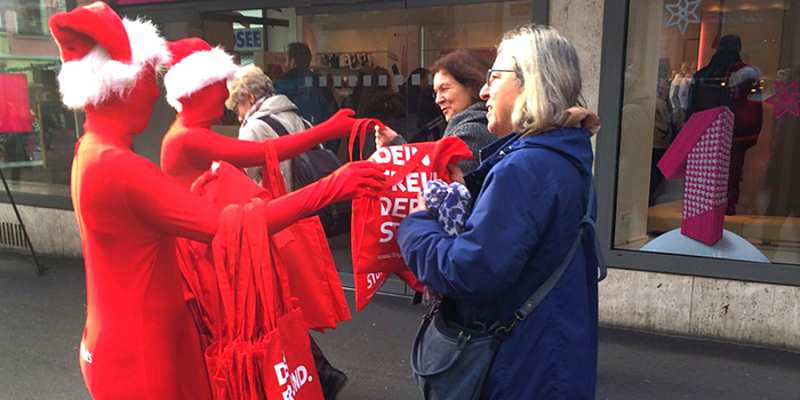
Promotion campaigns, on the other hand, are always carried out by promoters. Promoters not only send, they also receive, feedback from potential customers and can adapt to the situation individually. This creates advantages over the impersonal advertising measures, which more than make up for the disadvantages such as lower reach or higher contact prices.
2. Avoid wastage by addressing the target group
One of the main reasons why promotions are so successful is the selection of the target group. This is done in the first step by selecting suitable locations for the campaign. Whether a new energy drink is advertised at a festival or the new type of yoghurt in the refrigerated department of the local supermarket, the product must always match the location.
A rough target group selection is certainly made when placing TV or radio spots, but in the case of a promotion, the promotion staff on site can decide individually who belongs to the target group and should be addressed. In this way, target persons can be selected individually and the target group selected extremely sharply, such as glasses wearers for a contact lens promotion or smokers for a new nicotine gum.
3. We are still the most responsive to human interaction
The TV commercial begins? We switch away to another channel. The next page in the magazine is an advertisement? We turn the page. A banner ad flashing on the website? We keep scrolling.
With an estimated 500 advertising contacts a day, our brain has learned over time to classify advertisements as irrelevant and our innate, selective perception simply blocks these messages. Unlike with human interaction, if you are asked for directions on the street, you will certainly be able to remember it in the evening. Which poster was at this intersection, probably not. Our brain gives communication with other people a higher level of attention and relevance.
4. Interaction promotes memory and understanding
Good promoters don’t just hand over a flyer without a word; good promoters ask passers-by questions. Questions that cannot be dismissed with a simple yes or no, but are kept open and yet easy to answer. When the passerby reacts and interacts with the promoter, the biggest hurdle has already been overcome. The attention was created and kept by means of a promotional outfit with brand reference. As a result, the passer-by also has a spiritual anchor on which he can continue to engage.
If the promoter manages to introduce the product and the brand, he can ensure that this information reaches the recipient. Similar to a good salesperson, a good promoter can highlight the benefits of the product for the individual interested party and highlight the product properties that are important to him in particular.
5. Sustainability of the advertising message
The more senses are involved in an interaction, the deeper and more persistent the memory of it. A perfect example of this is taking a test drive in a new car. Of course, you can stroll through the car dealerships and look at different vehicles, configure the vehicle online and compare prices and equipment, but this is usually not a lasting experience.
Most likely, however, you can still remember your last test drive quite well, regardless of whether you actually bought this car later or not. In reality, you take a close look at the vehicle from all sides, feel the workmanship of the steering wheel and the dashboard, feel how comfortable the seat is, smell the smell of the new car and feel the tingling sensation in your stomach when you drive the newvehicle for the first time and really accelerate. Such a multisensory experience is extremely memorable.
The same applies to promotions. The more senses are actively addressed, the better. For example, tasting campaigns in the supermarket or product demonstrations in electronics stores are extremely successful variants in the large field of promotions.
A handover of give-aways such as samples or other product-related gadgets can also significantly extend the sustainability of the advertising message.
