

What are the best solutions for laundry problems? Our guide gives you 27 great tips, plus the basics of doing laundry correctly for beginners.
Find more cleaning guides, tips and advice
27 of the best solutions for laundry problems
The dosage of your detergent depends on the hardness of your water. This water hardness You can contact your local waterworks to check. The environment is relieved by using less detergent, on the other hand, if too little detergent is used, the washing result can be impaired.
»If your washing machine has a free drain and the waste water is emptied into the sink, you should attach a piece of nylon stocking to the end of the hose as a lint filter . This will prevent the drain from becoming blocked.
»If your washing machine overflows , quickly sprinkle some salt on the foam or sprinkle a little vinegar over it.
»An excellent alternative washing powder can be made from ordinary horse chestnuts without any chemicals : first peel, shred, dry and then grind the chestnuts into a fine powder. Chestnuts contain the saponins that act as washing substances.
» You can get beautifully bleached laundry with a little borax (a tablespoon in ten liters of water) in the last rinse water – a proven means even for delicate laundry.
» White linen stays beautiful longer if you (like back in the old days) occasionally expose it to bleaching on the lawn . The freshly washed items of laundry are laid out on the lawn in the evening, watered with fresh water and left outside overnight.
» Colored laundry should never be treated with too strong soapy water or ash, as this would fade the colors.
»If possible, you should run the waste water from the washing machine into the toilet. This cleans it thoroughly and you can save yourself the purchase of additional chemical cleaning agents that would further pollute the environment.
»Use vinegar as a fabric softener for your hand wash. The soap is neutralized by the vinegar. This means that you only need to rinse twice and refresh the colors at the same time.
» Delicate laundry is spared wear and tear if it is put in the laundry in a pillow case and not loose. Nevertheless, such laundry should be washed in a gentle cycle.
» Felted woolen things can often be saved by washing them after washing them again in a hand-warm brew made from white beans.
» Apply a paste of vinegar and baking soda to the yellowed collar. This paste can also be used to remove mold stains.
»If the collar is heavily soiled, it can also be rubbed with a shampoo before putting the shirt in the normal wash. The shampoo removes body fats from the collar.
» Yellowed laundry turns white again if you add a spoonful of turpentine and two tablespoons of pure spirit to the last rinse water.
» Yellowed curtains become white again if you add a cup of salt to the soapy water.
» Preventing woolen things from getting in by adding glycerin (one tablespoon to ten liters of water) to the wash water. Angora wool becomes fluffy and soft when you add glycerin to the final rinse water.
»To easily get creases out of your clothes , hang them up in the bathroom and let the shower run for five minutes with the door closed. The resulting water vapor penetrates through the fabric and the folds dissolve . This tip is highly recommended when traveling .
»If the work clothes are very dirty, add three tablespoons of salt to the wash water.
» Heavily soiled laundry , especially work clothes, should not be put directly into the washing machine. Rather, you soak them overnight and add a dash of turpentine or petroleum to the soaking water.
»If there is a lot of laundry to be starched, the starch should be sprayed onto the laundry that is still wet on the line. So you can spray the clothes from both sides and make them ready to iron.
» Kitchen aprons do not get dirty so quickly and look nicer if you put them in an alum solution and then let them dry. This process is also recommended for anoraks and children ‘s pants, as the fabrics become waterproof and dirt-repellent. Fabrics are thus cheap and easily impregnated.
» Repair laundry before putting it in the washing machine, otherwise there is a risk that washing will cause even greater damage.
» Check all pockets before washing (it is best to turn them over). A handkerchief that is washed along can spoil the whole laundry.
» Handkerchiefs that no longer want to turn white shine like new if they are soaked in salt water for a day before washing.
»For items with a zipper , care should be taken that they are closed before washing. This keeps them in shape and works even after washing.
»With corduroy clothing , you should carefully brush out all seams and hems before washing. After washing, you should never wring this fabric!
» Cloves are a very good, fragrant moth protection . You should therefore always put them in the pockets of woolen items in addition to mothballs before stowing them away.
The basics of doing laundry correctly
Thanks to the washing machine, laundry is now child’s play. But if you’re new to the field, you need support. In addition to our best solutions for laundry problems, this will help you starting out.
Your first home … Pure freedom. But with freedom there are also duties such as cooking, cleaning, washing clothes. Since things can go wrong when cleaning clothes and it is very annoying when the laundry suddenly turns pink from the washing machine, here is a washing course for beginners.
1. The right machine
Although every washing machine has the same core competence, there are many differences between the individual devices. Because the task of “washing clothes” can be done in many different ways.
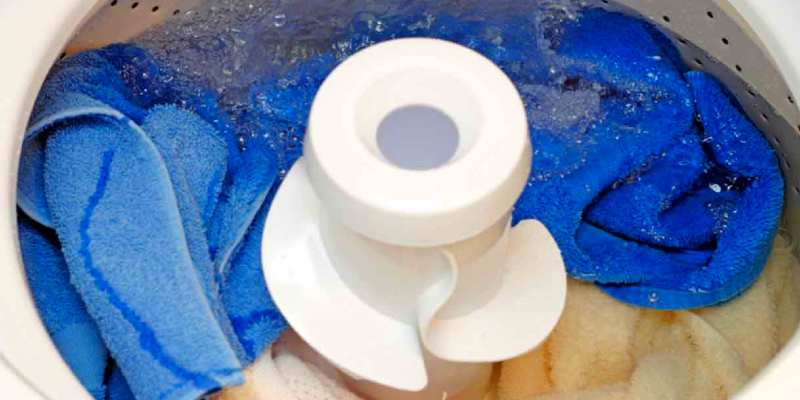
On the one hand, there is a basic distinction between washing machine types: drum and tub washing machines . Both differ in the storage of the washing container – in Germany the drum washing machine is mainly used, in which the drum rotates about a vertical axis of rotation. In tub washing machines, this axis is mounted horizontally, i.e. at a 90 ° angle to the floor. This type of machine is more common in the United States, Asia and Australia.
Under the drum washing machines there is again the front loader, with the classic porthole, through which the laundry can be observed, and the top loader, with which the laundry is put into the drum from above. This distinction has a purely practical aspect: the top loader needs space to open the lid and no access on one of the four sides. The front loader needs space to the front, but it can be fed from the other three sides as well as used as a storage or work surface, which is particularly practical if the machine is in the kitchen or a small bathroom.
There are further differences in the programs, the spin speed, which determines how much residual moisture remains in the washed laundry, and the drum size, i.e. how much laundry can be washed at the same time. For most machines this is 5-7kg. When considering which washing machine is the right one, it is worthwhile to find out more . This decision depends on your own needs and since the washing machine ideally lasts for a few years, the selected device should meet your own requirements.
2. Sort laundry and select program
In order not to experience the surprise of pink laundry mentioned at the beginning, the textiles to be washed should be sorted carefully. This is possible according to the nature and color as well as the care instructions of the manufacturer, in which the maximum degree the fabric can be washed, and is one of the best solutions for laundry problems in that it prevents a lot of them!
Basically, white should be washed separately, light colors together, dark colors together. If there is enough laundry, you can go again according to the nature of the fabric. Hard textiles, such as jeans, should not be washed together with fine dress pants (which are best kept in a dry place anyway), as the firm fabric can roughen the softer one. Wool, silk and cashmere should never be put in the washing machine.
The program then depends on the manufacturer’s care instructions as well as the degree of soiling of the laundry.
As a rule of thumb, first of all: 30 ° C for very fine textiles such as blouses and shirts, 40 ° C for all colored, jeans and normal sensitive textiles and 60 ° C for underwear and socks, towels and bed linen. For more precise information and to be on the safe side, the manufacturer’s care instructions should always be followed.
In addition to the normal programs, some washing machines also have a short program, which is particularly suitable if the laundry is only lightly soiled. The spin cycle can also be reduced for delicate textiles if the washing machine has a corresponding setting option. Otherwise, when choosing a program, the following applies: note the material and select the appropriate option on the washing machine – for many devices, these are divided into cotton, synthetics and delicates, or colored fabrics, jeans and easy-care.
3. Detergent types and their differences
Similar to the different washing machines and programs, there are also differences in the detergent. In addition to liquid detergents and washing powder, the difference between which is user-friendliness, there are other differences. The rough classification is: heavy duty detergent, color detergent, mild detergent and fabric softener.
A heavy-duty detergent can be used for almost any laundry, only a delicate detergent should be used for delicate textiles. Colored detergents are said to better maintain the color of the textiles, including special detergents for dark laundry. Especially in regions with hard water, fabric softener ensures that the laundry remains soft – but this cannot be used with every fabric. The following applies again: observe the manufacturer’s instructions.
Special detergents are particularly available in the area of mild detergents. Machine-washable wool (note care instructions!) retains its properties longer when using special wool detergents.
With regard to stain removal, there are different means and approaches depending on the type of stain, and you can find several above in our best solutions for laundry problems.
4. And afterwards?
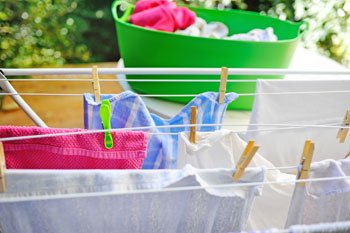
After the machine is finished, the laundry can be hung up. If this is done promptly after washing so that the laundry still has a certain amount of residual heat, it will be easier to iron it later – just shake it thoroughly and hang it as smooth as possible. If a dryer is available, so much the better. Insensitive, dryer-suitable textiles can be dried completely in the dryer, shirts, pants and blouses can be easily dried for 10 minutes and then hung up – this smoothes the fabric and makes ironing easier or no longer necessary.
Even if it may sound complicated here and there are many options available – washing clothes is actually very easy. Once the basic things are understood, it is no longer a problem, and once you have our best solutions for laundry problems, you can hardly ever be faced with an issue you can’t solve!
