



What are the best ways to tell a fake or genuine Patek Philippe Nautilus? Our illustrated guide outlines the 7 key clues to look for, to distinguish a real Patek Philippe Nautilus with a market value of $100,000 from a $500 high-end replica.
Find more Fake Check guides, tips and advice
If you want to know exactly which details differentiate even the best replicas from the originals, if you want to know how good the best replicas 2020 are and if you don’t want to spend $100,000 on a fake Patek Philippe, then this guide is for you. So let’s start right away!
What is the difference between replica, fake and ‘homage’?
If you are brand new to the topic, you may not even know exactly what a replica is or what differences there are between fakes, replicas and homages. Therefore, we will now tell you what you generally need to know about replicas, but if you already know that, you can skip this part and go straight to the 7 characteristics .
Replicas and fakes are basically exactly what the name suggests about them. By the way, the two terms are used for one and the same thing: a fake watch. They mimick another watch down to the smallest detail by adopting the watch’s design, logos and distinctive features. This gives the impression that it is the real watch.
Our main image shows a real Patek Philippe Nautilus 5711 on the left, while the watch on the right is a replica – a forgery of the Patek Philippe Nautilus 5711.
Homages, on the other hand, are watches that have taken a certain model as an example in terms of design, but do not copy it down to the smallest detail, as a replica does. Homage watches have their own brand names , logos and fonts , so that a homage is more of a cheaper alternative with sometimes more, sometimes less design borrowings from the real clock.
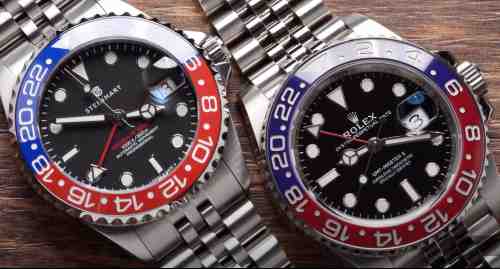
A typical example of an homage is visible on the left: the Steinhart Ocean One GMT is a homage to the Rolex GMT-Master II reference 126710 BLRO, nicknamed “Pepsi”, on the right.
You probably know all the cheap fake watches that you can buy for a few dollra, which turn out to be fakes relatively quickly because the dimensions, color and quality are visibly different from the original? I’m definitely NOT talking about that here. I’m talking about replicas that are of such high quality that they are extremely difficult to see without a comparison watch; for someone who has no experience with this topic, even almost impossible.
BUT there are replicas that not even watchmakers recognize at first glance. First of all: The Patek Philippe Nautilus shown today is definitely good enough that a watchmaker could NOT recognize it at first glance, but on closer inspection, even the best replicas would be revealed immediately.
However, you and I are not watchmakers and replicas are definitely good enough today to fool someone who doesn’t know the original as well as the back of their hand. Do you understand now what I mean? If you don’t have a comparison watch to hand and if you don’t know what to look out for, it will be next to impossible to identify such a fake.
And so that you know exactly what to look for in the future in order not to accidentally spend a lot of money on a counterfeit, I will now show you the 7 most important features to recognize even this high-end counterfeit immediately!
7 best ways to tell a fake or genuine Patek Philippe Nautilus
1: COLOR OF THE DIAL
The first feature is the most easily recognizable IF you have a comparison watch on hand, namely the color of the dial! This is one of the best ways to tell a fake or genuine Patek Philippe Nautilus.

Comparison of fake vs real Patek Philippe Nautilus 5711 dial
The dial of the real watch seems a little greener than that of the fake one. In addition, the gradient from light inside to dark outside is stronger. Both watches have a sunburst effect and at the same time a color gradient from light inside to dark outside – but the color tone is clearly different and at first glance.
The real Nautilus has a blue dial with a slight shade of green, while the fake watch has a blue dial without a green cast.
Surprisingly , the sunburst finish is also of a very good quality with the fake – the fakes are often far too strong and that often looks cheap, but this is not the case with this replica.
However, the progression – called degradé by the way – from the inside to the outside of the original watch is somewhat stronger than that of the fake. This gives the original Patek a slightly stronger effect.
The problem with this feature is that without a reference watch it becomes extremely difficult if you don’t really know the original. I would not have noticed that myself, for example, but we will also dedicate ourselves to a few details that can be recognized immediately without a comparison watch , but first we come to the case of the watch.
2: HOUSING SHAPE AND SIZE

In terms of the shape and size of the case, the proportions differ slightly between the original and the fake. This is one of the good ways to tell a fake or genuine Patek Philippe Nautilus.
This can be seen mainly from 3 things:
Number 1 is the brushed surface on the bezel – this is the distinctive ring around the dial: This is a little wider on the fake watch than on the real one. The brushing on the original Patek Philippe Nautilus is much finer than on the fake.

The edge of the forgery is also a bit harder, the original is softer and a tick higher quality.
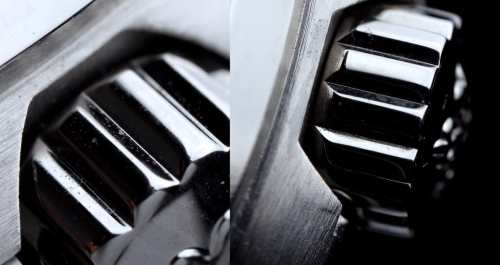
Number 2 is the crown on the right of the case, with which you set and wind the watch : This stands out more on the fake watch than on the real one.
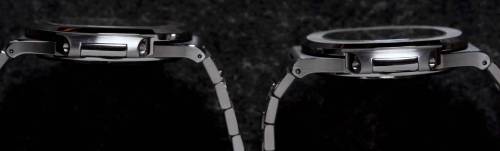
And difference number 3 is the height or the thickness of the watch: The fake watch is not quite as slim as the real one. This is because the counterfeiters did not use a real Patek Philippe movement, of course, but an inexpensive Asian movement that is a bit thicker. We’ll come back to the subject of clockwork in a moment!
3: PROCESSING OF THE CASE AND BRACELET
All in all, one has to say in advance, even if many people certainly don’t like it: This fake Nautilus is really pretty well made for a watch that costs $500. In the details, however, you can see differences mainly in 2 areas:
The first difference is to be found in the phase. That’s the flattened, polished edge of the watch.
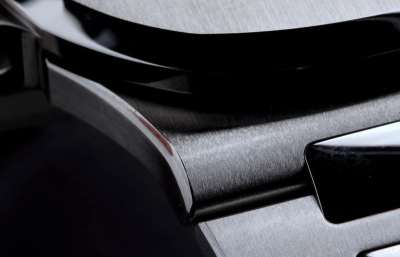
With the real one in the first image, this phase is very pronounced on the case and makes the shape even more beautiful and of higher quality.
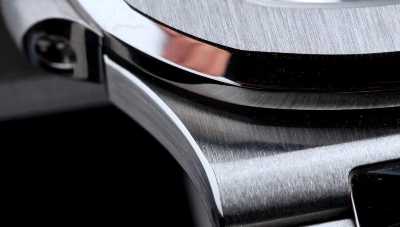
This phase also exists in the fake watch, but it is very weak and at first glance it almost looks like a normal edge.
The second difference is the brushing of the steel: Both watches use stainless steel, but the fake has a somewhat coarser structure here, which can be seen even without great magnification, because the brushing on the real watch is very fine and reserved – just pure perfection.
4: POINTER
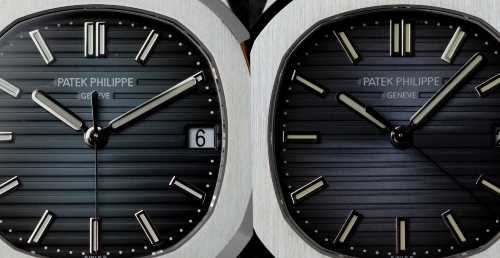
With the hands, the fourth feature, we now go into great detail and here we have the first feature for which you don’t necessarily need a comparison watch – so potentially the best first starting point if you don’t have one!

The pointers of the two in comparison: With the real watch, we have absolute perfection : almost no dust particles, but above all the cut is perfect and everything is evenly processed on the sides without disturbing structures.
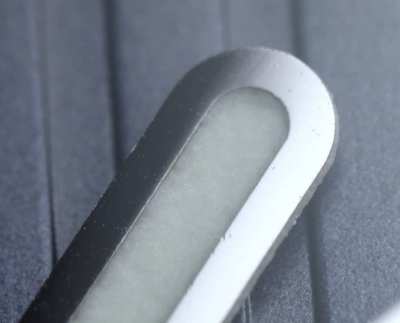
With the fakewatch we have great inaccuracies , not only are there several dents and residues on the hands, above all we see significant manufacturing inaccuracies and fraying on the sides, which we would not find in any high-quality luxury watch over $1,000 not at all with a Patek Philippe that costs tens of thousands!
The hands of the Fake Nautilus are full of fraying and inaccuracies. So be sure to use a magnifying glass to help, because then you can see the inaccuracies immediately: Fraying and dirty hands should be a huge red flag here!
5: INDICES
Feature number 5 are the indices, these are the individual hour lines on the dial – and unfortunately the differences are much less clear than with the hands, but you can see them on closer inspection!
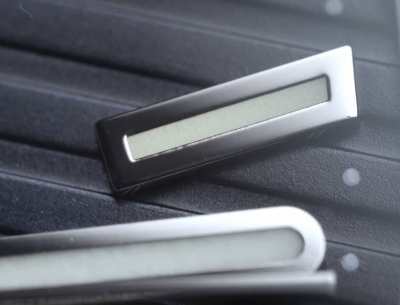
The most noticeable thing about fake indices in general is that they have harder edges and this is also the case with the Nautilus: The indices on the fake watch are almost angular, but the indices visible here are definitely the best I’ve ever seen on a fake watch.
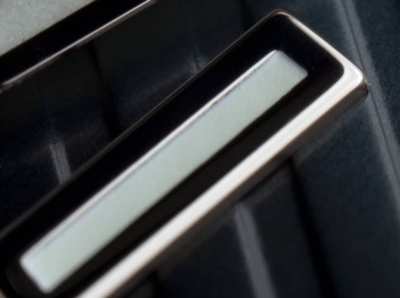
With the real Patek Philippe just above, on the other hand, the indices are nicely even and rounded, which can be seen not only in close-up but even when you look more closely when you hold them in your hand. This gives the dial of the real watch such a 3D look that the fake does not have.
Incidentally, these angular corners on the fake ensure that the double index at 12 o’clock also works closer together – it almost looks as if the two indexes are right next to each other.
The double index of the fake is not as detailed as the original. In the real watch, on the other hand, there is a slight distance between the two indices due to the rounding.
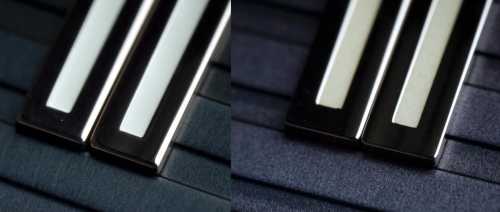
In a direct comparison you can see that the double indices of the original Nautilus have more distance to each other.
6: FONT AND STRUCTURE OF THE DIAL
As for feature 6, we definitely need to look again at the dial because that’s the point that shocked me the most. Usually the writing and the structure of the dials of fake watches are always miles behind the original watches.
In the case of this Fake Nautilus, however, the writing is really razor-sharp without blemishes on the dial. Fortunately, we have several real Nautilus available for comparison and see here with a 13-year-old, real Nautilus – at that time with a slightly different dial than today – that the writing even looks a little bit more blurred than with the fake.

The writing on the forgery is sharper than on the original from 2007. I would say even compared to the current real 5711 the differences are too small to be clearly recognized.
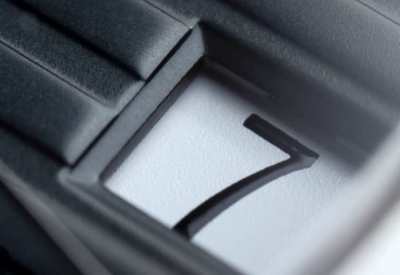
You can see clear differences in the date: With the real watch (photo above) it is completely flawless and sharp , but with the fake watch (photo below) you can see an annoying structure , especially on the white part of the date disc, for which you need a magnifying glass. But this is still one of the best ways to tell a fake or genuine Patek Philippe Nautilus.
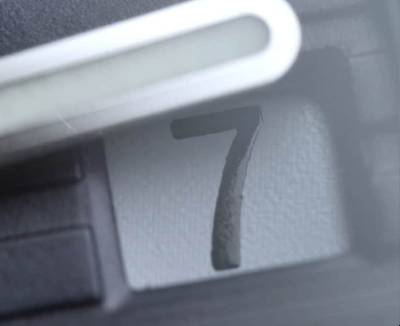
There is another, small difference in the structure of the dial. While the sunburst finish and the degradé gradient really work well with both, as I said before, you can see in the details that the fake dial is more coarsely processed and has some disturbing structures.

The structure of the nautilus fake on the right is much coarser than the original. The real dial, on the other hand, is fine and perfectly processed even at ultra high magnification .
7: THE MOVEMENT
The last feature is the movement and also the clearest – and luckily the Nautilus has a glass bottom so that everyone can take a look at it right away as this is one of the best ways to tell a fake or genuine Patek Philippe Nautilus.

Two things stand out here: First, the counterfeiters really made the effort to copy every single detail here. They have made a 1: 1 clone movement of the Patek Philippe Nautilus out of a cheap Myota movement – that is a simple movement off the shelf that you find in many watches in the price range 100-500e – which looks terrifyingly similar at first .
BUT the processing is not only one, but several levels worse than the original: Much coarser polishes and the finish of the entire movement looks coarse and somewhat dirty . In the case of forgery, the fonts are also milled in with a machine instead of engraved by hand and you can see that immediately if you take a magnifying glass.
The placement and arrangement of the elements is almost identical, but not complete, and individual parts of the fake movement, such as the center of the golden winding rotor, are different in size between the original and the fake.
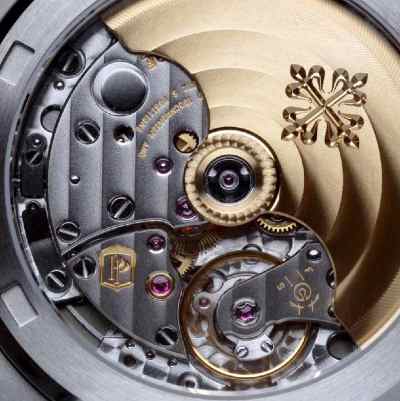
But there is also a hint that you can see IMMEDIATELY with the naked eye: In a real watch, only rubies are used as bearing stones, these are more purple in color as shown in the photo above. The forgers have only used decorative stones here , probably made of plastic and these light up almost red in comparison, as shown in the photo below.
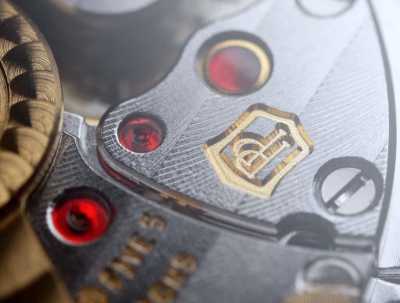
This is particularly noticeable in comparison with the ruby, which is also used for the balance on the fake watch and which, on the other hand, also looks purple. This is probably due to the fact that the red stones on the real watch serve as bearings for the movement, while on the fake they probably simply serve the appearance.
The feeling when winding and setting the watch is by the way similar with both watches, BUT the rotor of the wrong movement rattles quite strongly when the watch is shaken and sometimes turns for seconds after the watch has been shaken a little. The rotor of the real Nautilus can be heard, but it doesn’t clatter .
IS IT OKAY TO WEAR A REPLICA?
After the 7 characteristics with which you can guarantee to distinguish a fake from the original, I would like to address a very specific question that I keep hearing about this topic: “Is it okay to wear a fake watch?”
This question can really only be answered by everyone for themselves , I can only give you my view of this question, but in the end everyone has to decide for themselves. But there are many reasons why, in my opinion, it is not advisable to wear a replica. And I want to go into one of them again, even if you have to admit with the waiting time, the price and the chances on a real Nautilus that the thought is tempting to just get the (unfortunately) extremely well-made replica.
A Nautilus is a pretty blatant statement among watch connoisseurs. With a fake watch, you pretend you’re not and pretend you’re wearing a statement piece that you don’t really have. At the end of the day, only YOU can decide what is right for you.
