
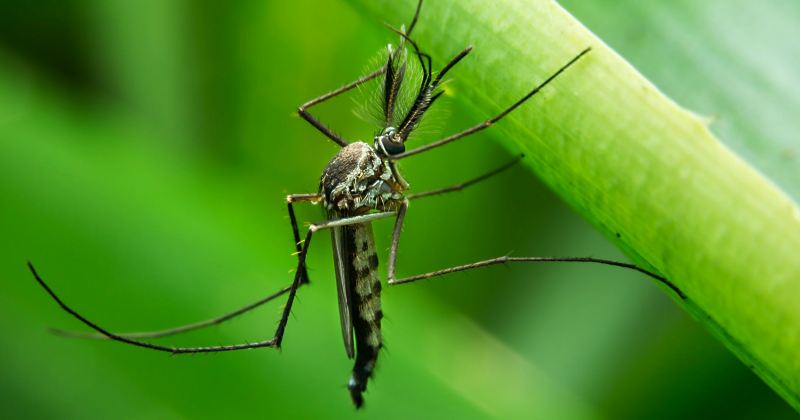



What are the best ways to stop mosquitoes breeding in the garden and home? We explain how to stop the mosquito breeding cycle and stop them returning.
Find more great garden guides, tips and advice
If you want to protect yourself from mosquitoes, you should prevent them from multiplying. We’ll show you how to do it best.
Female mosquitoes lay their eggs in calm waters. This gives them an almost infinite number of options for laying their eggs. The most obvious are the rain barrel, the garden pond and the pool. But mosquitoes can also lay their eggs in less obvious places. So what to do to curb the nuisance population? We have a few helpful tips on how stop mosquitoes breeding in the garden and how to destroy the larvae.
Best ways to stop mosquitoes breeding in the garden
Prevent mosquito larvae – prevent egg laying
First of all, you should get an overview of where mosquitoes could find water and, if necessary, dispose of it. However, since mosquitoes find well-hidden water accumulations themselves, you will not be able to completely prevent egg laying. We have put together a couple of measures for you to at least contain them:
- Cover your water tanks, the garden pond and the pool with an insect net. Make sure that the network is completely tight. Mosquitoes find even the smallest entrances.
- If you turn around containers that can hold water (for example watering cans, trivets or buckets), you take away the mosquitoes’ ability to lay eggs.
- You can also fill containers in which water can collect with fine gravel. This makes them unsuitable for egg laying.
- If drains, pipes and gutters are blocked, water can collect in them, which is used by mosquitoes to lay eggs. You should therefore check them regularly and clean them if necessary.
- A CO2 trap emits CO2 and attractants. It attracts mosquitoes. As soon as these approach the trap, they are sucked in and killed. If you place such a trap near a rain barrel, a pond or a pool, you can effectively contain the egg laying.
Mosquito larvae in rain barrel
If you do not protect your rain barrel or do not protect it adequately, you will not be able to avoid mosquito larvae if you do not want to breed mosquitoes. You have several options for this:
- Sieve out mosquito larvae
- Empty the rain barrel
- Destroy surface tension
- bacteria
❖ Sieve out mosquito larvae
If you notice mosquito larvae in your rain barrel , you can try to remove the larvae from the rain barrel with a close-meshed net.
❖ Empty
the rain barrel You can also empty the rain barrel together with the mosquito larvae. The water seeps into the ground and the mosquito larvae die because you take away their habitat.
»Note: This solution should only be an emergency solution. The water wasted with this solution is extremely high!
❖ Destroying surface tension
Mosquito larvae hang upside down under the water surface and breathe through a breathing tube located on the abdomen. However, this only works if the surface tension is intact. If you lower this, the mosquito larvae can no longer hold to the water surface and suffocate, and you can stop mosquitoes breeding in the garden.
Detergent is suitable for this, for example. But make sure that you use a biodegradable product that does not pollute the environment.The surface tension of the water arises from the fact that the individual water molecules attract each other. If you now add surfactants (i.e. soap, detergent or dishwashing liquid) to the water, their molecules will get between the water molecules. This reduces the surface tension of the water.
»Tip: Vegetable oil does not reduce the surface tension, but can also kill the mosquito larvae. Since it is not water-soluble, it settles on the water surface and literally takes the air away from the larvae to breathe.
❖ Bacteria
The mosquito larvae feed on algae and microorganisms in the water. In the garden trade you can get biological preparations from bacteria that contain a special protein. If the mosquito larvae eat this, they die. According to the manufacturer, these preparations are harmless to other insects, vertebrates and plants. So you can still use the water to water the flowers.
Mosquito larvae in the garden pond
In order to control the mosquito larvae in the garden pond, the same measures can sometimes be used as for the control of mosquito larvae in the rain barrel. Both the landing net and the bacteria can be used here to stop mosquitoes breeding in the garden. The following measures can also be helpful:
- Use fish
- Move the water surface
- Cultivate water hose
- Siting dragonflies
❖ Use fish
If you don’t have any fish in your garden pond, you should do so as soon as possible. Because certain fish species have a preference for mosquito larvae and can tackle even large populations. When choosing the type of fish, make sure that it also fits the size of the pond. The following applies: the smaller the pond, the smaller the fish have to be to keep them in a species-appropriate manner.
The following fish species are ideal for combating mosquito larvae:
- goldfish
- Gold Thrown
- Moderlieschen
- Minnows
- Red feathers
- Roach
❖ Moving the water surface In
order for mosquito larvae to develop, they need a calm water surface. So if you keep the water surface in motion, you prevent the development of the mosquito larvae. On the one hand, you can use a pond pump and see the effects of pond aeration that constantly circulates the water. On the other hand, there are fountains or fountains that constantly move the water surface and interrupt the surface tension.
❖ Cultivating a water hose
Various water plants can help to reduce the number of mosquito larvae. Some actively contribute, others indirectly.
The water hose floats in the water and does not stick to the bottom. It is one of the carnivorous underwater plants and feeds on organisms that live in the water. There are small air bubbles between the leaves on the long shoots, which are a trap for mosquito larvae and other small organisms in the pond. Once caught, there is no escape. In this way, the water hose can enormously reduce the number of mosquito larvae.
»Tip: You should put four to six plants into your pond per square meter so that they can control the mosquito larvae.
❖ Settling dragonflies
Dragonflies feed exclusively on other living beings – even at the larval stage. You can therefore use dragonflies specifically to repel mosquitoes. To do this, you can put aquatic plants such as hornbill or the spiny millipede in your garden pond. With a little luck, dragonflies will settle in your garden and will not only eat the mosquito larvae, but also the adult mosquitoes. Note, however, that dragonflies also consume small fish.
Mosquito larvae in the pool
If you properly maintain your pool, it is very unlikely that mosquitoes will lay their eggs in it. Therefore, check the chlorine content and the pH value in the pool every day. If the values deviate from the standard, you must take suitable measures to adjust the values. In addition, the circulation pump for water treatment should run for three to four hours a day. Here it is advisable to work with a timer that switches the pump on and off independently.
Cover your pool at night. This prevents water from cooling down and leaves or bugs from entering the pool. It is also important that you clean the pool once a day with a landing net and once a month with a pool vacuum.
If you follow these measures, you shouldn’t have a problem with mosquito larvae.
