
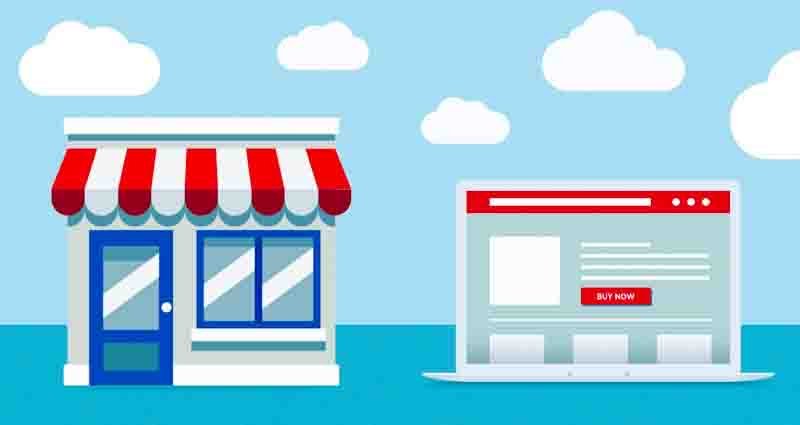



How do you move a shop to online retail to take advantage of the increased trend to internet shopping. Our guide outlines how — and why you should do it.
Find more business guides, tips ad advice.
The rapid development of Internet technology has led the market to a steady trend towards online retailers and manufacturers. All major electronics and home appliance chains, cosmetics, perfumes and clothing, and footwear stores have long since moved to the online format.
Why is this happening and what are the benefits?
The format of large stores is becoming less and less justified. When the entire range of goods, no matter how extensive, the customer can see online, the need for huge stores, where all available items are displayed, gradually but surely disappears.
In addition, overpayments for rent, especially when the economy is storming, it becomes categorically inappropriate. Even very large offline retailers are trying to change the format of stores to a small, and much of the sales shift to the Internet. Let’s add here the increase in taxes on retail space, rental of premises, registration of shop windows, utility bills, staff salaries – and we get the obvious conclusion: going to online retail – is primarily a reduction in costs for the maintenance of the store at times.
Why do you need to move a shop to online retail?
Even if an offline retailer does not want to reduce the physical footprint area of the shop, the development of online sales now gives a tangible increase in profits, not to mention the loyalty of customers.
The next important point is an opportunity to go beyond the region. In small towns, opening shops or representative offices is often simply unprofitable. But at the same time, if you take into account the entire pool of small towns, it becomes clear that the seller who does not have an outlet for this audience loses a significant percentage of customers.
Moreover, the main growth in buying activity year is provided by the remote regions. There, at last, broadband Internet came, and people were able to realize their shopping needs.
Thus, today’s prerequisites for taking a step online are quite serious, and the market situation clearly confirms this conclusion.
What does it take for a store to go online?
1. To organize an online showcase. That is to make a site and create good content for it.
2. to provide proper advertising and promotion of the online store.
3. to organize a contact center, which will accompany the potential client from the moment of the incoming call to the order, to consult on the product, to answer questions about the purchase options.
4. organize logistics – warehouse, order picking, and delivery.
Each of the processes can be implemented independently or passed into the hands of professionals when you want to move a shop to online retail. However, the optimal solution – both in terms of cost and efficiency – is a combination of approaches.
What to pay attention to when choosing a full-filling company?
1. The territory, which covers the capabilities of a logistics company in terms of delivery.
2. The possibility of clear control and transparency of processes for the store-client and for its customer as the final recipient of the shipment. And, as a result, compliance with declared delivery terms.
The company to which it is transferred on outsourcing of the logistics of Internet shop, should at any stage have the possibility to trace occurring processes and to give on each carrier with which it cooperates, as many detailed reports as possible. And in that format, for which the client is technologically ready.
This can be a format for simple exchange of Excel documents, or a personal account on the site of a full-functioning company, providing access to all the necessary information, or API integration for technologically advanced customers.
Ideally, the process of sending an order should look like this: a bar code is applied to the shipment, the same code is indicated as the order number when sending the shipment to the outsourcer – everything! More from the point of view of the physical organization of delivery nothing is required from the online shop.
The logistics company is provided with information about where, to whom and at what cost it is necessary to deliver the order, as well as the desired carrier. Then there is the outsourcer: sends a courier for orders, delivers to its sorting center, where the registration of all necessary supporting documentation, packaging according to the requirements of one or another carrier and the transfer of the shipment to the delivery.
Another important point – transparency of the delivery path for the final recipient of the order. There are companies in the market that provide not only SMS-notification of recipients at all key stages of the parcel, but also provide services of their call-center in order to accept the recipient’s questions about delivery, thus freeing the online store from non-core issues. Finally, delivery date & time efficiency is a great option to use in cooperation with the logistics company.
Moreover, the fulfilment company accompanies the parcel up to its delivery. And, if necessary, solves issues related to refusals to receive the parcels and returns.
And the main thing worth paying attention to is the responsibility of the fulfillment company. A logistics company should act as an integrator for an online store not only at the IT infrastructure level but also in terms of physical processes and responsibility.
An outsourcer telling a client something like “We didn’t do it, we gave it to a carrier, go sort it out” is not the best option for serious work. The company must provide a service that allows the retailer to work comfortably in a one-window structure. And at any stage of delivery assumes responsibility for occurring as in case of force-majeure circumstances at the delivery of the goods (loss, damage, opening), and for terms of delivery and return of money.
Among other benefits, this allows the online store to practice sending orders by cash on delivery, without looking back at the risk of increasing the percentage of returns. The growth of regional orders as a result of the introduction of cash on delivery ranges from 30 to 100% depending on the nature of the goods of a particular online store.
