
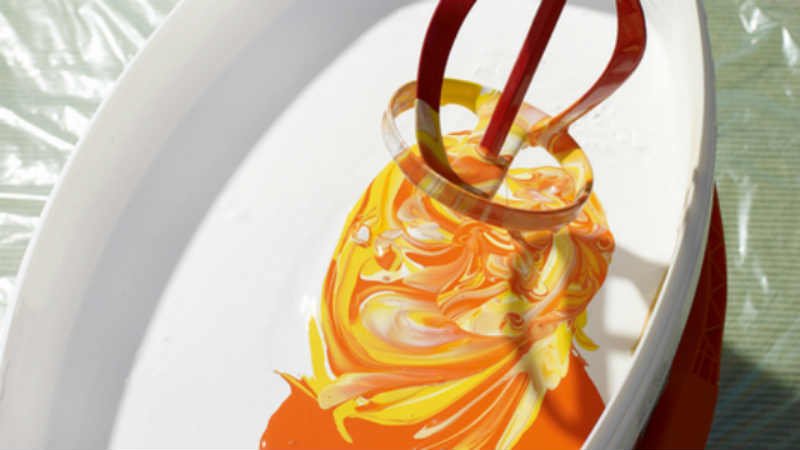



When you are painting, the first thing you think of is the color, so it is important to know how to mix tinted paints correctly.
Colors significantly influence our mood and thus our well-being, which we all experience in the everyday context again and again, such as when the atmosphere of a café with terracotta-colored walls invites you to linger. We also know the effect of color on the dimensions of a room. High, narrow spaces can gain depth through skilful coloring, and narrow spaces continue to appear.
Mix tinted paints correctly: the right color
Today, the paint manufacturers offer a wide range of finished, tinted wall paints, including various shades of white and current trend colors. However, these are significantly more expensive compared to the white base color. And those who want to design their walls individually according to their own ideas, for which (self-) mixing is the means of choice.
Then there is the decision in terms of color. Basic color schemes are helpful here, as can be recognized, for example, via the color fan. A harmonious color image results when only a single shade is used, which is tinted differently bright or dark.
Quiet combinations are created with two or more colors that lie side by side in the color fan. A high-contrast color combination results when working with complementary colors (for example, red and green). Black, white and gray as well as brown, beige or cream tones can be used well for tints and shades (contrasts).
How to find the right color for your home
Information and suggestions on current color trends and possible color combinations can be found, for example, in living magazines. Practical examples show the effect of colors in combination with the furnishings (furniture, curtains, etc.). If you do not want to be dependent on your imagination, you will also be able to find color palettes interactively on the internet pages of the paint manufacturers or even to paint entire rooms virtually, thus checking your own color ideas. If you have come closer to your desired color, the final certainty is the advice in the specialized trade or hardware store.
Mix tinted paints correctly: from the catalogue
The dealer has the opportunity to mix a color directly. Even brought along patterns, be it a piece of wallpaper or a tile, paint mixers of the latest generation hardly any problems. They “read” the pattern color via the scanner and then provide the formula for the mixture. However, it is always advisable to use test strips to check how the dried color actually looks.
A decisive advantage of the mixing is, of course, the safe reproducibility of the hue, if you want to use it again some time later (or misjudged in the required amount). Anyone who keeps the color chart or notes the code is on the safe side.
Tinting colors are available in countless variations and different sizes for those who want to stir themselves. Mostly the mixing ratio for different color intensities is indicated on the packaging. Even clever dosing devices help to achieve the individual desire tone. This can only be reproduced if you work very carefully and note all the information. If you use several colors for tinting, it makes things much more difficult.
Use large vessels
Always mix in sufficiently large containers – angular ones are less suitable – and with a stirring attachment for the drill, hand stirring is not enough.
Mix tinted paints correctly: what the paint really looks like
In order to be able to judge how a color will actually look on the wall later, the color sample should be well dried (this process can be accelerated with a hair dryer) – wet color always looks a bit darker. In addition, it is important to look at the sample vertically and not lay it flat, as the wall surfaces reflect less of the incident light and therefore appear darker. In addition, the light conditions in which the color sample is assessed should correspond approximately to the real lighting conditions in the room to be painted. So it’s worth taking the time to come out with the sample and see it in daylight, for example from the hardware store.
Use products from the same manufacturer
The wall color must match the tinting color! It is therefore advisable to buy both products from the same manufacturer, as these are perfectly matched and therefore in any case “the chemistry is right” or the desired color can be produced exactly. This is especially important when using special emulsion paints , and you should consider early on whether tinting is possible at all or in the desired intensity. Under certain circumstances, the special properties (for example, a lock against nicotine stains) are lost due to too much tinting color.
Tinting with an environmental color
Anyone who wants to tone a white environmental color, should choose the complementary substance tinting color. If no emulsion paint is used, but a natural color such as casein, it must be colored with appropriate additives — in this case, pigments. Inquire in advance if your desired colour can be made with natural pigments.
Of course, a thorough assessment of needs is required before each mixing – whether by machine at the dealer’s or in the bucket at home. Do not be stingy in the calculation of quantities, it is very unfavorable if in the middle of the wall (or before the last) the well-composed color runs out — and you have to try and mix it exactly again!..
