

How do you clean sneakers correctly? Our 6-step guide explains how to do this, and also gives you some tips for preventing future damage to your shoes.
Find more fashion guides, tips and advice
Find more cleaning guides, tips and advice
Sneakers are an integral part of fashion. In order for them to last a long time without looking worn, intensive care is required. You can find out what that looks like here.
In terms of fashion and trends, sneakers have not only risen again in recent years, but also represent a passion for many fashion lovers that can be expensive. If you do not want to quickly re-sort limited-edition pieces that cannot be bought again, fashionable or beloved couples, it is important to properly care for and clean the sneakers.
Because only with the right treatment can sneakers survive all weather conditions, retain their fit and look fashionably appealing – this also means that you can use them for significantly longer and thus get added value for your money.
Things that damage sneakers
Sneakers as sporty shoes for everyday life should be as comfortable as possible, but also fashionable and elegant – that’s why soft materials and soles are usually used, which can be damaged quickly or look unattractive. So water can wet the fabric through rain or puddles, dirty the inside of the shoe and also change the color of the sneakers, sun exposure can fade the color.
Snow and mud, on the other hand, are particularly stubborn “enemies” for sneakers. In addition to the constant use, there are many factors that are responsible for the fact that sneakers must soon be sorted out because they have lost their shape or have simply been damaged – which is why the right care should not be missing in everyday life.
With the right care and the right products, it can be prevented that some of these influences attack the material of the sneakers, that they lose their shape or even appear very worn out in terms of color and appearance. If you also take care of it regularly and place value on careful handling of the shoe, it can also be used for a significantly longer time, so that you get more for the money you spend and do not have to buy new shoes soon. By the way, you also get limited shoes of this type longer so that you don’t have to get hold of an expensive second pair that is very rare to find.
Sneaker care tools
In order to clean sneakers correctly and thus maintain them for a long time, you do not need expensive branded items, extensive equipment or luxurious sets that then collect dust in the closet – simple, perfectly matched and selected care products and household items are sufficient to clean sneakers correctly.
In addition to a soft household sponge, you can also use soft cloths that can both be moistened. A gentle shoe brush can also be used with sneaker pairs, impregnating spray should be on the shopping list and a cleaning foam suitable for the fabric or material. If you want, you can also provide your sneakers with a shoe care cream, which should also be matched to the material of the shoe.
If the shoe is made of leather, it requires, for example, other care products than the sneaker made of fabric or synthetic materials – that’s why the packaging and its description should always be considered when buying. So you can put these items at home:
- Shoe trees for long-lasting shape maintenance
- Newsprint as an emergency aid
- Cloths and soft sponges
- Shoe brush with soft bristles
- Impregnation spray for the corresponding material
- Cleaning foam, adapted to the material
- Shoe polish to match the material in a color-matching version
As already mentioned, the items mentioned above do not have to be expensive – even inexpensive options are suitable for the shoe and its longevity if they are tailored to the material.
6 steps to clean sneakers correctly
Of course, you should follow a certain routine or order in sneaker care in order to achieve the best possible care effect and to keep the shoes as long as possible. It is important, for example, to carry out maintenance at least every two weeks, if not more often, since sneakers of all kinds are somewhat more sensitive than, for example, boots or proper shoes developed for sport.
❖ Step 1: Clean the fabric
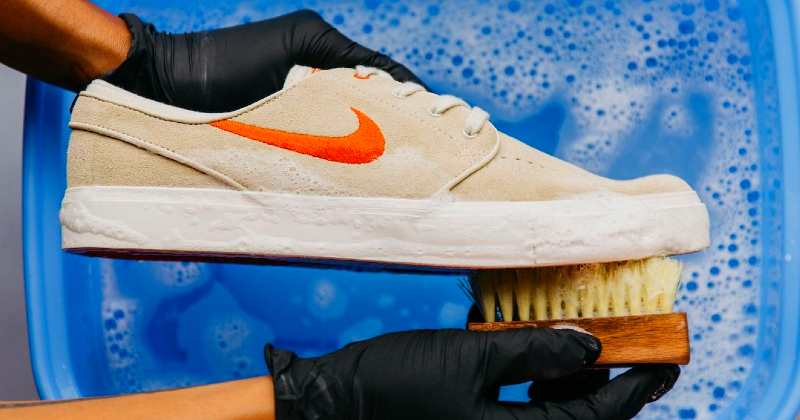
First, the sneaker should always be cleaned gently. To do this, first use a slightly damp cloth or a slightly damp sponge. Clean the shoes in a circular motion without much pressure. If you cannot get all the dirt out, it is recommended to use cleaning foam for the material and to put it on the cloth first and then massage it in. Then take another fresh cloth or a new damp cloth to remove the loosened dirt and leave a perfectly clean surface.
Caution: Do not include the sole in this procedure.
❖ Step 2: Clean the sole
For the sole it is usually sufficient to remove coarse dirt with the soft shoe brush and then wash it off with a slightly damp sponge. Cleaning agents are hardly needed here. However, if the sole is white and yellowed, household vinegar can be a good remedy.
❖ Step 3: Let it dry
Whether you have just come out of the rain from outside or cleaned your shoes – it is very important to give the sneakers enough time to dry. If the inner surfaces are also moist, newspaper inside the shoe helps to absorb the moisture and also to minimize sweat and odors. Then the shoe should be allowed to dry for at least 24 hours – and not in the heating, but in the hallway, because the heating air could make the upper of the shoe porous. It is also advisable not to wear the shoe every day to give it enough time to air and dry.
❖ Step 4: Impregnate
To protect your shoes from the ingress of moisture, it is very important to impregnate them. The surface of the shoe is irrelevant. Thanks to an impregnation, the moisture rolls off and the sneakers stay dry.
❖ Step 5: use shoe cream
Now the surface of the leather sneaker can be polished to look like new again. For this purpose, shoe cream that matches the color and material should be placed on a cloth and then brought to the surface in a circular motion. It should be distributed very evenly so as not to cause discoloration. Once the whole thing has been polished in, a clean cloth can be used to remove or distribute excess.
❖Step 6: oil the sole
There are special oils for shoe soles that ensure that they change color less easily and do not become porous, i.e. they last longer. It is highly recommended to use these from time to time – especially with thick rubber soles that are not particularly flexible and therefore quickly crack.
