
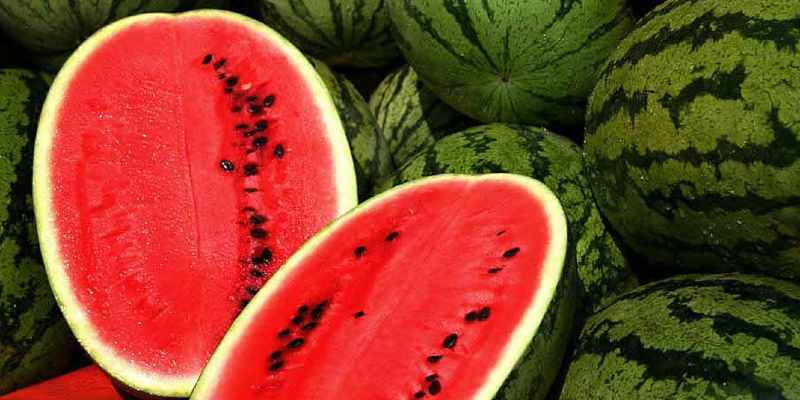



Outlines how to choose watermelon that are ripe with 6 clues tey are ready: sound, shape, the comparitive weight, the stem, the field spot, and the mesh pattern. Armed with these strategies, you will know how to choose good watermelon.
Find more food guides, tips and advice
How to choose watermelon: overview
Even if you don’t suspect it right away – the Watermelon (Citrullus lanatus), like all melons, actually belongs to the pumpkin family, so strictly speaking it belongs to the vegetable. We eat it like a fruit, however. The watermelon comes originally from Africa, more precisely from Egypt. Today the most important growing countries are China, Turkey, the USA, Iran, Brazil and Spain.
Since the watermelon plant prefers a hot and dry climate, cultivation in the northern hemisphere is difficult the further north you go. The annual plant has dark green pinnate leaves and its flowers are light yellow. It twines up to ten meters long, either flat on the ground or on climbing aids.
Watermelons can be round or oval. Their up to 4 cm thick shell is light to dark green and monochrome, striped or marbled. The flesh of a watermelon consists of 95% water , which not only explains its name, but also makes it particularly refreshing. The carotenoid lycopene is responsible for the typical red color of their pulp. But there are also yellow, green, orange and white varieties. Today watermelons are grown with as few as possible seeds or without seeds. As a rule, however, they carry brown to black seeds.
A single watermelon can weigh up to 100 kg, but fruits weighing between two and 25 kg are common in stores.
The watermelon, along with the other well-known types of melon such as the rockmelon or honeydew melon, is in season largely from June to September. It is available from us all year round from imports.
How to choose watermelon that are ripe
Determining the degree of ripeness of a whole watermelon is not very easy, because you cannot tell the ripeness of the round fruit. When buying the melon, it should be as ripe as possible, as it no longer ripens after harvest.
1: Tapping the watermelon
How to determine the degree of ripeness: Tap the whole watermelon. Ripe fruits give off a dull, full tone. Immature, they sound rather hollow and quiet. The color of the skin does not indicate the degree of ripeness.
2. Pay attention to the “field spot “
This does not mean that something is wrong with the melon. Rather, they provide information that this watermelon lay in the sun until it could ripen completely. The underside of the watermelon should have a yellowish stain. With unripe fruits this is white to light green, with ripe fruits it is yellow, orange or even shows spots. At this point the fruit was lying on the ground and ripened in the sun. If there is no spot or only a very light one, it means that the watermelon was harvested too early – and is not yet ripe.
3. Good shape
A well-shaped size Look for a symmetrical roundness – without dents, cuts or bruises. If the watermelon has lumps or bumps, it means it has been watered irregularly or has received too little sun, which will affect the quality
4. The weight
Does the melon have the “right ” weight? Lift the melon and compare the weight to another melon of a similar size. The heavier the fruit, the more ripe and therefore it tastes better. Compare two melons of the same size and choose the heavier one, because this one is sweeter.
5. The stem
The stem reveals a lot, if still attached. Is the stem still green? Then the watermelon was harvested too early and the fruit is probably not yet ripe. A slightly darker, brown stem is better.
6. The mesh pattern
Some melons show a kind of brown mesh pattern that even causes many people not to buy the fruit. But these fruits are particularly sweet. The mesh pattern is created when the flower of the fruit has been visited particularly often by hungry bees.
Halved or sliced melons are also often offered. If you buy a cut watermelon, the pulp should be a rich red or pink hue. If it already looks floury or has brownish spots, it is overripe or already fermented and no longer fresh to eat.
How to store watermelons properly
You can keep a whole watermelon in the refrigerator for up to three weeks. Specimens that have already been cut keep for about three days. Be sure to cover the cut surfaces with cling film.
Watermelon calories and nutritional value
Since the watermelon to 95% of water is and wonderfully low in calories , it is very suitable as a summer relaxation and even as a thirst quencher.
100 g watermelon contain:
| energy | 37 kcal |
| protein | 1 g |
| carbohydrates | 8 g |
| sodium | 1 mg |
| potassium | 140 mg |
| Calcium | 7 mg |
| magnesium | 9 mg |
| phosphate | 10 mg |
| iron | 0.2 mg |
| Beta carotene | 245 µg |
| Vitamin B1 | 0.04 mg |
| Vitamin B2 | 0.05 mg |
| Vitamin B6 | 0.07 mg |
| Folic acid | 0.07 mg |
| vitamin C | 6 mg |
