
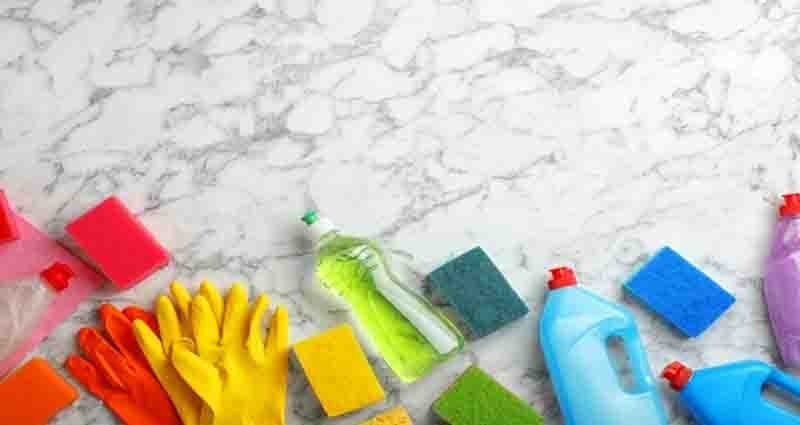



What are the best ways to clean marble without damaging it? Our guide outlines what to do — and what NOT to do!
Find more handy cleaning guides, tips and advice
Can I clean marble with common household cleaners? This is not a good idea, because they often contain surfactants, are acidic or simply too strong.
Do I need to use a special natural stone cleaner? For the usual cleaning , (distilled) water is also sufficient. In addition, you can also use alcohol.
Can I clean marble with the high-pressure cleaner? No, because the pressure is too strong, so you can easily damage the surface. In this way, dirt often sticks more easily in the future and the marble shines less.
Marble stands for durability and elegance. The timeless natural stone gives a rather simple room a lot of charm and often provides envious looks.
But not only floors, but also kitchen countertops or table tops enhance the ambience. This applies, of course, only as long as marble shines beautifully and is not covered by stains. We will therefore show you how to clean marble and what tips you should consider when nurturing and polishing.
1. Clean marble – no problem with the right cleaner
Marble slabs used indoors usually have a smooth, polished surface on which dirt can hardly adhere.
Cleaning is therefore also easy.
The limestone stone is comparatively robust, but can suffer from the use of aggressive cleaning agents.
It is best to use either special natural stone cleaners or mild cleaners that do not attack the floor and the table top.
The following products are not suitable for marble cleaning:
- Acid-containing detergents
- Cleaners containing surfactants
- Lime cleaner
- Fruit acids
- Home remedies such as vinegar, wine or oil
- Cleaners containing abrasives
The problem with acidic cleaners and home remedies such as vinegar is that they attack the surface so that the marble floor looks dull after cleaning. However, this is not done overnight, but gradually.
Many commercially available cleaning agents also contain surfactants, which can be deposited on the surface of marble. This creates an ever thicker layer on which dirt adheres faster and requires more frequent cleaning.
However, you can safely clean your marble floor with water and alcohol and disinfect at the same time.
However, it is best to wipe only misty wetso that no limescale deposits form. In areas with more calcareous water, it is also a good place to use distilled water instead of normal tap water.
Tip: When cleaning marble, use the cleaning agents sparingly, as the stone itself requires little care.
2. Clean marble regularly – this is how the natural product is preserved for a long time
The biggest problem for marble floors is grit and small stones that leave scratches on the surface.
It is therefore best to suck dust regularly (preferably every day) or you can sweep the ground with a natural hair bhisl.
Wet cleaning is recommended (depending, of course, on the respective stress) about once or twice a week. Make sure that you wipe the floor with little water. This is especially true for marble surfaces that are not sealed.
To prevent stains on marble floors, do not wear shoes in the house. For marble tables, it is best to use coasters to avoid water stains.
3. Remove stubborn stains on marble
Classic care products are not always sufficient to clean marble. Some stains leave traces that are difficult to remove.
If the marble is untreated, be particularly careful and test the respective methods in an unobtrusive place. In addition, the motto is to slowly approach each other.
Therefore, it is best to start with a weak dosage so as not to damage the marble stone.
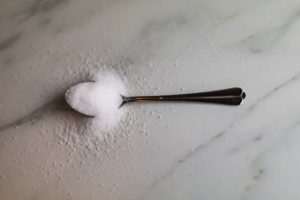
Sometimes a teaspoon of salt does wonders.
- Water stains on the window sill, for example, can be removed particularly easily with hydrogen peroxide or soda.However, this only applies to bright marble species.
In both cases, the agent takes a few hours to act. During this time, it must be kept moist so that you can cover the stain with some plastic wrap.
Afterwards, the thorough washing is carried out. - Apply pure alcohol: After an action time of about 10 minutes, wipe off the alcohol and take a damp cloth to remove the alcohol residue completely.
- Sprinkle salt: Salt absorbs liquids and is therefore excellent for removing relatively fresh spots (red wine or juice spots after a party).
To do this, sprinkle generously slightly moistened salt on the spot and wait for the next few hours.
Afterwards, thorough wiping is necessary.
If you want to clean yellowed marble, however, these tips will quickly push you to the limit. Particularly deeply absorbed stains can only be removed by mechanical removal, i.e. by grinding the surface.
4. Maintaining marble – these tips help
It is best to wipe stains wet as soon as possibleso that they have no chance to settle in the stone. Ideally, therefore, you protect marble by impregnating.
In this way, stains can be removed much more easily and stubborn contamination does not arise in the first place.
It is also worth using special care productsto make marble shine again. The application of a polish also helps you to make fine scratches invisible.
5. Clean marble outdoors
In principle, the same information applies in the exterior and interior. However, since marble is exposed to the weather outside without protection, the maintenance effort is correspondingly higher.
An impregnation is therefore almost unconditional in order to cultivate marble. It is best to use a brush and a suitable natural stone cleaner outdoors.
However, do not use the high-pressure cleaner, as you can achieve good success with it in the short term, but often only push dirt deeper into the stone.
In addition, you damage the rather sensitive surface, so that you do not do yourself any favours with the time-saving variant in the long run.
The classic tombstone is also often made of marble and can be easily cleaned with a damp cloth and a low-dose detergent.
