
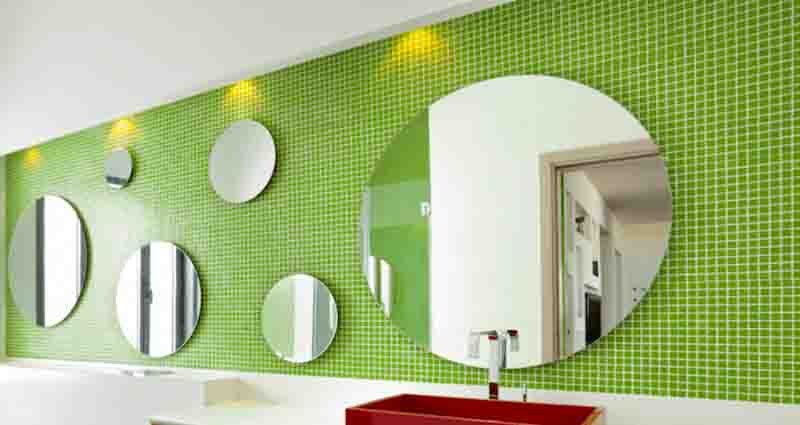



Are there ways to attach a mirror without drilling? Our guide outlines which surfaces you can glue a mirror to and what to avoid.
Find more home decorating guides, tips and advice
Can I glue a mirror to the wall? In principle, this is possible, but by no means the most sensible option in every case.
How can I attach a small mirror to the wall? For fairly light mirrors, you can use double-sided adhesive tape or special mirror tape.
Can mounting adhesive be repositioned or replaced again? The adhesive is designed for high adhesion, so it is difficult to remove. On tiles, however, this is possible with a little sensitivity and plenty of patience without damaging the surface.
How to attach a mirror without drilling
Mirrors are available in many different versions. In any case, the mirror should hang safely. You can also attach A mirror without drilling. We will show you how to glue a mirror to the wall and give tips on what to look out for when assembling.
How to fix a drilled power line
1. Glue mirrors – it is possible for these surfaces
If you want to stick a mirror instead of drilling, this is possible in principle. However, there are a few things to keep in mind.
On the one hand, the substrate on which you want to stick the mirror must be clean. It is therefore best to clean the area thoroughly, as grease and dust significantly impair the adhesive strength.
If a rather thin mirror is used, this is not so important. In the case of a heavy mirror, however, a very good bonding is important.
You can attach a mirror to the following substrates without having to drill:. Make sure that the mirror is aligned exactly.
- Tiles: Especially in the bathroom you will usually stick a mirror to tiles. This has the great advantage that you avoid boreholes. In addition, the adhesive residues can be removed from the tiles later (with some effort) without leaving any residue, if you should replace the bathroom mirror once.
- Plaster and wallpaper: If the plaster or wallpaper is firmly connected to the wall, you can also stick a mirror on. Since both plaster and wallpaper are most likely damaged when detaching, a mirror mount is more suitable here, which you can screw to the wall.
- Wood: You can also stick a mirror on the door of a wardrobe. However, if you stick to wood, keep in mind that the mirror is difficult to remove from the cabinet without damage.
2. Observe the size and weight of the mirror
In general, you can glue very large and heavy mirrors. However, this requires a good glue. In addition, the mounting adhesive must have enough time to become firm.
This usually presents you with a challenge when you glue a mirror to the wall. It is best to support the mirror for about 24 hoursso that the adhesive can reach its maximum adhesive strength.
If you glue a mirror to tiles, mounting or silicone adhesive can connect very well. In the case of wallpaper and plaster, however, the connection is less strong. In addition, a very high weight can cause the entire wallpaper to tear off the wall.
Therefore, it is best to use a classic mirror holder for wallpaper and plaster, where you fix the mirror to the wall by plugs and screws.
This is especially true when installing a large and heavy mirror.
If you intend to attach a mirror to the ceiling, you will always use a mechanical fastening.
Tip: With a rather small and thin cosmetic mirror, you can also use double-sided adhesive tape as well as special mirror adhesive tape. Unlike silicone or mounting adhesives, it is very easy to replace it later.
3. Glue a mirror – this is how to proceed step by step
- First, consider where to hang the mirror. Try a little in advance to find a suitable position.
- Draw vertices on the wall so that you can press the mirror perfectly into that position later.
- However, before you draw the position, verify that the mirror is exactly hanging. To do this, use a spirit level.
- In addition, it is a good thing that the mirror (depending on the environment) is glued in such a way that the left and right distance to the wall remains.
- Therefore, align the mirror with the help of a spirit level.
- If you have drawn the markings, place the mirror with the front on a large ceiling so that it cannot be damaged.
- Next, clean the back of the mirror.
- Afterwards, mounting adhesive is used. Apply it generously on the back.
- It is best to pull one line of glue along the outer edges (approximately one to two centimetres from the edge) and several lines through the middle, in a wave or crossed pattern.
- If you now have a wave or cross pattern in front of you, you can move the mirror to the previously defined position on the wall.
- Now you should secure or support the mirror in this position until the glue dries and cures. For example, you can slide a supporting board under the bottom side of the mirror so that the glue does not have to hold the entire weight of the mirror immediately.
Tip: Subsequent corrections to the orientation are only possible for a short time. Be especially careful about the exact positioning. If there are adhesive residues next to the mirror, remove them immediately before the adhesive can connect to the substrate.
 Gerhardt Richter is a writer and a trainer at trade technical colleges, specializing in carpentry, plumbing, mechanics and construction.
