
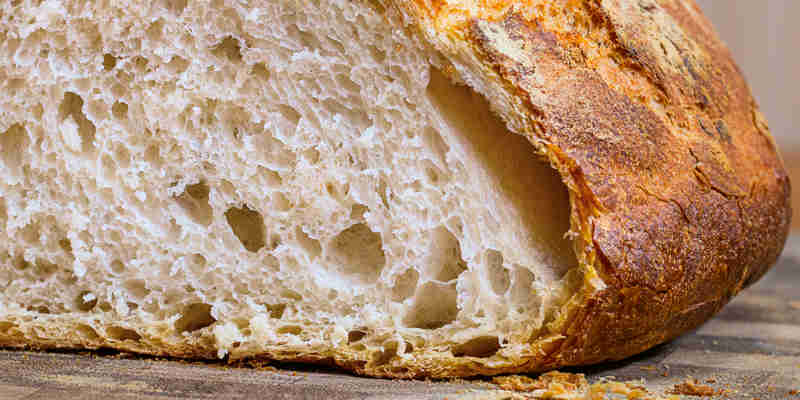



Fresh from the bakery or from your own oven, a loaf of bread tastes juicy and delicious all day long. But already on the following day it is aged a good deal. But since bread is always in the house, the storage problem should be optimally solved once you know how to store bread correctly.
How to store bread correctly: The challenge
A freshly baked bread contains water, which is bound by the contained starch. After baking, this moisture is gradually released back to the environment – the bread dries up. This process is accelerated by low temperatures. The emitted moisture must not collect and thus favor mold. Therefore, to store bread correctly, a bread storage location must provide:
- Temperatures of 18 to 22 degrees Celsius
- Protection against dehydration
- adequate air circulation
In the fridge it is too cold
The temperatures in the refrigerator are far below the ideal value. The cold quickly dries up the bread instead of keeping it fresh as intended. Only on hot and humid summer days would the bread spoil outside faster than in the fridge.
Paper bag at short notice, plastic bag never
At the bakery, the bread comes in a paper bag for a good reason. This material can absorb the excess moisture well and still protect the bread from drying out. Smaller quantities can also remain at home if they are consumed in a timely manner.
From a plastic bag, moisture released cannot escape. The bread gets damp and soon starts to mold. The otherwise practical plastic bags are suitable at most for transport, for storage rather less.
Bread box – the best solution
If bread is to be stored for a long time, then a bread box is the right choice. Commercially copies of different materials are offered. But not every box is as good as the other. It is important that air circulation can take place:
- The material used is breathable, such as wood, ceramic u. A.
- or the box has ventilation holes
If the baked goods are additionally left in the paper bag, it is optimally protected against dehydration. It also keeps foreign odors away. The natural material wood contains tannic acid, which has an antibacterial effect.
Store bread correctly: Shelf life depends on bread type
The rule of thumb is: the darker the bread, the longer its freshness can be preserved. Below is a brief overview of the types of bread:
- Wheat bread lasts about two days
- Rye bread is edible for three to four days
- Wholemeal bread is best for the longest: 7 to 9 days
TIPS
For longer storage, there is the freezer. It keeps bread for about four months and can be thawed wonderfully overnight.
Whole bread or slices?
Whole breads can be kept longer than slices of bread. The latter dry out faster or mold. Sliced bread should be stored with the cut surface down so it will not dry out.
What to do when the bread molds?
When you see mold on the bread, everything has to be thrown away. Just removing the moldy piece is not enough. It may well be that mold spores have invisibly traversed the whole bread for the naked eye.
Wipe the bread box with vinegar water to remove adherent mold spores. This procedure should generally be performed preventively every two weeks.
Conclusion
- Moisture: In the bread, water is bound, which is released slowly after baking
- Result: The bread dries up, it ages. The cooler the ambient temperature, the faster
- Refrigerator: Mostly not suitable for bread storage; only on warm and humid days
- Ideal storage location: Has 18 to 22 degrees Celsius, good air circulation, protects against dehydration
- Paper bag: paper can absorb well the moisture released; suitable for short storage
- Plastic bag: moisture can not escape; the bread sweats and molds quickly
- Longer storage: A bread bin is an optimal storage location; In addition, leave bread in the paper bag
- Requirements: Breadbasket is made of breathable materials or has ventilation holes
- Tip: Wood contains tannic acid and thus has a natural antibacterial effect
- Shelf life: depends on the type of bread; the darker the bread, the longer it will last
- Bread types: white bread: about 2 days; Rye bread: about 4 days; Wholegrain bread: 7 to 9 days
- Cutting: Whole loaves last longer than slices; keep cut breads with cut surface facing down
- Tip: In the freezer, bread can be stored for four months; just let it thaw overnight
- Moldy bread: Must be disposed of completely; not just the moldy piece
- Cleaning: wipe out bread box with vinegar water; generally every 14 days or after mold
