




Explains how to write an essay with examples for each section, outline, structure, format, and steps on how to write an essay. Plus tips and instructions in each section that help for how to write an essay fast and much more easily.
Find more education guides, tips and advice
The essay is a popular homework assignment at school and a frequently requested proof of performance during college and university studies. As with all types of writing, there are a few points to keep in mind. We’ll explain what they are and what is important when explaining the steps and example on how to write an essay.
- How to write an essay: background
- How to write an essay proposal
- 1. Establish your target audience.
- 2. Explain the argument or topic
- 3. Explain your solution
- 4. Devise an outline
- 5. Begin with a solid introduction.
- 6. Assert the issue.
- 7. Suggest solutions.
- Conclude your proposal.
- How to write an essay outline
- Format on how to write an essay: the right structure
- How to write an essay title
- How to write an essay introduction
- How to write an essay hook for the introduction
- Body of the essay
- How to write an essay conclusion / summary
- Language and style of an essay
- How to write an essay compare and contrast format
- How to write an essay argumentative format
How to write an essay: background
An essay is a short treatise on a literary or scientific question. One could also say: an essay is nothing more than an explanatory or argumentative on a certain issue. Unlike a or housework, the focus here is not on the technology of scientific work. Rather, it is about convincingly presenting your train of thought and argumentation and developing it in front of the reader, as it were. Therefore an essay can also be used as a kind of thought experimentin which you consider a topic from science, culture or society as wittily as possible. The advantage: Since you don’t have to prove that you can work scientifically correctly, this type of text gives you some freedom.
Instead of formal requirements, an essay is primarily about reflecting on the chosen topic, working out your own theses and perspectives and taking a stand. It’s about your ideas, arguments and thoughts , not the positions of others. Therefore, you should avoid directly in an essay, you do not need to include footnotes.
Are you a highly ambitious student interested in attending the Immerse Summer School in Oxford or Cambridge? The Immerse Education Essay Competition offers applicants the opportunity to win a 100% scholarship to participate on an Immerse summer programme. Immerse academic summer schools and pre-university online preparation programmes are designed for students aged 13-15 or 16-18. Visit https://www.immerse.education/essay-competition to enter for free.
The different types of essays
Different types of essays can be distinguished depending on the topic and approach:
- The comparative essay deals with two different topics, which in a certain way are related and contrasted. In this way, differences and similarities between these two topics are worked out.
- The argumentative essay is about convincing the reader of your own point of view. You discuss a specific topic and contrast pro and contra arguments .
- The explanatory essay relates to a specific situation or process and has the task of explaining and explaining it. To do this, he cites the most important aspects of the respective topic.
- The analytical essay analyzes and interprets a literary work in terms of its motifs, characters and meanings.
How to write an essay for college
When it comes to how to write an essay in college, the essay assignment tells you exactly how to set up your essay and what type of essay to choose:
evaluate: You should examine a procedure based on defined criteria (which are mentioned in the task).
discuss: You should compare pro and con arguments and come to a final judgment on this basis.
comment: You should comment on the topic with your opinion and add reasons and examples.
justify: Here you should explain and justify why a decision is right or wrong
assess: You should weigh the advantages and disadvantages of a situation and draw a conclusion from it.
compare: This is about comparing and identifying differences and similarities on a topic .
contrast: Here you should focus on the main differences , point them out and justify them and relate them to your previous knowledge.
Academic essay
At the university there is usually talk of an academic essay. This is characterized by a concise scientific argumentation. It is subject to the style of presentation of the respective subject and a methodological justification. But here, too, the following applies: It is about an independent argument, not about the stringing together of definitions or theoretical statements by others. Rather, you should relate your own knowledge to the topic and let the famous common thread in your argumentation be recognized. Each faculty has its own guidelines here, which you can usually access on the respective homepage. The structure, scope (usually four to eight pages) and formalities are precisely defined. A scientific essay can be written as an explanatory, argumentative, analytical or comparative essay.
How to write an essay proposal
An essay proposal can easily be structured around the essay outline, and this will make writing the proposal — and writing the essay — much faster and easier.
1. Establish your target audience.
First of all, you must consider your target audience. Think about the identity of your readers and their degree of experience with your subject. Your writing style should be adapted so as to satisfy your readers’ expectations and wishes.
2. Explain the argument or topic
- To which particular case is the topic relevant?
- What are the specific motives?
- Have other researchers worked on this particular topic before? Were they successful? If so, why? Did they fail? Why?
- Avoid writing a summary that is evident to anyone in the profession.
3. Explain your solution
This phase ought to be clear and easy to comprehend. After establishing the problem you’re dealing with, think about how it can be fixed. Your answer should be brief and achievable.
4. Devise an outline
While you will not include it in the proposal itself, it can aid you in structuring your ideas. See our section on how to write an essay outline.
5. Begin with a solid introduction.
You ought to attempt to captivate your readers from the very beginning. Your proposal needs to be as determined and practical as possible. To make your audience aware of the problem, utilize some background data. Afterwards, announce the objective of the proposal.
6. Assert the issue.
Once you complete the introduction, you need to start working on the body paragraphs, which constitute the substance of the proposal. At this point, you need to assert your issue. In case the audience is not well-informed about the topic, you should provide explanations. You should regard this as the “factual situations” phase of the proposal. Talk about the specific issue, its source and its consequences.
Highlight the reasons for which the issue must be fixed and the way in which it can be fixed. Describe how the problem can have an impact on the readers if left unattended. You must offer responses to all problems and support them using research as well as certainties. You should utilize plenty of credible sources.
7. Suggest solutions.
In our opinion, this represents the most significant part of your proposal. In the solutions chapter, you need to state the way in which your essay will deal with the issue, the reasons for which you chose this approach and the potential results. To be certain that your proposal is compelling, you should pay attention to the following aspects:
Conduct a comprehensive research on your proposal. To make sure you’re able to persuade your readers, you should provide as many instances and certainties as possible. Steer clear of personal beliefs! Your ideas must be based on solid research.
Conclude your proposal.
Your conclusion ought to reflect your introduction, briefly summarizing your primary communication.
How to write an essay outline
Before you start writing, take notes to roughly draft out the essay structure and arguments. You can do this even just in dot-point form at the start, as this makes it easy to move them around to create the best structure and outline. The essay outline is essentially a framework of the essay.
For a detailed outline instructions, see How to write an essay outline: structure, format, steps and tips
Format on how to write an essay: the right structure
Regardless of the type of your essay, the structure is always the same. As with all written treatises from the interpretation of the poem to the discussion to the at the university, the essay also consists of a three-part structure of introduction, main part and conclusion.
How to write an essay title
It might seem counterintuitive, but it is best to write the essay title last. As we explain in how to write an essay introduction, you might think of new aspects or clever approaches during the writing, and these will seed an idea for the title.
Essentially, the second-last part of writing the essay is writing the introduction, and then the final part is writing the title.
However, as a useful step in how to write an essay title, you can give the essay a working title while you are still writing it. The working title could even be your main argument or question, which you then refine into something attention-grabbing for the final version of the title.
Example: working title “Why does toast always land butter-side down when it falls?” becomes the final title “The eternal toast-drop question”.
How to write an essay introduction
The introduction is about introducing the topic. To do this, you formulate a thesis or key question , which you will explain and explain in more detail later in the text. For example, you can take up a current study on the topic or refer to a current political discussion.
Since an essay should reflect your opinion or your point of view, the introduction can also be subjective. It is important that it arouses the reader’s interest and represents a coherent introduction to your train of thought. This is the only way to understand why you selected the topic and why it is relevant to deal with it.
Tip: Do not write the introduction until you’ve finished your essay. Because in the course of writing, the focus may shift or aspects that you have not even thought of before come to the fore.
How to write an essay hook for the introduction
The purpose of the essay hook is to open the introduction in a way to ‘grabs’ the reader and makes them want to read on, and it is a crucial part of how to write an essay introduction paragraph ‘opener’.
Classically, introductions often begin with hook formulations such as “Everyone knows …”, “We are currently discussing …”, or “A current study shows …”. This is a fairly easy way to start a text, but it is also not very original. Only choose this option as a stopgap solution if you really can’t think of anything else.
Instead, choose a more creative approach , for example by briefly describing a concrete situation that fits your topic and that your readers can empathize with. This will make you stand out from the crowd and create an incentive to continue reading.
You can also ask an engaging question, which is designed to get your reader thinking about the topic or argument you are presenting. It can be a simple question like, “Is it possible that….?” Or it can be a more complex question like, “Why is it that toast always lands butter side down when you drop it on the floor?”
Body of the essay
The main part is the heart of any written work. In the main part, you explain the topic of your essay . How you do this depends a little on the type of essay you choose. In an explanatory essay, you should provide more explanatory information; in an argumentative essay, your line of argument is in the foreground. In general, however, it is always about providing arguments for and / or against your thesis set out in the introduction.
You should explain each main idea in a separate paragraph and combine the individual paragraphs with successful transitions. Subheadings are rather uncommon. Your train of thought should be clearly structured and be coherently linked. Subjective elements can and should even be included – after all, it’s about your thoughts! Just writing down your opinion is not enough either. Your attitude must always be justified or made plausible through examples.
Tip: come up with an argumentative strategy . That means: Which arguments and opposing positions do you want to incorporate? And how do you want to contrast them? Should pro and contra arguments alternate? In general, there are no precise specifications here. It is important that your argument is coherent and builds on one another.
How to write an essay conclusion / summary
The final part rounds off your essay and draws a conclusion. Often the end is used to summarize the most important arguments again, to confirm your thesis and to answer the question from your introduction. However, this quickly leads to the fact that you repeat yourself and only write down what you have already explained in detail in the main part. This is pretty boring, especially for your readers . It is more exciting if, based on your explanations from the main part, you give an outlook, for example, and offer suggestions for solutionsor, for example, when analyzing a literary work, explain why this aspect of the work is still relevant today. This shows not only that you can deal with a topic, but that you are also able to develop your own thoughts.
In general, the following applies: Writing an essay should encourage critical assessment and the weighing of various (scientific) positions . You should learn to develop your own ideas from other opinions and facts and to place them in a larger overall context. That is why an essay must never and can never completely depict all the details of a topic. You don’t have to provide new insights, but rather show new perspectives .
Language and style of an essay
In addition to structure and content, the linguistic design of your text also plays an important role when writing an essay. Because with your style of language you can make your text not only interesting, but also convincing . What use is the best argument if the language is not on point? On the other hand, even weaker arguments seem more meaningful if you illustrate them with a comparison or a metaphor. You might have made grammatical or spelling errors. Your formatting might not be on point. Keep revising until you have reached a satisfactory version. It would help if you also ran your essay on Grammarly to ensure no potential mistakes were left. Check our Grammarly Review for plagiarism.
Overall, you should choose an objective style , but you can also incorporate such as rhetorical questions, alliterations, allusions, repetitive figures or metaphors. But before you worry your head about original linguistic blossoms: The most important thing is intelligibility. The language should support your fluent argumentation process and enable a pleasant reading flow.
How to write an essay compare and contrast format
A compare and contrast essay looks at the similarities of two or more things, and the differences. This essay type is common at university, where lecturers frequently test your understanding by asking you to compare and contrast two theories, two methods, two historical periods, two characters in a novel, etc. Sometimes the whole essay will compare and contrast, though sometimes the comparison or contrast may be only part of the essay. It is also possible, especially for short exam essays, that only the similarities or the differences, not both, will be discussed. See the examples below.
- Compare and contrast Frye’s and Bartky’s accounts of oppression. (Explain both similarities and differences)
- Compare WWI to WWII, identifying similarities in the causes, development, and outcomes of the wars. (similarities)
- Contrast Wordsworth and Coleridge; what are the major differences in their poetry? (differences)
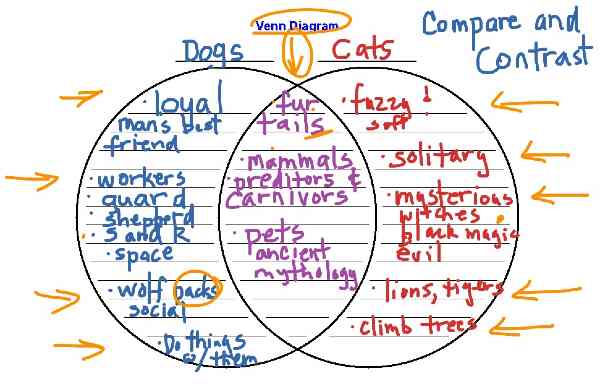
As the University of North Carolina explains, a good strategy for how to write an essay compare and contrast type is to list the similarities and differences as a Venn diagram, with the overlapping section showing the similarities — an example is shown above. You can also just do with as a three-column set of lists. Once you have these listed, you can start structuring your essay from them.
How to write an essay argumentative format
Argumentative essays are often confused with ‘persuasive’ essays. However, there are subtle differences that you should be aware of. While the goal of a persuasive essay is to convince a reader to agree with your point of view, the aim of an argumentative essay is simply to convince the reader that your position is valid.
When writing an argumentative essay, try to stick to facts. Do not get involved in emotions or descriptions. With regard to the structure, argumentative essays also follow a formula.
Below is a description of what you should include in each section of your argumentative essay. The outline you created should briefly summarize each section. For a more detailed guide on how to write an essay argumentative format, go to the complete guide at How to write an argumentative essay: complete guide and steps.
Introduction
Hook: Like all other types of essays in this article, the argumentative essay should start with a hook, which should be a fact, rhetorical question, or intriguing phrase that attracts the reader and makes them read on.
List your main points: Immediately after the hook you should introduce your main points. In the main part of your essay, you will provide details and explain these points further. Here, however, each point should be introduced in no more than a sentence or two.
Thesis statement: Here you should present your reasoning briefly and succinctly. Make sure the reader knows which side you are on. However, it is worth noting that you should not let your emotions invade your thesis or anywhere in your essay. Argumentative essays should be based on facts.
Body
In the main part of your argumentative essay, you should break everything down. All statements that you made in the introduction should be explained in more detail here. As with writing a compelling essay, you should outline your strengths in the first paragraph. Each paragraph should start with a topic sentence and be followed by supporting sentences.
After you’ve made your points, many teachers and professors will ask you to add another paragraph mentioning the counter arguments and providing your evidence against them.
Conclusion
Repeat your thesis: Repeat your thesis in such a way that your essay comes to a natural conclusion. You want the reader to think about your position as something that deserves attention.
Summarize the main points: Now that you’ve rephrased your conclusion, you’ll want to summarize your main points. However, don’t just rewrite the subject sentences from your text sections. Instead, subtly remind the reader why your points are important.
Remind the reader why your reasoning is worthwhile: Here, too, argumentative essays are about validating a position or side of an argument. So in the last or second sentence of your essay, you want to make a lasting impression. For example, you might end up with another related fact that reminds the reader why your reasoning is worthwhile.
