
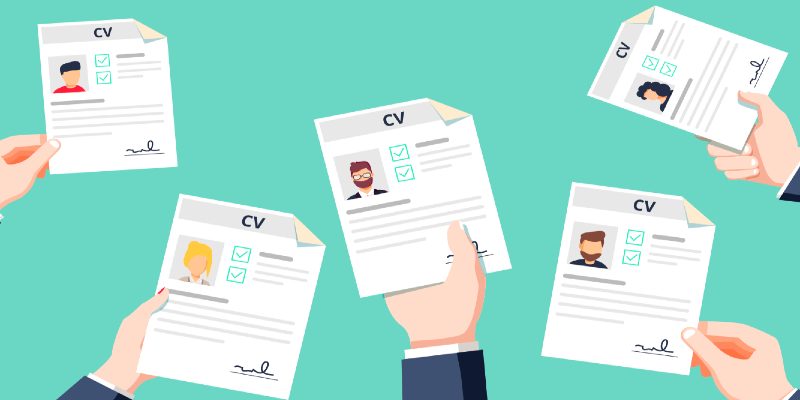



The knowledge of how to write a good resume is the most important key to getting a job interview. Our complete guide to the perfect resume shows how to produce one.
Find more career guides, tips and advice
Are you looking for a new job and have you already seen your potential dream job? Now all that remains is to compile and send the application documents. But stop … first you need to know . In order to stand out from the crowd of applications, you should first update and spruce up your résumé, as HR professionals place special emphasis on its content.
Classic or Modern?
It is up to you whether the CV is designed in a classic or modern way. However, it is advantageous if the design corresponds to that of the company, and this is a key factor in how to write a good resume. So if it is a job as a photographer, the CV can be accordingly creative or, conversely, if it is a job as a legal assistant, the CV should be rather simple.
The perfect length of a resume
What is more important, however, is the length of the résumé – it should be a maximum of two pages. A survey by the Institute for Competitive Recruiting among more than 250 recruiters showed that recruiters take an average of 60 to 120 seconds to view an application. In other eye-tracking studies, the average time the recruiter takes for a résumé is even less than a minute. The résumé should only contain the information necessary to convince the recruiter that you are the right candidate. Meter-long lists from elementary school and hobbies can thus be deleted.
Vague times
The content of the résumé should clarify the questions of the recruiter, not raise new ones. If only the approximate dates of the time that you have spent in a company are mentioned in the résumé, the HR staff will doubt your honesty. What do you want to cover up with it? Is there a gap? Even if gaps arouse the attention of HR managers, it is essential to be able to explain them.
Wrong font
Experimentation is allowed, but the font should be legible and appear serious, and this is a key factor in how to write a good resume. Garamond, Gill Sans, Georgia, Calibri or Didot are recommended. Don’t forget that the same font should be used throughout the application dossier.
Missing structure
A lack of structure and confusing design are a clear no-go for HR professionals. The curriculum vitae should not contain long texts and the HR manager should be able to get an overview quickly – on top is the personal data, followed by a table of professional career and a table of training followed by a list of special skills, for example foreign languages, IT skills and other qualifications. After a quick scan, the recruiter should know whether you are suitable for the vacancy, as this is a key need in how to write a good resume.
How to write a good resume: 15 key factors
Does it fit or does it not fit? HR managers ask themselves this question with every single application – and they can find their answer in seconds using the résumé. Often, software even takes on this crucial pre-selection, in which around half of the applicants are screened out. The perfectly fitting résumé is much more than a cover letter, your entry ticket to the shortlist of candidates and ultimately to the job. The curriculum vitae has no space for flowery wording and imaginative design. Only facts count here. This is crucial to remember for how to write a good resume
1. Decisions are made at first sight of a good resume
The résumé is the most important document in your application. HR managers look at this first, before the cover letter – and make their first decision. Because in order to make a preselection and filter out obviously unsuitable candidates, for many HR managers it is sufficient to submit a CV.
So it’s clear that your résumé should be perfect.
The challenge here: It doesn’t primarily depend on how your résumé is written and structured. Both are important, but much more important is: What does it say?
You can optimize the formulations and design of your curriculum vitae or CV for short – your CV. How your life has gone so far – you can no longer adjust it afterwards. What is happening and especially what has not happened cannot be changed.
So the most important tip for your perfect resume is: optimize your life. And start doing it as early as possible.
To be interested means to be interesting
Optimizing life does not mean working nerdy towards the absolute best school grades and degrees with regard to the curriculum vitae and mastering all the social soft skills of this world from Cha-Do, the Japanese tea ceremony, to Hongi, the Maori nasal rubbing. But show yourself from the earliest possible age as an interested person, willing to learn and open to new ideas .
Do not content yourself with passively accepting what is offered to you in school, training and studies. Go your own way, expand your possibilities and skills. Of course, it is entirely up to you where your curiosity takes you.
Some are fascinated by languages and foreign countries. She is learning French or Chinese, and moving to distant continents for a semester abroad or for work and travel. Others are more practical and want to learn how to repair a car or make a piece of furniture. Many are fascinated by social media and produce Instagram stories or have their own YouTube channel. Still others expand their social and communicative skills, for example through training as youth group leaders or through NLP seminars.
Tips: Whatever you do: Make sure you can document your activities, as this is important for how to write a good resume. Wherever feasible, get certificates for everything, if possible even certificates or references that you can attach to your CV as a PDF.
Proceed systematically
The older you get, bring a recognizable pattern, a system into the diversity of your interests. A young person is ideally suited to trying out a wide variety of fields. As you get older, it will do better if you gradually define your personal goals and work towards them consistently .
Internships, stays abroad and advanced training should then build on experiences that you have already made. If you have learned French, for example, you should now also aim for one of the advanced DELF certificates. If you operate a YouTube channel, it makes sense if you are just as fit in professional recording, editing and sound techniques as you are in marketing your posts. If you have blossomed into an NLP practitioner, it doesn’t hurt if you now also saddle up the master’s degree.
CV with character
All of this, of course, is not the core structure of your résumé: It consists of your school career, your vocational training and / or your studies and, ultimately, your previous professional positions. But your internships, training and further education bolster the core structure, they add richness and color. In doing so, you demonstrate personality, character and dynamism – and at the same time you may close unsightly gaps between two professional stations.
So: make more of your life. Start early, and if you missed it, start now.
2. How does your life fit in how to write a good resume?
There is no room for nuances , you cannot explain or justify anything. Your life, like that of every human being, is probably not 1 or 0, black or white, but diverse and dynamic. Determination and phases of uncertainty alternate, sometimes you have progressed purposefully, sometimes you let yourself be carried away a little.
Why this pointlessly wasted semester back then? Oh right, you were unhappily in love and couldn’t concentrate on studying. Why did you choose your career path back then? In all honesty: Because you couldn’t think of anything better and you had this uncle who recommended the job to you. Why this unpleasant termination back in the third year of your career? Because the chemistry between you and your supervisor was simply not right – but how can you explain that on your résumé?
So much happens in life that doesn’t fit on the résumé. Life knows no template from the sample booklet. And yet you should now sit down and pretend that your personal existence can be evaporated onto a factsheet. Who on earth comes up with such an idea?
Who invented the résumé?
The surprising answer is: Leonardo da Vinci. In 1482 he applied, well, to the Duke of Milan – and he did so with the first curriculum vitae known to historians. Leonardo listed his ability and professional experience much like we do today in resumes.
According to some historians in England from the late Middle Ages onwards, it became increasingly common for experienced craftsmen to summarize their specialist knowledge and professional expertise in writing in a résumé in order to inform their potential clients – the word résumé (often also written resume) is, by the way, next to CV today the in Anglo-Saxon countries are still a common term for curriculum vitae.
As informal, mostly hand-written bullet point lists, CVs were used more or less frequently until well into the 20th century; there was no real system behind it. A turning point was the book “Think and Get Rich” by Napoleon Hill. The writer and journalist, born in 1883 in a poor log cabin in the US southern state of Virginia, wrote it; the work has sold around 70 million times to date. In it, he recommends job applicants to write a “killer résumé” in order to position themselves optimally among the competition. With this Napoleon Hill gave a template that is still valid today.
Resumes are becoming standard
From now on it became more and more natural – initially in the USA – to request or write CVs. By the 1950s the practice had largely become established. At that time it was still common to write very personal information in the résumé – for example about marital status, religion or even body weight. In addition and beyond that, job candidates have started to mention their hobbies and personal interests on their résumés in order to be able to present themselves more comprehensively and individually.
The extensive standardization of CVs has advanced with the invention and spread of personal computers and has finally become a matter of course. In 1984, the Orwell year, the first guidebook, devoted exclusively to writing résumés, was published under the title “How to Write Your CV”. Since then, the number of guides in books and websites has been legion.
Send the resume and application digitally
We are now experiencing the next technological change for a long time. It has led to the fact that sending out an application folder by post is rare. It may be appropriate when applying to small or very small companies that do not have a personnel management IT system and where the boss himself wants job candidates’ applications to be on the desk to leaf through them (if he has time …) In large companies the HR desk was empty; they get the documents on the monitor.
Nowadays, applications are usually typed into the PC with a word processing program such as Word, but are then not printed out and sent by post, but sent directly or, better still, converted into the popular PDF format by e-mail to the employer of choice. There, in turn, there is, at least in larger companies, special software that is designed to archive and process incoming applications according to a uniform template, and this should be remembered in how to write a good resume. Viewing, evaluating and deciding on your résumé – these days HR managers do this job on the screen.
The introduction of applicant management systems means a change that many applicants and writers of résumés are still unaware of. The incoming CVs are reformatted by the software from the previous PDF or Word formats to match the ATS that is used in the company. That means: Careful design, creative ideas, beautiful designs are at least in this respect for the cat. What the HR manager sees from the résumé on his monitor are just the sober facts.
Basically, that too is old hat. Technologies are increasingly being used that standardize and standardize the creation and processing of CVs and applications even more. There is:
- On the one hand, the digital application, directly online in the forms on the employers’ career portals or via mobile app
- On the other hand, there is artificial intelligence, the self-learning software in HR departments that makes a merciless pre-selection from among the applications before a human eye has even seen a résumé or a cover letter.
Since around 2005, so-called applicant tracking systems (ATS) have been used more and more frequently in the personnel departments. You automate the administration of incoming applications and do the preselection. The ATS provides a complete workflow from the receipt of the application to the final selection, which standardizes and simplifies the handling of the applications in the companies.
Software makes the first choice
Above all, HR managers have the option of defining relevant filters in the ATS: for example, keywords, certain skills, professional experience or qualifications, and this should be remembered in how to write a good resume. The ATS then sifts through the incoming applications with regard to these specifications and automatically sorts out all those that do not contain the relevant information. This is the end of the line for about half of all applications .
Specifically, this means: If the job posting requires management experience, all applicants who do not have anything of the kind on their résumé are automatically eliminated. Business fluent English? If this qualification is not literally found in the résumé, the computer draws the red card. Do you need a command of a specific programming language? Then write your relevant know-how on your résumé, otherwise it may end right at the beginning.
The remaining applications are usually pre-sorted by the ATS according to a certain pattern. That means: The HR managers are the first to receive the applications on their monitors that match the requirements in the job advertisement completely or most comprehensively . Of course, this significantly reduces the chances of all applicants that they have made it through the ATS selection with their CV and cover letter, but are only far back on the list of those who remained.
While applicant management systems were initially only used by large corporations, they have now also found their way into medium-sized companies, especially in Anglo-Saxon countries, but increasingly also in Germany. To be on the safe side, anyone who writes their résumé and cover letter today should assume that the first person to read this application in the company of their choice is a machine.
Application management IT as a platform
Complex Applicant Tracking Systems offer HR managers extensive options. This also includes, for example, automatically placing and managing your own job advertisements in your own job portal and on external job portals.
Combined with so-called Talent Management Systems (TMS) or Talent Management Relationship Tools (TRM), companies can even keep an eye on candidates who narrowly failed previous applications or, on the contrary, were not yet ready to change jobs themselves. The TRM keeps these candidates in the database and automatically compares their curriculum vitae with vacancies in the company. If it finds a match, it can automatically contact these candidates directly, so this is something to consider in how to write a good resume.
ATS is also interesting for medium-sized companies
The latest generation of ATS often comes as open source or cloud-based software as a service (SaaS), so that it is affordable and therefore more and more interesting for small businesses. Today, ATS is often a digital platform to which other service providers such as job portals or other applicant management tools can dock. The aim is to continue to reduce the spread in the search for candidates and to address the people who are really suitable for the free job as precisely and purposefully as possible from the outset.
CVs that are permanently visible online play a particularly important role here – whether on LinkedIn, on your own websites or wherever. The more the automated candidate search – more and more often controlled in the background by a self-learning Artificial Intelligence (AI) – is used, the more important it is for job seekers to strategically expand their resumes and their online activities.
3. How to write a good resume in career portals
In 2003, the establishment of LinkedIn added a significant new model to the application process. This applies in particular to the résumé. Because with the new career portals on the Internet, there was and is the possibility to permanently store the curriculum vitae on one’s own profile page and keep it up to date, and this should be ongoing in how to write a good resume.
This has several advantages. On the one hand, recruiters have templates that they can use to search for suitable candidates directly. You can see in the résumés before you even contact them personally whether they have the skills and experience required for the job. This saves time and effort – also for the applicants themselves, because they do not have to create applications that are doomed to fail from the outset.
Secondly, job seekers themselves have a finished résumé at hand, which they only need to adjust a little for an application in order to highlight the details of their previous career that are particularly important for the job advertised. This also reduces the effort, especially if you apply several times in the course of your professional career.
Keep resumes posted online
On the other hand, the online profile in career portals also has requirements. Because it is of course crucial that the information provided there is always up to date, which is extremely important in how to write a good resume. At the same time, the descriptions of the various training and professional stations must be clear and coherent. Your own successes should be presented in a clear and understandable way in your résumé , as well as additionally acquired qualifications, for example in foreign languages, computer programming or leadership.
If you apply to a company by cover letter or online, you must ensure that the information in the submitted résumé matches the template on your profile page one hundred percent. Because at least the candidates who have made it past the first preselection will certainly be scrutinized by the HR staff through online research in the career portals (and often also in social networks such as Instagram or Facebook). Contradictions quickly become apparent.
However, different variations are allowed. Not everything that you have ever done in your training or career is important and interesting for every job. While it is absolutely correct in the career profiles on LinkedIn to present your own competencies as completely as possible in the CV, certain elements can be more or less emphasized in the direct application.
Use communication opportunities
It works very well when one’s own competencies are confirmed or positively commented on by third parties in the career portals. So if you have the chance to motivate former bosses or customers to do so, you should take advantage of it. Authentic testimonials are always particularly convincing in marketing – why should that be any different in self-marketing? This is a key inclusion in how to write a good resume.
In addition, the career portals offer numerous opportunities to network with others and develop communicative activities – chats, messages, blog posts . You can join or even found groups, contribute to discussions or initiate such. These activities in turn provide recruiters with a lot of valuable information about the commitment, personality and professional competence of potential applicants. It is therefore advisable to take advantage of the opportunities that the online portals offer – but never to be hasty or frivolous, but rather focused and with a clear view of your own career goals.
Make your own application video
Anyone who knows from their own experience and feedback from friends and colleagues that they come across particularly well in presentations and in front of the camera should also take the opportunity to shoot their own application video to supplement their résumé (or several – depending on the desired job ). This can then be presented on its own YouTube channel and networked with profiles in appropriate career networks.
Such a video does not replace a written application or a standardized online application , because it cannot be processed in the company’s automated management systems. But anyone who has already been shortlisted and is now checked online by the HR staff before a possible personal contact can be made more personal and personable with a video than with any document.
Self-criticism is particularly important here. Produce such a video as professionally and carefully as possible . Show the film to as many people you know as possible and ask them to express their opinions honestly. The video is only useful if you have a really positive effect on the viewer – otherwise it will do you more harm than it will help you. Do not take the possible rejection or criticism of your first viewers too much to heart: How you come across in the video says little about how you come across as a person in direct personal contact. The camera has its own laws – some people love them, some don’t.
4. How to write a good resume: Information must be complete and accurate
A curriculum vitae must, as a matter of principle, completely and accurately describe your education and training path and your professional stages, and this is the most important factor in how to write a good resume. Completely refers to the timing: no longer phases should be left without information. That doesn’t mean you should list your primary school certificates and student internships. The résumé includes:
- Last school degree
- All other educational qualifications
- Vocational training
- Internships
- Additional qualifications
- Career history
- Periods of unemployment
- Parental leave or the like
Who has a life without gaps?
For many people, however, completely seamless CVs are basically not possible. Somewhere there is often one or the other blank space that is initially inexplicable for the reader. If you only cover a few weeks, it will not bother anyone. But if it spans more than two, three months or even years, the potential employer will want to know what you have done during that time, and this is something to remember in how to write a good resume.
- For example, did you drift through Asia as a back packer for a year?
- Did you care for sick parents?
- Did you have a protracted physical or mental illness?
There are a number of methods you can use to cover up unsightly gaps in your CV. For example, it is popular to give years instead of months.
With such years, gaps of several months are no longer an issue. Great thing, it seems. But HR managers are even more curious about that. They recognize the pattern and immediately suspect that a gap is to be hidden here and ask – or they decide not to even invite such a candidate for an interview.
The uncomfortable truth is: there is no sample or ready-made template that will help you hide gaps on your resume. The personnel managers in the companies know the common tricks, have read all the usual lies before, and immediately stumble upon suspicious passages in their résumé.
It also doesn’t make a good impression to imaginatively decorate blank spaces in your CV – a long journey, for example, as a phase of intercultural competence expansion or the year as a waitress in Berlin as a socio-cultural communication internship. At best, this elicits a tired smile from the HR manager.
Deal with gaps in your resume
The only thing that helps: say how it is. The unexplained in the CV always arouses suspicion, and you should keep this in mind in how to write a good resume. If you are also committed to the phases of life that are more detrimental to your application, you and the staff can at least deal with them openly . Knowing where you stand – that’s what the HR manager prefers to a hidden secret that could hide anything.
Examples of such gaps (and dealing with them in how to write a good resume):
Change of degree, unnecessarily long studies: For many people, studying is not a highway towards a career, but an orientation phase. They need more time than the standard period of study allows, or they change subjects after a few semesters. Quite a few leave university after several semesters without a degree. If possible, show through internships or voluntary work that you are still a committed, goal-oriented person. Don’t hide anything, but give all aspects of your résumé more space and details that make you valuable to your dream employer.
Gap between school and apprenticeship or studies or between studies and career entry: If this phase does not last more than half a year, it is not a big problem. When, if not at such times, should you do the things for which there will be no room for later in the regular working day? HR managers understand that too. Feel free to write in your resume what you have done: for example a trip, a voluntary social activity, a stay in a Japanese Zen monastery. However, if you’ve only chilled out and watched Netflix series for half a year, that’s not going to look so good – but an experienced HR manager should allow you to relax after school and at work.
Illness: You should definitely name it, for example with a phrase like “time off for health reasons”. You should not explain what disease it was. That is none of the employer’s business. However, you should write in your résumé that you have now fully recovered and are fully operational. If your illness was a long time ago and you worked for a few years again, no one should see it as a problem.
But let’s not kid ourselves: Returning to work immediately after the phase of illness is not that easy. It is quite possible that HR managers secretly (they will not say it out loud) reject you because of your long time off because they fear that you will get sick again in the future and put a strain on the company. In that case, it is a matter of weighing up to what extent you would like to speak openly about the nature and cause of your illness and your recovery. Sometimes retraining is necessary after an illness because you cannot continue in your old job. It can help if you can prove that you have completed coaching – whether with professional coaches, the employment agency or other providers – in order to optimize your performance.
Unemployment after dismissal : Of course it makes a big difference here whether you caused the dismissal yourself or not. If your previous employer has gone bankrupt or cut staff as part of a restructuring process, write this openly on your resume. If you have actively resigned yourself or, for example, have been terminated due to insufficient performance, it is usually sufficient if you mention the fact of the termination in your CV, but nothing more. Above all, avoid doing dirty laundry on your resume, application, or interview, and avoid talking badly about previous employers or colleagues.
5. This is how a résumé should be structured
The CV is basically a very simple and clearly structured document . It includes:
- At the top your first and last name, date and place of birth, address and contact details. If you want to use an application photo – more on that later – this has its place here too.
- This is followed by the table with your training and professional positions.
- Point three is the list of your job-related special skills, such as foreign language certificates, truck driver’s license, coaching training or similar.
- You can then state your private interests, such as sports or hobbies.
- Date, place and – handwritten! – Signature complete the document. If you send your application together with a cover letter, make sure that the place and date in the cover letter and in the CV are identical.
There are other ways to structure the topics above. There is no such thing as “right” or “wrong”. But it is important that the structure is clear, plausible and clear and this is crucial in how to write a good resume. For example like this:
- Cover sheet (for the entire application) with your personal and contact details and, if you want, your application photo
- Table with your professional stations
- Table with your education (school, studies, internships, vocational training)
- Table with your additional qualifications
- List of relevant private commitments (for example successes or awards in sport, in “Jugend forscht” or in creative activities)
- Finally, that remains in any case: date, place and handwritten signature.
Personal data and anonymity
You can put your personal data at the top of the first sheet of your résumé and then continue with the next points below. It is nicer and even clearer if you give your application a cover sheet. Then your personal data plus your application photo are in the right place.
Incidentally, you do not have to state the date and place of your birth. For the same reason, you can even do without your name. Completely anonymized applications are therefore possible – in this case, however, it is particularly important to provide contact details (telephone number, e-mail) at which you can be reliably reached.
How recruiters react to such anonymous applications is another question and you should remember this in how to write a good resume. As the law requires, will they treat qualified anonymous candidates in the same way as those who disclose their names and other information? According to the law, they must, and therefore no HR manager will answer this question in the negative. But hand on heart: you shouldn’t rely on it.
It is still very unusual to submit applications without providing personal information. That is why it is better to refrain from irritating with anonymity, and keep this in mind in how to write a good resume. Anyone who fears racist, misogynistic or religious discrimination in the company to which they are applying should ask themselves whether this is really the right employer. Who wants to work for someone who demeans other people because of their origin, appearance or gender?
Your professional positions
The actual main part of the résumé is the table of your professional stations. They are the most important part in how to write a good resume. In the first place, it directly follows your personal data. The presentation must be clear and consistently show all stations in a structured manner so that they can be quickly understood by the reader.
First choose a heading, for example “Professional career”. As a template for you: The following table in the curriculum vitae only needs two columns – the time information is on the left, the brief description on the right. It is only about facts, not about decorative or explanatory details. You shouldn’t use complete sentences on your resume – keywords will do. For example:
The most recent professional position should be at the top ; the others follow in descending order. So the most recent aspect can be found at the bottom of your résumé. This so-called antichronological order originally comes from the USA, but has long been international and therefore also standard in Germany.
The times in the left column include the entire duration of your employment or training station. You don’t have to be precise to the day; it is sufficient to state the respective month and year.
The details of your professional position on the right-hand side of your résumé include at least your position, the employer with the company structure and the location. In the case of lesser-known employers, you can also add an explanatory keyword and state the number of employees – for example “leading manufacturer in specialty chemicals, 1500 employees”.
Highlight important responsibilities, successes and achievements
You have thus fulfilled the minimum requirements for the résumé, but it is better to briefly describe in a little more detail what you were responsible for and what successes you had and this is key to success in how to write a good resume. This is the only way to highlight certain aspects of your résumé that put you in a particularly good light. Imaginative descriptions in the résumé are forbidden – concise information, preferably numbers, must suffice.
Same employer, different positions
How do you present it when you have changed jobs within a company or your area of responsibility has changed or expanded? Is that a new station each time, even though the employer has stayed the same?
A good possibility is to state the entire period of employment with the respective employer, but to list the different positions and periods of time slightly indented below. In this way, your employment with this employer remains recognizable as a uniform professional station. At the same time, the steps in your career completed in this phase can be clearly read.
If you have changed your position name, you should highlight it optically, preferably in bold. So the reader immediately sees that a new phase is beginning here. For example:
New section for the education and training history
If you have an education and training phase going back over the years, create a new table with the same structure as the first one. The heading (in the same font and size as the heading above the first table) can read, for example: “Education”. The order also remains as usual, namely antichronological – your last training station is at the top, followed by the penultimate and so on.
You do not necessarily have to name your respective final grades. But why not score with it if the grades were good?
With the indication of your last and highest school-leaving qualification, you should leave it in your résumé regarding your educational path. You can make exceptions if, for example, you spent a long time abroad during your school days and thereby acquired special knowledge. You can then indented and note this under the heading “Abitur” (or whatever degree was your last). Like this:
What not to include
Even under this condition, it is worth mentioning your primary school years but only if it is relevent or interesting, and this should be considered in how to write a good resume. For example, if you attended elementary school in Osaka, Japan, between the ages of six and eight, this is information that a potential employer could still find interesting 25 years later.
As a rule, however, your primary school years do not add anything in your CV. Incidentally, this also applies to information about your family of origin, i.e. the education and work of your parents and siblings.
In very rare cases it can still make sense today to include information on the occupation of the parents or siblings in the résumé – namely if one or more of these persons is or has already worked for the employer to which you are currently applying. In the best case scenario, this reveals a family tradition, a personal connection to the company, which could create additional trust. If at all, this will generally only occur in the case of applications from young professionals.
The correct place for such information about parents and siblings is the personal information, there again in the last position. It is not necessary to explicitly state the name of the parents – the family name is sufficient. As usual, this information should also be provided as keywords, so don’t forget this in how to write a good resume.
6. How to write a good resume: listing your qualifications and training
Your professional and training stations are mandatory for the CV. You cannot do without it under any circumstances, so don’t forget this in how to write a good resume. It makes sense to add one to three further elements according to the same pattern and structure.
The first of these describes the qualifications and knowledge that you have acquired in addition to your school and professional training or your studies. In doing so, you should only list those competencies in your résumé that are really important for the advertised position or that show your general value for your dream employer. This definitely includes (good) foreign language skills, but possibly also training in certain programming languages, special manual skills, special driving licenses, social skills.
First choose a suitable heading, for example “Additional qualifications and knowledge”. As a deviation from the example in the first two tables, do not proceed chronologically here, but put the generic term of your qualification in the left column. Write the respective specifications in the right column.
If you have completed extensive advanced training and part-time training in order to acquire your additional qualifications, then it makes sense to return to the chronological representation for your CV. You can also choose your own table under your own heading (for example: “In-service training”).
7. Do hobbies belong on the résumé?
What about your hobbies and leisure activities ? Do you include on your resume that you ran your first marathon that summer, that you run a YouTube channel for cat lovers, and that you travel to the Scottish Highlands every year?
The golden rule is: Only write personal engagements on your résumé that add value to your potential employer and this should never be forgotten in how to write a good resume.
However, this makes the bandwidth quite large. Because it includes leisure activities,
- that bring you experience that you can also use in your job
- that prove your leadership skills
- that illustrate your motivation and willingness to perform
- that prove your social skills
On the other hand, there is a risk in the presentation of hobbies . Because the HR manager could conclude from too many and too intensive non-professional activities that you are not putting your full strength into the job, but are frolicking in a thousand fields.
So if you won the national competition for cello players at the age of 19, for example, then that proves on the one hand that you are ambitious, have perseverance and can work with determination. On the other hand, it makes you suspect that you are spending a lot of time and energy playing the cello instead of thinking about your job.
In addition, your hobbies can create a personal bond between you and the HR manager: If you are a passionate soccer player, then you automatically have plus points with a HR manager who also likes to play football. But maybe the same statement will have a negative effect on another HR manager who absolutely hates football.
How something works, what interests and previous knowledge you will encounter, you cannot know in advance. This also means: stay authentic when specifying your hobbies. Do not cheat in order to make yourself interesting – because you may well be asked in the interview which chainring you put on when climbing the Col du Tourmalet. If it then turns out that you have absolutely no idea about racing bikes, the conversation should end quickly.
Tips for including personal information in how to write a good resume:
- Only mention hobbies that you really enjoy on your résumé
- The hobbies should in some way represent a recognizable added value for your dream employer or at least round off your profile attractively
- You should name outstanding achievements (victories in cultural or sporting competitions from national level), but make sure that your intensive professional commitment is also evident elsewhere.
Presentation of hobbies and personal interests
Your private commitment is formally presented in your résumé under a separate heading and in table form, analogous to the previous areas that you have already got to know. The heading is “Hobbies”, “Private engagement” or something similar. In the left column of the table you write the generic term, for example “sport”, in the right column you specify the activity.
8. How to write a good resume: Choose the words correctly
It is said that he who seeks, finds. In the digital world in which we live, however, you only find exactly what you were looking for – and you don’t see what is left or right just off. So when recruiters use an Internet search engine or special applicant tracking software to search for the right candidate for a vacancy, the way they formulate their search is of decisive importance and you should remember this in how to write a good resume.
Conversely, this means for you: If you put your resume online – whether on a job portal, in a career network or on your own website – you should choose your keywords very carefully. Otherwise you will simply fall through the cracks when searching for recruiters and wonder why no one will ever get in touch with you.
The easiest way to do this is in professions that have very clear job profiles. So don’t just write: “Experience with agile management”, but “with the SCRUM method”, not simply “worked with frameworks”, but “with JEE and .NET” etc. Another example based on the same pattern: Don’t use any names simply as a project manager, write: “Experience in international project management according to ISO 69901 and PRINCE2 and tools such as MS Project and Open Project”.
Research the optimal terms beforehand
The best thing to dois to look at as many job postings as possible from the industry in which you work and pay close attention to the choice of words. What terms do the staff use to describe the requirements for the job candidates? How do you name the necessary training, qualifications, degrees? What words do you use to describe the skills and abilities to be mastered? Are certain certificates required?
From these terms, you then select the templates for your CV that describe your own qualification profile in detail. Then make sure that these exact words appear in the appropriate places on your resume, as this is important in how to write a good resume. If you operate your own website , you can use the appropriate tools to make the effort to optimize your website with regard to the key terms for search engines (Search Engine Optimization – SEO).
Tips: Don’t formulate your résumé from your own perspective, but reverse your perspective and formulate it from the perspective of your dream employer. Create your résumé and your online profile with exactly the keywords that recruiters would type into a search engine to find you.
9. Lying is not worth it in how to write a good resume
Do you have to be honest when writing your resume? Or are you allowed to claim competence at one point or another and name qualifications that you don’t even have? This is a crucial error many people forget in how to write a good resume.
An international study from 2007 in the USA found that three out of four employers have caught applicants lying. A few years ago, the detective agency Kocks found out in a study that 1,500 of 5,000 applications examined contained false information. Is it really just uncomfortable when a lie is noticed on your resume? Or is it worse than that?
First of all: an application is self-marketing – advertisement with which you advertise yourself. As with any type of advertising, it is about presenting something as particularly attractive and desirable – in this case you yourself. Therefore, it is ok and understandable if you emphasize and emphasize everything positive and hide negative aspects if possible.
HR managers know that, of course, and you should remember this in how to write a good resume. They expect resumes to be perfectly and accurately executed. And that’s why they look very carefully.
This is why lies are mostly exposed
Candidates who are shortlisted after the first sorting out of the obviously unsuitable applicants are intensively checked by the personnel managers. The first step is to compare the information in the different documents of the application with one another: CV, cover letter, certificates, work samples – are there any contradictions or inconsistencies? The HR managers may take the trouble to do additional research – for example online in the social media profiles or even, if the applicant is very interested, by phone calls with their former superiors.
Anyone who makes it to the interview must know that the staff are trained to use appropriate questioning techniques to uncover contradictions to the information from the written application. Unconscious factors such as word choice and body language are often telltale. It is very difficult for job candidates to sustain a story, big or small, under these circumstances. Better then: stick to the truth from the start.
In jobs for executives or positions with particularly high levels of responsibility, it is not even rare that employers commission specialized detective agencies with background research on the candidates.
These frauds are typical
It unfortunately seems to be particularly common for job candidates to attempt minor cheating on their résumés, somewhere in the gray area between glossing over and lying. A vacation trip is listed as an educational leave or a professional station is given a few weeks longer so that the gap that follows does not appear so large.
Incorrect information on foreign language skills is more prone, but also popular. Only school knowledge, good knowledge or even business fluency? Some people like to place themselves higher on their résumé than would be appropriate. In English or another common language such as Spanish or French, this can quickly become apparent if, for example, the interviewer suddenly switches to this language during an interview. People also like to cheat on the amount of the current salary – a hoax that the HR staff quickly finds out if they research the matter, so bear this in mind in how to write a good resume!
Cheating and trickery are particularly bad at employers when it comes to qualifications that are important for the advertised job. Anyone who states business fluent Japanese as a competence in their résumé and then does not get beyond Sayonara on their first business trip to the Land of the Rising Sun will get into a lot of trouble – or even a termination without notice. So remember this in how to write a good resume. If, on the other hand, he doesn’t need Japanese at all in his new position, then the lie is comparatively less important. However, that is the downside of it, in this case the job candidate does not have any advantages from his lie: The employer simply does not care about the qualification “Japanese”.
What many are not aware of: There are also lies through omission . Because a résumé must be complete – previous professional positions must therefore be listed without gaps. The temptation is great to delete a job that is embarrassing in retrospect or that ended with an unpleasant resignation – from the résumé and instead accept that a gap will arise there. In that case, it will not be easy for the job candidate to explain this gap plausibly.
Never lie. Ever.
With no ifs or buts, applicants should keep their hands off lies or even fakes relating to degrees, certificates, and certifications, so please remember this in how to write a good resume. Falsifying certificates and documents is a criminal offense and has corresponding consequences. If the employer hired the applicant and it later turns out during the employment relationship that his information about the university degree, for example, was false, then the liar caught is also liable for damages. Wages of several years may have to be paid back.
On the other hand, there are also topics for which the following applies: Lies are allowed . This applies, for example, to answers to questions about private life, religion, sexual orientation, marriage plans, the desire to have children or pregnancy. You can also lie to questions about party membership or union activities. However, there is one exception: If information from private life (such as religious affiliation or party membership) is important for the job, then here too the answer must be honest. This is the case, for example, with church-owned companies, trade unions or foundations supported by political parties.
Tips: To summarize again:
- Lies in the résumé are forbidden: forging documents or educational qualifications, inventing jobs or qualifications, cheating on the times, citing training and professional experience that you do not have.
- It is justifiable to gloss over your résumé: Presenting actual activities, experiences and successes more interesting than they were, that’s ok. As soon as you give concrete figures, they have to be exactly right.
- Lies (mostly) allowed: for information about private life, sexuality, religion and politics.
10. The application photo – is it part of the résumé?
Nowadays, anonymous applications are legally permitted in order to prevent discrimination based on age, origin, etc. However, they are still uncommon. However, there are steps towards anonymity, and one of them is not to include an application photo on your résumé.
Not using the application photo makes a lot of sense. It is known from psychological research that attractive people are more successful in their job regardless of their qualifications. Why should someone applying for a civil engineering position go into a beauty contest with all their competitors without a problem?
Submitting an application photo is also a trap for HR managers. Because the messages that we take from a person’s appearance work unconsciously, but extremely strongly, and this should be remembered in how to write a good resume. The first impression counts and becomes permanent. If the recruiter did not like a candidate when looking at the photo, then it is very unlikely that he will still be completely objective in assessing the facts from the resume.
On the other hand, many HR managers still expect the application photo to be included in their résumé. They understandably want to see who they are dealing with.
Present yourself optimally in the photo
So if you decide to submit a photo with your application, you should at least make a lot of effort and ensure that the picture works in your favor. A smartphone selfie is just as impossible as the snapshot from your last vacation.
In any case, have a current photo taken for your application and take on the investment in a professional photographer. Many photo studios nowadays expressly advertise that they take application photos for their résumé. You should consult several studios and have samples of their work shown. Only if you like the photos that the studio has taken of other applicants will you be in good hands there with some certainty. Trust your gut feeling. If you don’t like the sample photos shown, choose a different studio.
How you want to present yourself – whether just as a classic portrait photo in front of a neutral background or in a certain setting and with a certain pose – is best decided in consultation with your photographer. There is no general template for this. If the photographer has experience and takes enough time for you, he will sense relatively quickly which appearance will best show you off.
A good photographer not only masters the rules of illumination and composition. Rather, it manages to photograph you relaxed and relaxed and to emphasize your personality. Your photo will turn out to be both appealing and meaningful – a real plus for your application.
Of course, you have to do your part to make the photo a success for your résumé by preparing for the appointment with the photographer. Get your hair freshly cut, choose reputable clothing (like you would wear to an interview, for example), and make sure you are rested and relaxed.
The format of your application photo
If you want to attach the photo to your printed application, make sure you have a good quality print – a printout on your home printer is usually not enough, so please keep this in mind in how to write a good resume. Usually you should opt for a color photo . There are no fixed rules for size, portrait or landscape format. Your application photo should be larger than a passport photo, but not in poster format. The template for you is a size of 4.5 by 6 cm, if you want to stick the photo in the upper right corner of your résumé, in the immediate vicinity of your name and your contact details. Place the photo on the cover sheet of your application in front of the cover letter and résumé, then it can be a little larger (for example 6 by 9 cm).
Fix it with glue dots or double-sided tape and write your name on the back of the photo so that it can be assigned again if it should come off the surface. Submit the photo digitally, then select a medium resolution and observe the quantity limit for uploading your application documents, which most company job portals impose.
Instead of submitting the photo as a separate file, you can of course incorporate it directly into your CV or the cover sheet of your application using the layout functions of your word processing program (e.g. Word). You can put it in a simple frame there or put a little shadow underneath if you like it. You should avoid conspicuous frame designs or photo effects. Then you should convert the Word format to PDF.
Tips: If your application does not work, the company will usually send you the documents you submitted after a while – including your application photo. Professionally created photographs are expensive – if the picture is not damaged, there is nothing to prevent you from reusing it for future applications.
11. Design your resume: design and fonts
The importance of the layout and design of your resume decreases as more companies use application management software. In this case, your application documents will be scanned (or delivered digitally) and not only pre-sorted by the software, but also reformatted, so factor this in how to write a good resume. The HR managers then receive all documents from all applicants in the same design, depending on the software used, on their monitors. For this reason, even ready-made templates for sample CVs will only help you to a limited extent.
That said, it may still be worth the effort and attention given to the shape of your resume. Many small and medium-sized companies are not yet ready to use application management software. And in addition, if you get into the narrower group of candidates – the HR manager will take the original of your application and leaf through your documents.
As a rule, you will create and design your resume with a common word processing program such as Word. You then submit it digitally in formats such as doc, docx or rtf. It is much better if you convert your file to PDF format. Application management software, like the one your employer of choice is likely to use, can handle all of these formats.
The font must be easy to read in how to write a good resume
It is generally advisable to use a common font that is easy to read on screens. The Times New Roman is probably the most widespread, and it is best to use it in font size 12 point (abbreviated pt.). The font Arial is also popular, as it can be read very well even at 11 point. Format headings in bold or underline them. Choose them one to three points larger than the body text. You can also write the word CV at the beginning of your document in size 16 point and bold it.
If you want, you can optically differentiate yourself from your competitors by using fonts that are also common but rarer, for example with the Garamond type, the Verdana or the Cambria. You should better avoid exotic fonts, italics or the like.
Whatever you choose: stick with it. Changing the font within a document is just irritating. The best thing to do is to create not only your complete résumé, but also the cover letter for your application portfolio using the same template in a uniform format. As an exception, it is possible that you use a different font for headings in the resume than for the body text – but this is not necessary.
Tips: Whatever you decide on questions such as font type and size, headline and body text design, bold and normal fonts: Pay attention to clarity and clarity. And keep the basic structure you have chosen throughout your resume
Use highlighting sparingly
Highlighting such as bold, italic, underlined, uppercase or even colored background should be used as sparingly as possible, so keep this in mind in how to write a good resume. Bold type is very suitable for subdividing again within a passage.
You can also name a particularly important element – for example your position as in the example above – in bold letters throughout . You can write headings not only in larger letters, but also in capital letters (i.e. in capital letters). As a rule, there is no reason for additional emphasis in the curriculum vitae.
Contact information in the header
The best way to start designing your resume is to create a header that remains the same for all pages of the document. In the first line, write your name in normal font, but slightly larger than the rest of the body text (for example in 14 pt.). It is also a good idea to put the name in capital letters.
Below this, write your contact details in one line next to each other in the normal continuous text font: street and house number, postcode and place of residence, e-mail and telephone number. You separate these four elements either with sufficiently large spaces or with vertical or diagonal lines. If you wish, separate this header area from the parts of the document below with a line.
If you use a color, then this line is well suited for it.
Tips: It is a good idea to choose the corporate color of your preferred employer as a template for your design, this subconsciously creates a feeling of familiarity and belonging in the HR manager.
Tips: By the way, make sure that you have a reputable email address. Addresses like [email protected] don’t really work well on your résumé … If necessary, you should set up a new account with one of the well-known service providers.
Heading and personal information
After you have closed the header area of the page, write the word “CV” in the top left or in the middle with the largest heading of your entire document, left-aligned or in the middle.
If you would like to include further personal information about yourself in your résumé in addition to your contact details – you do not have to – then the next heading follows: “Personal data”. It is best to set the heading left-justified. This is followed by a two-column table with your details. Three to four points are sufficient. You can also create the table with three columns, so that the first two columns take up the left half of the page width and the third column offers space for your application photo.
Now the next heading follows, as usual left-justified: “Professional experience”, “Professional career” or similar.
List of professional positions
It is best to create the following table with your professional roles in two columns for your résumé. The left column, which only contains the dates, can be significantly narrower than the right. If you like this optically better, you can make the lines of the edges of the table invisible in the word processing program Word.
In the table, place the dates left-justified at the beginning of each new section. Each section begins on the right with the name of your position, preferably highlighted in bold. For the formatting of the paragraphs you should optimally choose the left-aligned flutter set. The justification (in which the lines on the right and left always end exactly justified) sometimes leads to unpleasantly large spaces between the individual words.
Whether you choose a one-line or one-and-a-half line spacing as a template for all paragraphs is ultimately a question of your personal taste. Text with larger line spacing is a little easier to read. On the other hand, they extend the document. So if you already have a very long résumé, it is better to stick to the one-line spacing so that the document does not go over too many pages. If you have only had a few stations on your résumé so far, then you should be more generous in layout.
The design of the other elements in the resume
The heading “Training” or similar and the table with your training stations follow the same pattern. If you want, you can follow the same pattern with one or two other elements, for example “Additional qualifications” and “Private commitment”.
Finally, at the bottom left, the place, date and below your handwritten signature follow.
Tips:
- Your resume should not exceed three pages in total.
- Make sure you are as concise as possible when describing your professional achievements and qualifications and avoid unnecessary details.
- Overall, value consistency. The headings should be the same in all sections. The dates should follow the same pattern everywhere.
12. CV for professionals
If you are an experienced specialist and manager , you are familiar with applications and have probably already written or updated your résumé more than once. You know the pattern. Are there any special features that go beyond the basic rules that you should consider in your situation?
It was a little longer ago that you were at school and university – that is why these areas are far less interesting for HR managers than they are for a young professional. It is sufficient if you state your Abitur, your study locations and your degree. You can do without the indication of intermediate stages on your educational path and the grades.
Prove your added value
Instead, it is particularly important for you that your career path shows a direction that logically leads to the position you are now applying for. This works best if you don’t limit yourself to listing the individual career stages on your résumé. Instead, describe at each station – in a nutshell and best illustrated by numbers – what exactly your tasks and successes were (for example, which large projects you have managed; number of employees you have led; amount of your budget responsibility, etc.).
Put yourself in the role of the HR manager who has an important, responsible position to fill and whose own performance in the company is measured by how successful he is. This HR manager’s interest is to find someone who promises to meet the exact requirements the job demands. If you want to show that you are that person, it is not enough to list your previous job titles on your resume; rather, you are most likely to convince if you present your specific range of experience in a clear and meaningful way.
Tips: Supplement each of your professional positions with three to five bullet points that briefly and precisely explain your most important experiences, tasks and competencies. In order to keep your résumé short (two to a maximum of three pages), you can limit yourself to the bare essentials in your training path. It is best to omit the indication of hobbies entirely.
13. Apply online: Does your CV fit in the form?
Sending your CV or application portfolio by post is old-fashioned? That’s right, but Word, PDF, and Email are getting pretty old school too.
Nowadays, applications are very common via applicant portals operated by the companies themselves. There they often provide you with input forms in which you should type at least your cover letter and often also insert your CV. Only documents such as references, certificates and application photos should then be uploaded as jpgs or PDFs.
Forms force you to adhere to a given template – all creative possibilities for designing your résumé are excluded here. It is important for you to work with concentration and care. Remember: Everything the HR manager will see from you on his screen afterwards are your words – so always pay attention to correct spelling, clarity and completeness of all information.
Choose keywords correctly
Here, too, it is important that you have informed yourself in advance about which key terms are used to search for candidates for the jobs in which you are interested. Make sure you use exactly these keywords on your résumé – if they apply to your qualifications. Free text fields may offer this opportunity.
Often, applications that are received online are archived by the company in the event that a job has not been placed directly. If another position becomes available later, the software searches the archive for candidates with a suitable CV. If you have chosen your keywords correctly, you may be in the second round.
Mobile life, mobile resume
The most common way to access the Internet nowadays is no longer via a PC, but via a smartphone. So why not apply for the job on the go, including a résumé and cover letter?
Study results from StepStone show that every second employer would prefer a short application via smartphone to a classic application, provided that it would receive more applications. Job seekers also prefer this option: the majority of the specialists and executives surveyed by StepStone would like to be able to apply more often via smartphone.
StepStone offers an app for this, with which the whole process can be done with little effort. The curriculum vitae is created in advance in a StepStone profile or in a cloud solution and, along with the other required documents, is simply uploaded via the app.
14. At a glance: Dos and Don’ts in a résumé
What do you definitely have to consider in your CV? What should you definitely not do? For a quick overview, we have listed the “Dos and Don’ts” in how to write a good resume:
The Dos
- Complete and complete information on all professional positions
- Chronologically descending structure
- Emphasize professional success and best prove it with numbers
- Organize clearly
- Formulate it clearly and concisely
- For qualifications and positions, choose exactly the terms that are in the job advertisements
- Time specifications always with month and year
- Highlight job titles and educational qualifications in bold
- One or two, at most three pages
- If photo, then professional quality
Don’ts
- spelling mistake
- Rambling
- Lies and fakes
- Content contradictions to other sources of information (certificates, cover letters, online profiles)
- Larger gaps in the resume
- Too many different fonts or colors
- Exaggerated or restless design
- Obvious use of patterns and templates and individual elaboration
- Unnecessary private information
- State hobbies that have nothing to do with the advertised job
- Dubious application photo
15. Checklist for your résumé: Everything on it, everything in it?
- Is your resume up to date?
- Have you checked the relevance of the information on your CV for the advertised position and formulated the relevant information appropriately and emphasized it as much as possible?
- Have you looked at samples and templates for the resume and decided which template suits you best? Have you thought of carefully customizing a template you downloaded from the Internet for your purposes?
- Is your résumé clearly and consistently structured and formulated in a clear and understandable manner?
- Are the company names of your previous professional positions spelled correctly, are your contact details correct and complete, is all the data correct?
- Does all the information in the résumé match your cover letter, your certificates, your online profiles, etc.?
- Have you always stuck to the truth, for example with your foreign language skills?
- Have you carefully considered which of your personal data you want to include on your CV and which you don’t?
- Does your application photo look serious and personable?
- Do the place and date match the information given under the application letter?
Conclusion
Your resume is your calling card. Imagine selling yourself, but still being honest. Prefer a simple structure with the essential information about yourself and the decisive characteristics why you fit into the company. And last but not least: Proofread your documents several times and ask your friends to look for mistakes too, because the HR manager will save himself from having to read the entire application dossier more closely if there are grammatical or spelling mistakes.
