
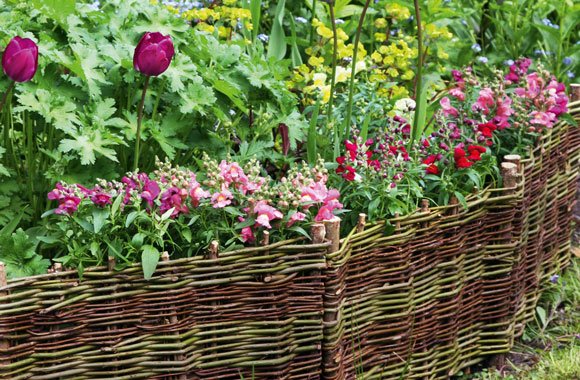



Natural fences, growing gazebos, tunnels and flower beds: wickerwork is diverse and an eye-catcher in any garden. Here’s how to braid willow rods properly. Be inspired by our ideas for garden design to weave willow wicker for the garden!
A natural garden is beautiful. To ensure that fences, bed frames and garden arbours fit seamlessly into the variety of plants, landscape gardeners and gardeners rely on willow and bamboo wicker. As a versatile building material, there are no limits to your creativity when designing to weave willow wicker for the garden.
Where are willow and bamboo growing?
If you do not have it yourself in the garden, you can ask neighbors or the community if and how much of the pastures may be harvested on public roads and roads. Willow branches for weaving are also available on the Internet.
Anyone who owns pastures in the garden harvests in autumn and winter. The best time to plant willows is spring. Put stronger rods in the ground for this. After a few weeks, the sticks form new roots.
Weave willow wicker for the garden step by step: How to build a bed frame
Dense wickerwork is ideal as a bedding border . It consists of several elements that are stuck side by side in the ground. Rods with a diameter between 3 and 8 mm are best suited. Tip: For more color, weave willow branches in several shades of brown and green.
- Before processing the willow branches, soak them in a tub or creek for one to two weeks .
- The rods should be between 3 and 8 mm in diameter . Remove all branches and cut off the tips .
- Also from the hazelnut plugging be all branches and twigs removed.
- Then cut the rods and hazelnut pieces . The approximately 3 cm thick outer pegs are 60 cm long, the inner, about 1.5 cm thick 40 cm.
- The thicker plug at one end with a knife sharpening . This allows the element to be easily put into the ground later .
- Drill blind holes in a braid of at least 6 x 4.5 cm for the braiding. On the outside one with 3 cm Ø, in between at regular intervals 1.5 cm Ø. The distance is about 10 cm.
- Insert the sticks and start braiding.
- Lay the rods alternately in front of and behind the pins and around the outer posts.
- The attachment points of the rods are always behind a vertical.
- In between, constantly squeeze the mesh firmly.
- Finally, cut the middle pegs to the same length.
Wickerwork in the garden: the most beautiful ideas
In addition to bed borders, there are numerous ways to make your garden with natural effects. Here we have put together the best ideas of wickerwork :
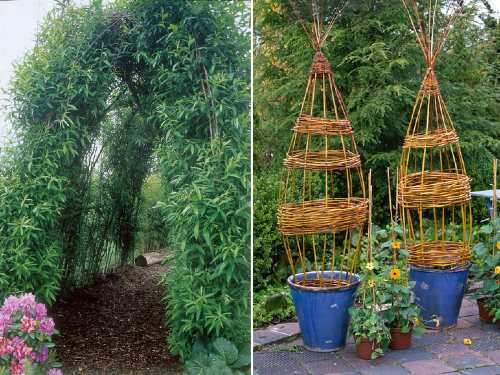
1. Build a gazebo yourself
A “growing” gazebo is a natural shade dispenser. Put freshly cut willow branches into the ground. Soon the willow branches will strike and form new foliage. From the fresh plants you can turn natural gazebos , tunnels or a tepee for children.
2. Build wicker obelisk yourself
A wicker obelisk serves climbing plants as a climbing aid . Put long branches in a pot. Join the poles with thin branches: with loosely braided rings in the middle and a solid wickerwork at the top. That holds the branches together. In addition to plants such as the black-eyed Susanne, Clematis or winds, the willow construction is also suitable for peas and other climbing vegetables .
3. Build a wicker fence yourself
With their natural look, wicker constructions showvegetables and flowerbeds to advantage. The basic ingredients are stable branches and sticks you put deep in the ground. The wickerwork connects fence slats and piles.
 Gerhardt Richter is a writer and a trainer at trade technical colleges, specializing in carpentry, plumbing, mechanics and construction.
