




Puppy education is a fundamental issue for all dog owners. It covers all aspects of dog everyday life, such as going for a walk or staying in the home. This guide shows you how to train a puppy properly.
What is already routine for older dogs is an absolute new territory for the puppy, even if it is just running on a leash. Dog training is also a big topic in dog sports or when communicating with the dog. In the beginning, however, you have no influence on education.
In the first weeks of life, the breeder usually takes over the education of the little ones. So if you get your four-legged directly from the breeder, then there are things that show you a good education.
The puppy should be integrated in the breeder’s family and not just know his litter-mates and mother. As a result, touches from people are not alien to him. Also watch how your potential new family member behaves outside his whelping box:
Does he curiously explore the world? Is he approaching you? Does he already know the garden of his breeder? If so, how does he behave? Is he afraid of the box or his mother?
Once your darling is found, there are simple tips for living together at home that will quickly turn your dog into a solid family member if you know how to train a puppy properly. If possible, place the puppy basket or blanket in the apartment in a place where the newcomer can watch the buzz in the apartment.
So he quickly gets used to smells, familiar and strange people, noises and everyday life. But also ensure a quiet retreat, because the little one has a very high sleep requirement.
He wants to play like any other child, of course. Let him win every now and then, for example, in simple search games that make you slowly more difficult. Success boosts self-confidence.
How to do puppy care when you work full time
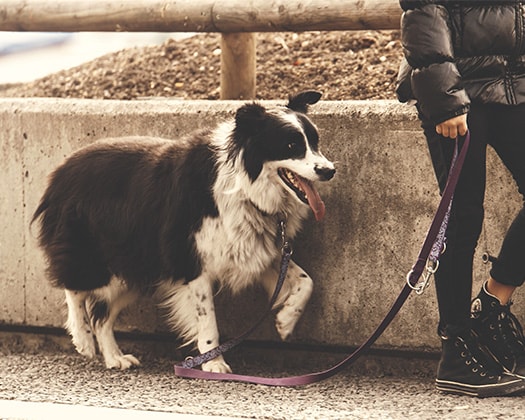
How to train a puppy properly: Going for a walk
Important when walking in the context of puppy education is the correct posture. If you want to show the dog that you are taking the lead, you have to show it visually. Stand upright and show broad shoulders. Go consistently towards a goal. Through a physical, self-confident orientation, the dog is more inclined to orient itself to you.
In the final analysis, it should be so that you give the direction and the dog follows you. Of course he can also sniff and look around. But he should stay in the track of master or mistress and adapt to the pace. A very important tip is that you should not constantly look at the dog. Rather, find your own destination. If you look at him constantly, he can misunderstand this as backing off or insecurity. If your companion walks after you, then you should praise him for it. He can orient himself on the praise.
Also praise him exuberantly when he behaves as intended by you, for example, when he encounters a larger dog confidently. By the way, puppy schools are also a good place to learn how to deal with other dogs. Do not be afraid of surprising noises yourself. Do not consolation him in anxiety attacks, that only encourages him. If there is a real danger, you should actively show him that he can rely on you. Speaking of “pointing” – in the communication between humans and dogs it does not necessarily have to be verbal.
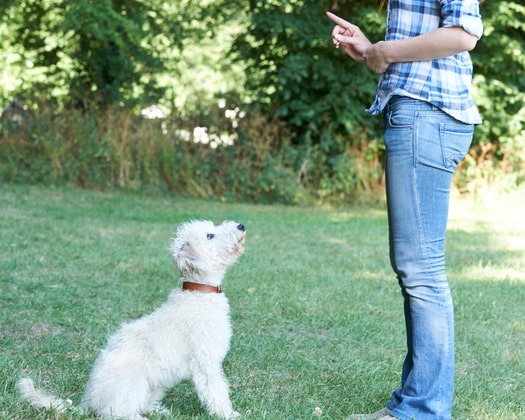
How to train a puppy properly: Sign commands so your dog understands you
Standard commands that are often heard being given by walking dog owners. However, dogs can also get used to sign language. Every dog can learn it with a little patience and consistency, including your new puppy.
For learning the word command “sit,” you can slowly feed a treat over the dog’s head. Most of the time he sits down automatically. You give the command and praise him when he sits down. Gradually you can reduce the distance to the muzzle and only hint at the movement. For the character, lift your index finger up during the word command. If he sits down, praise him immediately. With a little training, it will soon work only with the hand signal.
If your dog can “sit”, you can take the treats from the dog’s nose to the ground from this position. When he lies down, say “down” and praise him. Later, you can practice this even from a standstill. During the word command, you can also show the dog the palm of his hand held down as a gesture. After some training, the hand signal is sufficient and the dog lies down.
For the “heel” command, take your dog on a leash to your left side. Then hold a treat with your left hand and motivate him to follow your hand with his muzzle. Say “heel” and praise him if he executes the command correctly. But if he pulls on a leash, just stop. Take your hand forward, then he must make an effort to get the treat. If the dog can do that, change the pace or the direction every now and then, you practice without a leash. When the word command is in place, make the hand gesture at the same time. Just tap the left thigh with your left hand. If your dog is running, praise him. Later the knocking will suffice and the dog will follow you without a word command.
Swimming with the dog
Dogs are born swimmers. The bath in the cool water is fun and at the same time a good fitness training. Some dogs even have webbeds, such as the Labrador and the Newfoundland. In some of these toe intermediate skins are very pronounced, so the cuticles are often referred to as swimming skin. By the way, dogs do not have to learn to swim, they just can. Lose contact with the ground, just paddle on it and swim. But beware: you do not know that, your dog! Therefore do not throw him proverbially in the cold water. Carefully guide him to the new experience of “swimming”.
Getting used to the water is best started in puppy age, from the fourth month onwards. For the first approaches, find a shallow body of water. The puppy then needs time to slowly approach the new element and first explore everything. Show him how much fun it is to wade through the shallow water. Praise him vigorously if he follows you. If he does not dare follow you, tempt him with treats or toys – that works in most cases. Then you can bring your dog to swim. Retrieving games are well suited for this. Throw the object at the beginning only so far that the dog can still stand in the water. Only when you have the impression that your dog feels safe in the water, you can throw the object so far, that your dog needs to swim one or two moves. When he’s back on land, praise him for his achievement.
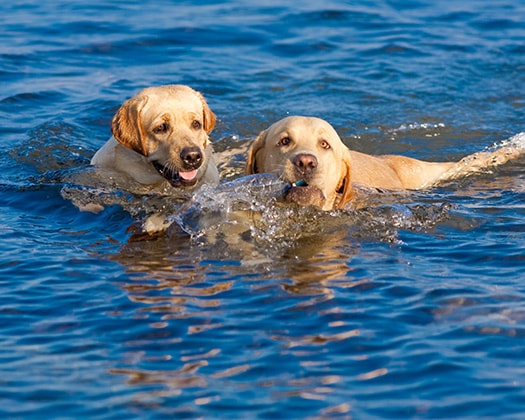
Safety when swimming with the dog
Do not throw the object too far at retrieving games, the dog must be able to easily move to the object and back to land. Who does not want to take a risk, buys his dog a life jacket. Basically, dogs who go swimming should not wear collars. They could get tangled and that can be dangerous. After the long bath your dog needs a lot of fresh drinking water, because sports make you thirsty. By the way, not every body of water is suitable as a dog bathing place, because dogs are not allowed everywhere. Clarify the situation before you leave for your trip. The same applies if a holiday with the dog is coming — check where you will be staying.
