

This guide outlines how to tell real turquoise from the fake versions that are flooding many markets.
Find more fake-checking guides here
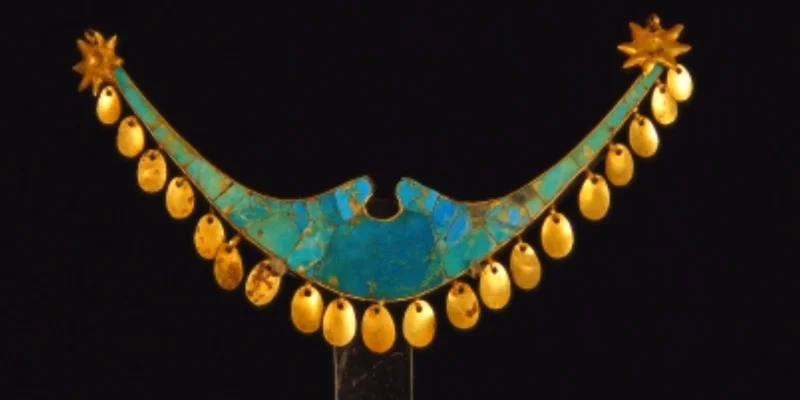
Turquoise is one of the world’s most ancient gemstones, with a history spanning thousands of years across various cultures. The earliest known use of turquoise dates back to ancient Egypt, where it was mined in the Sinai Peninsula as early as 3000 BCE. Egyptian pharaohs, including King Tutankhamun, adorned themselves with elaborate turquoise jewelry and used it for inlays in gold, valuing it as a symbol of life, joy, and protection.
In ancient Persia, now modern-day Iran, turquoise was considered a prized stone and was widely used in architecture, decorating the domes of palaces and mosques because its blue color was seen as a symbol of heaven on earth.
The Persians called the stone “pirouzeh,” meaning “victory,” and believed it could protect the wearer and warn them of impending danger by changing color. This “Persian blue” variety became a standard of quality for centuries.
The stone’s name, “turquoise,” is derived from the French phrase pierre tourques, or “Turkish stone,” a name that originated in the 13th century when the gem first arrived in Europe via Turkish traders traveling the Silk Road.
Across the Atlantic, turquoise held deep spiritual and cultural significance for pre-Columbian Native American tribes, especially in the southwestern United States. The Navajo, Zuni, and Apache peoples, among others, mined and used turquoise for at least 1,200 years, valuing it more than gold.
They associated the stone with the sky and water, using it in sacred ceremonies and as a medium of exchange. Many tribes believed it provided protection and good fortune, and its use in jewelry, carvings, and amulets remains a significant part of their cultural identity today.
How to tell real turquoise
Below are ways that should alert you if the stone you are being offered is a fake.

Check for color variations
When seeking how to tell real turquoise from a fake, you can look for several key indicators related to its appearance, price, and physical properties. A visual inspection is a good starting point, as real turquoise often has natural variations in its color and matrix, which are the web-like patterns of veins within the stone. A stone with a perfectly uniform color or a matrix that appears painted on or too consistent is a red flag and is likely a fake.
Price
The price is another strong clue for how to tell real turquoise, as genuine turquoise is relatively expensive, so a deal that seems too good to be true probably is. Many imitations are made from a naturally white mineral called howlite, which is dyed to mimic turquoise, or from plastic and epoxy.
Temperature and weight
A simple yet effective method for how to tell real turquoise is the temperature and weight test, as genuine turquoise feels cool and heavy in the hand, while plastic imitations will feel much lighter and warmer.
Acetone test
For a more definitive test of how to tell real turquoise from fake, you can perform an acetone test in an inconspicuous area. If you gently rub the stone with a cotton swab dampened with acetone, a fake will likely transfer some of its color to the swab, whereas real turquoise will not.
Hot needle test
Similarly, the hot needle test for how to tell real turquoise involves heating a needle and pressing it against the stone; a plastic imitation will melt, while genuine turquoise will be unaffected.
How to tell real turquoise vs stabilized turquoise
It is important to note the difference between fake turquoise and stabilized turquoise, which is very common in the market and is not considered a fake. Stabilized turquoise is real, low-grade turquoise that has been treated with a clear epoxy or plastic filler to increase its hardness and durability, making it suitable for jewelry. While it is less valuable than natural, untreated turquoise, it still contains the genuine mineral.
Final words
From the ceremonial adornments of ancient Egyptian pharaohs to the sacred jewelry of Native American tribes, this unique mineral has been valued for thousands of years. While fakes and imitations exist, these methods for how to tell real turquoise show it can be identified through a careful examination of its natural characteristics, providing a lasting connection to the earth and the diverse cultures that have revered it.
