


Are you looking for a creative hobby for yourself and your children? Sewing is one of many great ideas – it’s fun and children are excited about the versatile possibilities of letting the imagination run wild, designing, designing and creating. Similar to handicrafts, sewing is a meaningful occupation that not only trains fine motor skills and concentration, but is also a lot of fun. With our tips and a good guide, it is easy to teach a child to sew.
1. Teach a child to sew: Tips and tricks
Before you try sewing with your children, the question arises, of course, at what age the hobby is suitable at all. Have enough confidence in your child’s skills. Let it taste quietly and have a lot of patience. Normally, children between the ages of eight and nine are ready for first sewing.
Learn the sewing machine basics
With your help, however, you can also let kindergarten children tackle their first creative projects. Here, however, you should note that young children cannot handle the sewing machine yet and you should sew by hand for the time being.
But age alone is not, of course, a clear indication. Ask yourself the following questions before you start to teach a child to sew:
- Can your child already coordinate well?
- Can they handle needles safely?
If you answer “yes” in your head, you can dare to make the first sewing attempts teach a child to sew.
2. Carefully and slowly sew
Sewing looks easy, but you need a lot of concentration and stamina to learn the right tricks. To make it easier for children to get started, you can practice on paper in advance. To do this, paint zigzags, waves and straight lines on a piece of paper and let your child sew along. Try different tricks and show your child that it’s not bad when they make mistakes.
Be sure to take enough time for the first sewing attempts and be patient. You don’t learn to sew overnight.
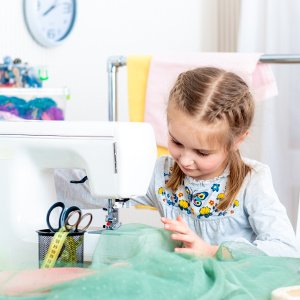
Sewing with children is a great, creative pastime.
Even while practicing on paper, you can see if your child is ready for needle and thread. Larger children can try a few sewing attempts with the sewing machine, best use a piece of paper for this. Take it slowly and enjoy the time together.
To prevent injury, you should explain to your child in advance that you can get injured with the needle – but don’t be afraid of your offspring. Show your offspring that you have confidence in their skills. If a small mishap happens, you should encourage your child to continue, but not push it. Also, be sure to stay with your child and never leave them unattended!
3. Teach a child to sew- that’s how it’s done!
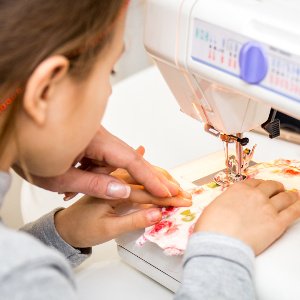
Cotton is an ideal fabric for sewing for children and beginners.
The time has come: Everything is ready and your offspring at least masters the basics? Then you can start with the first DIY. The very first sewing and the finished piece will certainly make your child very proud.
- Transfer the pattern to the fabric with a trick marker.
- Unplug the fabric.
- Start sewing with your child, with or without a sewing machine.
- Support your child, let them try it out as much as possible on their own.
- Take your time and take breaks.
TIPS: Instead of pins, clips are recommended for holding pieces together. These do not prick the little children’s hands and leave no holes in the fabric. Small fabric scissors can be found in the hobby market. These are much better suited for the children’s hand than the huge fabric scissors for adults.
Children can learn to sew with sewing machines. Special children’s models are particularly suitable for this purpose. However, the purchase of such a is not mandatory. You can also simply raise the pedal of a commercially available sewing machine with a stool.
4. Choosing the motif for sewing with children
Every beginning is difficult: At the beginning you should do without heavy patterns and better resort to simple sewing templates,such as a lavender bag.
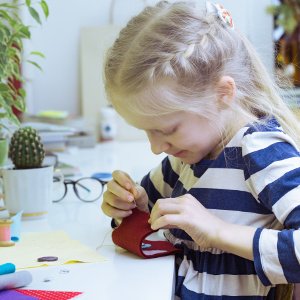
Have bandaids there in case the needle slips.
Especially at the beginning, children need success experiences, so that the new hobby does not get boring. Your child will surely be very proud when he completes his first homemade sewing piece – even if it is “only” a lavender bag. After all, it is a project that is simple and fast and something that the child can use himself. Cuddly pillows, carrier bags, snowman and co. are also very popular with children. Over time, you and your offspring can become more and more creative and choose more unusual motifs.
Together with your child, find simple patterns that are fun and enjoyable.
5. With the right materials, it sews easier
Did your child already like to choose the pattern? Wait and see how much fun he will enjoy choosing the fabric. Depending on your selected project, you now choose the right fabric. Colourful, glittering, shrill and best still with special effects – but also pay attention to the quality of the fabric. We have summarized the properties of the well-known cotton and polyester fabrics in the following table:
| Description |
|---|
| Cotton: does not slip when sewing, good to process, Hem breaks remain in shape after buckling, less de-fitting is necessary, robust, soft, pleasant material, ideal for sewing beginners |
| Polyester: usually available in shriller colourselastic, wrinkles less,usually more heat-sensitive, well suited for clothing |
How to thread a sewing machine: simple guide
How to learn the sewing machine basics
