
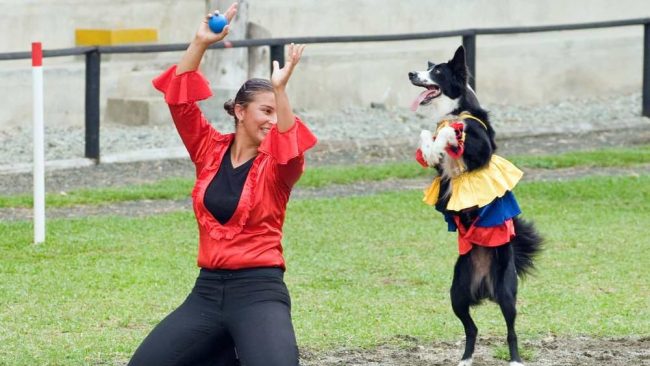

Many people are keen to start dog dancing freestyle with their furry friends. Dog dancing has become a trend sport in dog sport in which the four-legged friends with their master or mistress complete a rhythmic choreography to music. The dog does little tricks and moves in time. You can only practice dog dancing with your dog for fun or participate in tournaments. Dancing is a good exercise for the discipline. Dog dancing is suitable for many dogs and is not limited to specific breeds. But before you start dog dancing freestyle, it is helpful to know some background.
Where does dog dancing come from?
Dogdancing is a further development of obedience. Obedience is a division in the classic dog sport, where the obedience of the animal is in the foreground. While Obedience, which was developed in the UK, has been around since 1951, dogdancing is a relatively recent development.
Unlike its predecessor, Dog dancing has emerged in the US, where show elements enjoy great popularity in many areas. His first breakthrough was the dance of humans and dogs in the late 1980s. Dog dancing is also referred to simply as “freestyle” in the USA.
Official classes and fun classes
Dog dancing distinguishes between fun classes and official classes. Official classes are subject to stricter rules in tournaments: toys, food and similar incentives must not be used. In addition, your dog will be judged by an official class of judges. ” Dog dance International ” has developed a scoring system that distinguishes two areas:
1. the artistic achievement
2. the technical achievement.
According to this rating system, dog-human teams can win up to 100 points in each of the two sections. For example, the technical grade takes into account the difficulty level of the exercises and their execution. Criteria such as the choreography, the dynamics and the charisma of man and dog are incorporated into the artistic and artistic evaluation.
However, this scoring system is only a variant according to which the performance in the official classes can be judged. The decisive factor is what criteria the organizer of a tournament determines. Because in terms of rules, dogdancing is often still “freestyle”: different rules and regulations can be used at different tournaments. However, if you are interested in dogdancing, the criteria of “Dogdance International” may give you a clue as to what matters most.
Is dogdancing suitable for every dog?
Not every animal likes this type of occupation, but many dogs love to interact so intensely with their mistress or master. The feats and movements should be based on the natural movements of the animal when you start dog dancing freestyle.
Four-legged friends with limitations or a high age can also do dogdancing – with appropriate adjustments. For example, jumps represent a high physical load that may no longer be appropriate for such animals.
Which breed for dogdancing?
There are no limits to the breed of your dog . Big and small dogs, Yorkshire Terriers and Golden Retrievers alike can demonstrate their good upbringing and sense of rhythm when you start dog dancing freestyle. There are also no restrictions on many tournaments. Older or disabled dogs are often judged separately in official classes to maintain fairness.

In small (dance) steps to the goal
Dogdancing training, like many dog sports and educational methods, relies on operant conditioning: When your dog performs a command correctly, you reward him by praising him, giving him a treat, or using similar positive enhancers. Thus, the dog combines the exercise with the delicious food or the good feeling that gives him your praise.
In dogdancing, you first study the individual tricks and tricks with your four-legged friend. Only later are these connected to a choreography with fluid transitions and music.
Shaping
With the help of the so-called shaping you can also study more complex movement sequences. You reward the dog at the beginning, if he has performed a part of the movement correctly. Gradually you raise the hurdle.
For example, if you practice a spin with your dog and get used to it, you can praise it at first if it’s just going in the right direction. Later, the dog receives praise or reward only if he makes a quarter turn. Once he has mastered the quarter turn, you only gain half a turn and so on – until your dog finally makes the whole turn.
Dogdancing appropriate to the species
Ideally, the dog sport promotes the four-legged friends. Most dogs can not imagine anything better than to get attention from their owner. In addition, dogs need sufficient employment opportunities. In this respect, dogdancing can accommodate the natural urge to move of the animal and offer him a varied employment.
Is criticism of dogdancing justified?
Critics complain that the movements in Dogdancing and some other dog sports do not correspond to the natural behavior of a dog. However, you should keep in mind that dogs are not just the best friend of humans, but that species would probably not exist without humans. Dogs are much more than domesticated wolves: they have adapted to humans over time and have been selectively bred. For this reason, behavior that a wild animal would not show in this form can not automatically be considered harmful. Ultimately, dogdancing is part of the culture for both dogs and humans.
Requirements to start dog dancing freestyle
Minimum age at Dogdance
As well as human sports, dog sport is a burden on the body. A utilization does not mean overloading. However, there are rules in dogdancing tournaments to avoid overloading the animal. The minimum age is twelve months in the official classes. For a fun class, the paw buddy must be at least six months old and may not perform certain items if he is less than nine months old.
Teamwork
Most dog owners attach great importance to the welfare of the animal. Dogdancing requires intensive study of the animal, as humans and dogs must be perfectly attuned to each other. That’s why many dog owners would not even dream of pushing their dog to do exercises that they absolutely do not want to do. In tournaments, it is also prohibited to force the dog to something.
A scientific study with a small group of dogs indicates that dogdancing is good for dogs living in shelters. In this case, the four-legged friends were a little more often taught to a new owner, if they were trained in dog dancing. The study director, however, assumed that it does not necessarily have to be dogdancing. It just seems to be the intense occupation of a person with the dog that promotes the dog.
Dogdancing requires a good relationship between man and dog. Conversely, dog dancing can help to establish and strengthen this relationship. In addition, the motivation of the animal plays an important role. This can be promoted in training with the help of treats and similar enhancers.
Enthusiasm for learning
In addition, it is helpful when you start dog dancing freestyle if the dog has a temperament that fits this dog sport. Although there are rough indications of which race tends to which temperament – but it depends on the individual animal. Most dogs do not get in the way of their temperament if you want to practice dog dancing with your four-legged friend. For a learning enthusiastic dog, you will certainly have a lighter game than an animal that is a bit “puffy” and (at first) needs several prompts each time.
Ability to concentrate
A dog owner should bring enough patience, because not every dog learns every trick equally fast. A good ability to concentrate helps dogs and humans to carry out the individual exercises exactly and not to lose track of the transition from one element to the next.
Since the concentration does not last forever, a training session often takes a maximum of 20 minutes. However, you can occasionally announce individual elements in everyday life and reward them if done correctly. A good opportunity is to go for a walk, but also playful mini-exercises are at home in between possible if your dog is currently receptive.
Fitness of the human
On the part of humans, it helps if you have some sense of rhythm. However, this can also be trained. You do not have to be very athletic or agile to try out dogdancing – of course, proper dance training is not required either.
What elements does the dog “dance”?
In Dogdancing you will find many exercises that you may have already trained with your dog. These include very classic figures such as the male, a role or a rotation about its own axis. Dogs often have a side that they prefer. You should, however, also train the other side, so that your four-pawed friend, for example, can roll both to the right and to the left. For this you need specific commands.
Also different gear directions are often involved in a choreography. The dog learns to move forwards and backwards at the right pace. The sideways gear you can also train with your four-legged friend.
You yourself perform movements when you start dog dancing freestyle that match those of the dog while dancing. In tournaments or in videos you will find many inspirations, which possibilities exist and which combinations look good. You can also think about it yourself.
Dog and dog work together, so there are elements that require direct interaction. A typical example of this is the leg slalom. But you can also teach your dog to jump over your leg when you stretch it out. The dog can also jump over an outstretched arm that you hold at a reasonable height. The jump height is based on the individual performance of the animal.
Advanced students sometimes complete very impressive tricks. This is the best way to do this until your dog is ready, provided you want to get into that league. Just as human sports can distinguish competitive and recreational sports, there are not only dogs in dog sport that can perform at their best. Most importantly, you and your dog enjoy dogdancing.

How is a choreography structured to start dog dancing freestyle?
If your dog already knows a few tricks, you can make a small choreography out of it. To include a choreography and other:
– the right music
– the individual exercises / tricks
– transitions between the exercises
The music
The music should appeal to you first and at the same time be accepted by your dog. Some dogs react to certain music with fear or unrest – such a piece of music would not be suitable.
If you want to dance with your dog on tournaments or demonstrations, you should also consider the occasion and the (expected) taste of the audience. The tempo of music also plays an important role. It should match the speed of your dog. By working with faster and slower movements, you can create a varied choreography.
The built-in exercises
Suggestions for exercises that you can use during dog dancing can be found in the previous paragraph of this article. Further inspiration comes from social media groups, forums and websites that deal with dogdancing. In any case, it is helpful to network with others and to talk with like-minded people about this great hobby. Tournaments and videos also provide a good source of inspiration. Note, however, whether the level of difficulty for your dog is appropriate at this time.
The most beautiful elements are not placed directly at the beginning, so that the choreography of a rising voltage curve can follow. Many dogdancers place the highlights of their dance from the middle to the end. The concentration of the animal should be considered, as it changes in the course of longer choreographies.
If your dog is upset at the beginning, you should also consider this. Anyway, dogs and owners alike enjoy a sense of achievement right at the beginning of a choreography – and they are more likely to do exercises that your dog is comfortable with.
The transitions
The transitions between the individual tricks you design by the most fluid, rhythmic movements that harmonize with the music. Dogdancers are often guided by a basic form. So you imagine, for example, a large triangle would be painted on the floor. Along the lines you carry out the exercises with your dog. You do not have to leave the lines stubborn, but you can make the choreography agile and varied. Of course, other basic forms are possible as a reminder.
If your dog controls the forward, backward and sideways gears, you can use these gaits to pass from one point to the next. Sometimes you move mirrored to your dog, another time synchronously. Let your creativity flow!
How long does it take to learn dog dancing?
The learning pace is very individual. It depends not only on your dog, but also on how often you train with him and how motivated and focused your dog can work. Physical performance also affects learning speed.
A simple choreography with some common exercises such as rolls, turn-your-own-axis-turning and the like can be put together after a relatively short time. Even a simple dog dance looks not only good, but also gives you and your four-legged friend pride and the motivation to carry on.
