
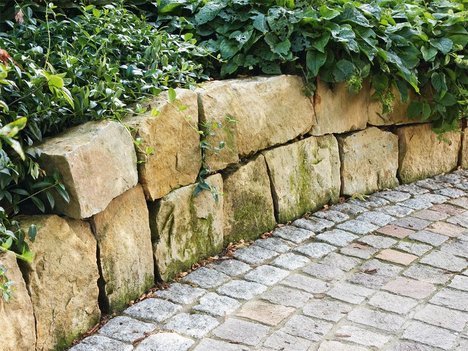



Dry stone walls have always been part of the usual appearance of many landscapes. Dry stone walls can be found in the woods, especially in areas with forests such as Ireland, England, Wales and Scotland, but also in the Balearic, Cycladic and Puglian regions, where material was rarely available for fencing. This is how to build a dry stone wall easily.
And so it is not far away that also homeowners in our latitudes resort to this traditional construction method. Not least because they can be made without mortar. This means that the necessary frictional connection in the dry masonry is created solely by friction and tension.
Here we show a small selection of dry stone walls made of natural as well as concrete blocks, which are quick and easy to produce so you can build a dry stone wall easily.
Build a dry stone wall easily: breakage wall
Pavement slabs made of concrete form the basis of this fracture wall. Since many houses have such concrete slabs for low-priced initial equipment on terraces and garden paths, you could now use the wall as an opportunity to process the existing plates of the terrace and paving the terrace again.
Of course you can also simply buy plates. Walkway slabs in the format 5 x 50 x 50 cm you get in any case in the hardware store with building materials department or directly from the building materials dealer.
Crushed stone plates
To turn the sidewalk slabs into bricks, use a miter, a sledgehammer, or a slash hammer to brace the middle of each slab so that it shatters into pieces that are not too small. And then it can start.
- Sandstone cuboid
Rustika (from Latin rural) is a masonry of stone blocks, the front side is only roughly hewn (embossed). And this natural stone wall is made of such ashlars. The light beige sandstone has the dimensions of about 40 x 40 x 20 cm and weighs about 26 kg each.
Align ground
For the substructure, the earth must be removed and laying sand is applied with an approximate grain size of 0 to 4 mm. This substructure should be about 20 cm deep and properly compacted with a heavy hand rammer. Before the first stone layer is applied, the loose sand substructure must be leveled. Only when the sand is straight can the first layer be laid out of the carved sandstone blocks.
- Walls with system
If everything is supposed to be pure and straight, then there is only one thing: the use of a wall system.
The 16 kg concrete blocks in the dimensions 25 x 24 cm at a height of 12.5 cm can be due to the special tongue-and-groove system, quickly and easily build up to a wall.
In addition to the normal stones with the two-sided “natural” surfaces, the masonry system also consists of three-sided broken initial and end stones in full and half format as well as corner stones, curve stones and cover plates.
The stones are available in the colors granite-light, gray-anthracite, brown, light-brown, natural-brown and limestone.
Tension the guideline
Remove the turf in stone width and then, using two metal pipes or wooden pegs, stretch a guide cord so that the wall can be aligned.
- The plantable wall system
Strictly speaking, the Bossaflor stone from Ehl is not a brick at all, but rather a square planting ring, filled with earth, a first-class retaining wall and slope attachment. The over one-hundred -weight components can be well stacked for two, need no foundation and thus guarantee a fast progress. Heavy food on pallets: With 53 kg per stone (40 x 40 x 25 cm) a real challenge.
Fill blocks
The blocks are placed on a drain layer, leveled and filled with sand or topsoil to the brim.
 Gerhardt Richter is a writer and a trainer at trade technical colleges, specializing in carpentry, plumbing, mechanics and construction.
