
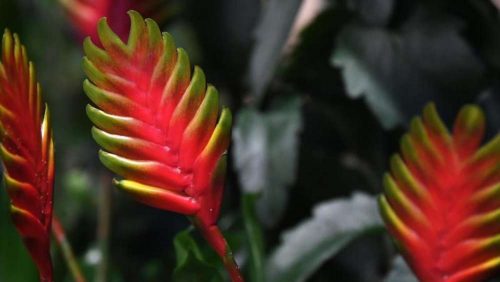



Bromeliads are among the most popular houseplants ever, and can remain bright for a long time if you know how to improve bromeliads color.
They offer an attractive leaf structure and often very colorful, spectacular flower formations that set an exotic accent in the room with little care.
Tips to improve bromeliads color
If the leaves of Bromeliad brown at the tips, the plant is too warm and too moist. To improve bromeliads color, move it to a cooler spot and make sure you do not overwater it. This is indicated by the Bromeliad Group, an association of bromeliad producers and growers.
Basically, many bromeliads like when they get water from their leaf funnel. Then you should keep the soil rather lightly dried. If the house plants have no funnel, one should also avoid waterlogging in the pot to improve bromeliads color.
Bromeliads tolerate sunlight only marginally when their leaves are rather thin and bright. You should not stand by the windowsill where the sun shines directly. Bromeliads with hard and dark foliage do not mind – on the contrary. You even need more light.
Bromeliads are exotic: Their home territory is the so-called Neotropic, which extends mainly over South and Central America, but also over the West Indies. Their original habitats are very different in climate than in our latitudes – namely tropical warm, humid and not subject to four seasons. Nevertheless, some of the very numerous species of bromeliads can be cultivated in our rooms very well as ornamental plants – they can thrive without any problems at usual living temperatures in heated rooms.
The bromeliads are named after the Swedish doctor Olaf Bromel. By the way, the first Bromelie came to Europe with the famous explorer Christopher Columbus – in the form of a pineapple, which is probably also the best known Bromeliad due to its fruit. Because of this, the plant family also has the nickname pineapple plants.
growth
Most species of bromeliads are evergreen perennials. Typical of their appearance is the strong rosette structure with broad, pointed, upright leaves. In the funnel-like center of the leaf rosette rainwater collects in some species. Many species are xerophytic, so they can reduce their evaporation through various mechanisms.
Characteristic of the Bromeliceae is also their epiphytic growth – they are among the so-called epithelium plants, such as orchids. They grow in nature so without roots mainly on trees or on rocks. In the pot they are kept in the room culture only for stabilization purposes.
leaves
The leaves are not only characteristic of bromeliads – they are also essential nutrient channels for many species. After all, as epiphytes, you can not cover their nutrient requirements via roots. Instead, they get nutrients and moisture directly from the air via absorbent dandruff and dandruff on the top of the leaves. A light hair is used to reduce evaporation and protection against sunburn.
blossom
Many consider bromeliads to be in the room or in the office, partly because of the quite spectacular and colorful flower. But what impresses most of the time, is not the actual bloom – that is rather unimpressive in most ornamental species. However, it is surrounded by large bracts, which often appear in magnificent colors and also last much longer than the actual flowers.
For most Bromeliads, flower formation is a very fragrant and therefore only a one-time thing that causes a death of leaf rosette or in the giant bromeliad even the end of life.
Which location is suitable?
The small selection from the huge variety of Bromeliceae, which are kept in our house plants, come originally from the tropical rainforests of South America. The species that come from airier, cooler mountain regions are usually of little relevance to our concerns.
It goes without saying that you should give a tropical Bromeliad – especially popular and widespread are the Guzmania – a location as tropical as possible. It should be bright, consistently warm and as moist as possible. It is best to put it on a window that lets in a lot of brightness but not full sunlight.
Conveniently, the preferred ambient temperature for Bromeliads is around 20 ° C, which is considered to be pleasantly warm for many. It may of course be warmer, but below 18 ° C the thermometer should not sink.
The main site conditions for ornamental bromeliads:
- bright, but not full sun
- highest possible humidity
- Warm all year round, about 20 ° C and warmer
In summer, you can also put most ornamental bromeliad species outdoors. Pay attention to the fact that she does not get an intense direct sun. In addition, the post-outdoor is usually only possible in phases – because on nights with temperatures below 15 ° C, the bromeliad freezes too much, so you need to bring them back.
