
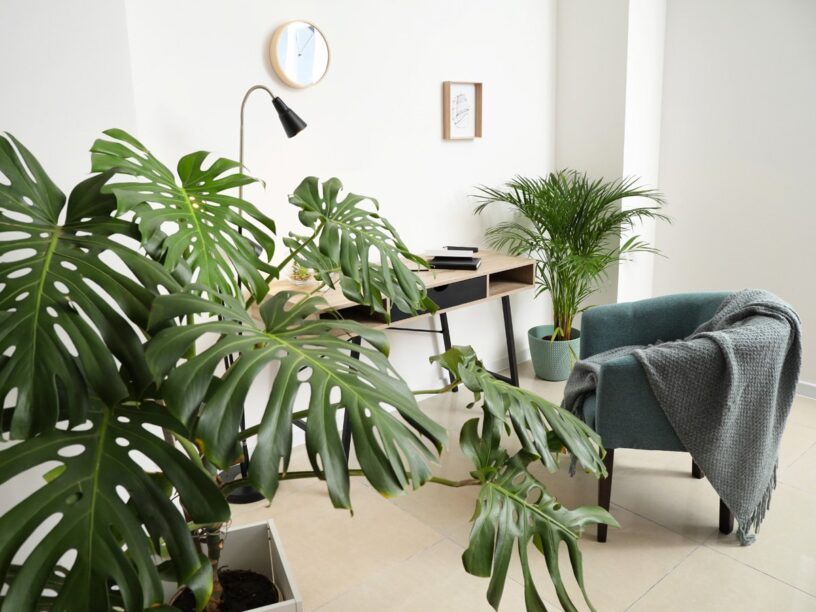



Plants in the office, home or apartment provide a pleasant indoor climate. But to retain their beauty, they always need some care. But if you do not have a green thumb, you do not have to do without plants. We show you seven easy-care indoor plants that are both robust and beautiful at the same time when you choose easy-care plants.
Good news for all furnishing fans who like it green! Because not every houseplant needs endless care and attention. And this does not just mean cacti. The well-known Monstera and the rubber tree are also among the easy-care indoor plants. What you should still pay attention to the green roommates, learn here.
1. The Yucca Palm (Yucca elephantipes)
The perfect plant for those who are too lazy to water! Because the yucca palm tree does not hold too much water. Especially wet roots due to waterlogging are deadly for the Yucca. Therefore, she is completely satisfied if she gets so much water once or twice a week that there is no traffic jam. In addition, this houseplant prefers a partially shaded space in the room, which gives her enough light to live. And even in winter, you do not have to worry about the yucca palm. Heating air does not bother her. The classic features are the sword-shaped and sharp-edged leaves.
2. Bow hemp (Sansevieria trifasciata)
The bow hemp is considered the number 1 of the easy-care indoor plants. Its fleshy leaves are very eye-catching due to their color and marbling. Bow hemp likes to dry rather than damp, which is why it is as good as indestructible. He does not seem to care about the blazing sun. Its ambient temperature can therefore be between 15 and 35 degrees.
Plus point: in addition to its robust nature, the bow hemp is also a natural air freshener. With its large leaves, it effectively filters pollutants such as benzene, formaldehyde, trichloroethene, xylenes and tulol from the air. Here you can find out more about indoor plants that improve your indoor air.
3. Window leaf (Monstera deliciosa)
As an easy-care indoor plant, the Monstera needs only a light to partially shaded and warm location, some potting soil and regularly a little water. Only you should dust their up to 50 centimeters long leaves two to three times a year to ensure a long life of the plant. Furthermore, you should not remove the brown “shoots” on the plant. These are air roots that help the plant to absorb water and food.
4. Money Tree (Crassula ovata)
The money tree belongs to the family of the thick-leafed plants (Crassulaceae) and comes originally from South Africa. He is not only known under the name “money tree”, but is also called “luck tree” or “penny tree”. Whether in a sunny room or in the shade – as far as the choice of his location, the money tree is frugal.
When pouring you should only make sure that no waterlogging forms. That makes the roots mold. From April to September, during the growing season of the money tree, you can add some cactus fertilizer once a month. Since this plant is non-toxic, pet owners and people with small children can keep them in the apartment with a clear conscience.
5. Dragon Tree (Dracaena)
Although the dragon tree reminds its observer strongly of a palm tree, it has its actual origin in the family of the asparagus plants. With good posture he can reach a height of up to two meters. You should therefore make sure that you can provide the Dracaena a sufficient room height.
As a houseplant, the dragon tree has no high light requirements and can therefore be kept in various living spaces. Only the direct sunlight can not stand the dragon tree. And even when watering this plant is pretty undemanding. In spring and summer, you can water your dragon tree a little more often. Anyone who avoids waterlogging in the meantime will be able to enjoy this easy-care indoor plant for a long time.
Plus point: As is the case with bow hemp, the dragon tree is one of the air purifying plants. Spray the leaves of the plant regularly with water to improve the indoor climate, especially in dry heating air.
6. Rubber tree (Ficus elastica)
The rubber tree is ideal for a location with low light. Its strikingly large and shiny leaves grow almost by itself – without any elaborate care. Place the rubber tree in a half shady spot at normal room temperature and he will thank you. And also when casting it says: dear little rather than too much! The soil should always be moist, but the roots should not be in the water. If the substrate still contains enough moisture, you can test it with your finger first.
Important: a dust layer quickly collects on the large leaves. This can affect plant activity. For cleaning, it is sufficient if you wipe the leaves with my duster. Tip: The white, milky juice that the plant gives off can cause skin irritation. So wear gloves when taking care of the rubber tree.
7. Gold fruit palm (Areca)
The Goldfruchtpalme, also known under the name Areca, is also one of the most popular houseplants. It forms numerous, rohähnliche trunks, which branch bushy and carry slightly curved fronds. She prefers a bright but not sunny spot.
Even if the gold fruit palm is a very thirsty plant, always make sure that it is not in the water. Excess irrigation water should therefore be removed as quickly as possible from the saucer. If you stick to it, you can enjoy its beauty and elegance for a long time. The Areca palm is a very easy-care indoor plant and brings holiday feeling in your four walls.
