



Looking for the perfect garden fence? Our guide will show the advantages and disadvantages of different materials and how to choose and build a garden fence. You will also learn how to erect garden fences made of wood, wire mesh or metal.
For expensive projects, thorough preparation can save a lot of money. This is also the case when you choose and build the right garden or privacy fence. After all, it’s not just about beauty, it’s also about what kind of garden fence fits the style of the house in the first place and which is suitable for practical reasons.
Steps to choose and build a garden fence
Rules of thumb do not help much when you want to choose and build a garden fence, because every house and every situation is a little different. Our checklist makes it easy to find the right garden fence.
How to build a fence: simple guide and steps
Checklist: How to find the right garden fence
1. Function of the garden fence
- Should the garden fence secure the property?
- Should he prevent children and dogs from running into the street?
- Should he only visually encompose the garden?
- Should it work as part of the garden?
- Should it be opaque?
2. Shape and color of the garden fence
- Is the house in the city, in the suburbs or a small town?
- In a single location or in a settlement?
- What are the enclosures in the neighborhood?
- What style does the house have?
- Which colours and materials dominate the house or garden?
3. Material for the garden fence
- Do you want to build the fence yourself?
- Can you spend time on care or not?
- Do you have helpers available for construction?
- Should the fence last for decades, or do you like to change something?
- Would you like to customize the fence?
- Should the fence catch the eye or are the plants more important to you?
4. Cost of the garden fence
- Is it necessary to fence the whole property?
- Does the same material have to be used for all property boundaries?
- Is the help of craftsmen necessary, or can the material be processed well by yourself?
- Is the disposal of the material expensive if the fence needs to be replaced?
Plan garden fence and front garden together
The fence is often referred to as the calling card of the house (or rather, its occupants). It is the first thing the visitor or passer-by sees, and sometimes the only one, because it does not allow a view when it is built as a high screen.
Most of the time, however, the front yard and house are less densely sealed off and the view over the fence is welcome. The way to the house, the entrance for the car, a carport, the space for the bicycles and the garbage cans, the letterbox. Finally, the facade of the house, trees, shrubs, flower beds, potted plants. All this plays an important role in choosing the right garden fence.
When the design is successful, all these elements combine to form a harmonious feature when you choose and build a garden fence properly in tune with the home. The house facade and fence form the frame that encomposes and brings out the front garden space. This means that the house and the fence should be in balance: a massive fence does not harmonize with a small, rather inconspicuous house, and conversely, a modest fence does not fit the magnificent villa.
Measuring and calculating
The approximate length of the property boundaries can be seen from the site plan of the cadastral office, but there is no way around the measuring on the spot. The first step to choose and build a garden fence is to draw up the floor plan of your property and enter the measured dimensions there. Measurements are made with as long a band measure as possible from boundary stone to boundary stone. Entrance and way to the house should be entered: Thus it becomes clear where fence elements are needed at all.
If the front garden is redesigned as a whole, the gate openings can be arranged in such a way that as much as possible can be worked with whole fence elements. For the exact calculation of the material requirements, the site plan is best applied to millimeter paper.
Most plots border neighbouring properties on three sides. Usually 125 cm high wire mesh fence is used here. If the fence is directly on the border, it belongs to the owners of both plots. A fence of your choice can be placed directly on, but not on the border. You should communicate with your neighbours about high rank grille or sealing fences, which may be desirable as visual protection.
Foundations
As soon as it is clear which material is to be used, it has to be measured again: this time it is about the exact position of the foundations.
First, you put rods at both end points of the fence and tighten a string in between – very tight so that it can’t move. Along this line, the lengths of posts and fence elements are now marked; the position of the posts must be marked very precisely, because there is hardly any room for manoeuvre when assembling finished fence elements. It is a little easier with self-built wooden fences or wire mesh fences: here, slight deviations can still be compensated.
Important: Buried posts need good water extraction.
Sloping sites
For flat terrain, it does not matter whether rigid or more movable fence elements are used. The posts are all of the same height, as are the fixing points of the fence fields.
Even with small ground waves, you can hold the balance sway. In the worst case, individual fence fields at the bottom must be shortened or (if it is to be animal-safe) extended. Different with terrain with a clear gradient.
With garden fences on a hillside, there are two possibilities.
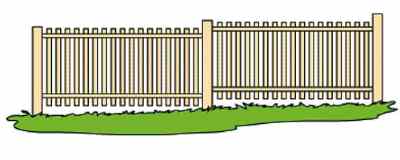
1. In this example, the fields are mounted unmounted. The steeper the slope, the shorter the fence fields must be in order for the fence to be adapted to the slope. The fence never becomes completely animal-safe, because at the bottom triangles remain open.

2. This garden fence runs on sloping terrain. The slats are only fastened to the upper and lower crossbars with one screw each and stand perpendicular to the posts. Mesh wire fences can also be mounted in this way, because the wire mesh can be clamped at an angle between the vertically standing posts.
Large gaps under the fence can be prevented with a massive plinth. It is led down the slope, each level having to be as long as a fence element plus post.
Plinths and walls
Bases and pillars made of masonry or concrete fit both wooden fence fields and metal elements. The effort is considerably greater than with normal fence construction, but the durability is also.
The first thing to do is to pour a frost-free foundation. For this purpose, one lifts an 80 to 100 cm deep trench, which should be about 5 cm wider on all sides than the base. After drying, bricking can be done.
A guideline guarantees that the stone layers are exactly horizontal. It is easier to work with stackable elements poured with concrete. They look like natural stones, but are much lighter and, above all, easier to process. If you want smooth surfaces, you can also pour the base and pillar entirely out of concrete and plaster them later.
Choose and build a garden fence: the 3 most popular types
1. Wooden garden fences
The classic DIY material, wood offers many advantages even with fences: it is relatively easy to process, offers endless design possibilities and is available everywhere. Even with finished fence elements, the selection is almost unmanageable, because in addition to the traditional forms such as staketen, slatted and hunter fences, there are many variants of decoratively designed fence fields.
A special role is played by stake fences made of split stems, which are offered with wire-connected and rolled-up. They are suitable for lightweight, fast-mounted mounts that can be guided around curves. They fit natural gardens and rural houses.
The same applies to plank fences. With them, large plots can be quickly and relatively inexpensively engraved. However, it is not suitable to prevent children or animals from leaving the garden. Visibility and noise barriers are actually more than fences, but they often take over their function, especially on busy roads. Since they are mostly built of wood, they can also be combined with wooden fences.
Of course, wooden fences also have a few drawbacks: they have a limited lifespan, even if impregnation, painting and professional processing bring a lot. The fence should definitely be painted regularly so that it is protected and looks good. Occasionally, untreated wood is also used for fences. It is cheaper to buy, saves work and money because it is not deleted and can be easily disposed of.
Wooden fence: Instructions
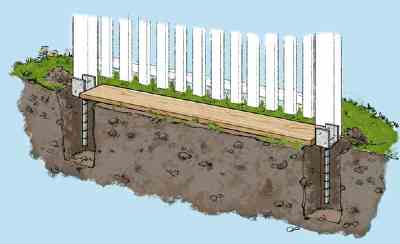
The post spacing can be determined with an auxiliary board: Add the length of the fence field plus 3 mm on both sides for the fittings plus the overhangs of the posts over the post shoes.

In the case of a fence directly on the footpath, it is first checked whether concrete paths can disturb. After that, it is decided whether finished point foundations fit or the foundations themselves have to be cast.
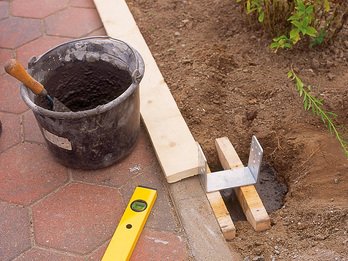
Here foundations were cast themselves. The post shoe, which is poured in, lies on auxiliary wood at the right height
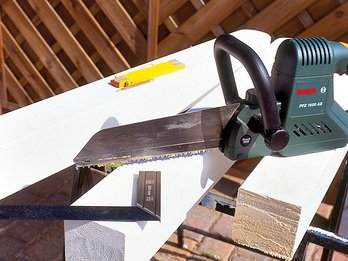
Once the height of the fence has been determined, the posts are cut and painted. Pre-painted parts were used here.
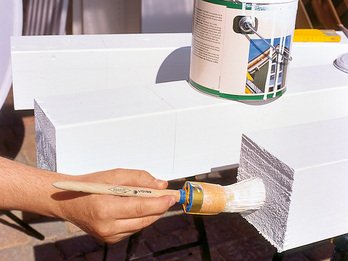
The interfaces are coated with wood protection background and then sealed with double paint application. This is important because the wood is only protected against moisture from below and thus against rot and fungal infestation.
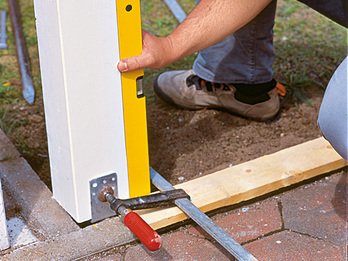
When the concrete has been tied and the post shoes are resilient, the posts are inserted and precisely aligned piece by piece with water scales. A screw clamp keeps them in position.
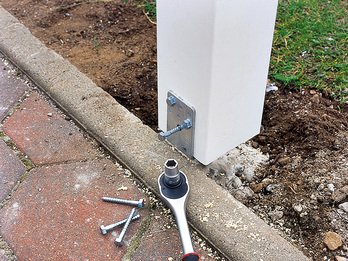
The screw holes are pre-drilled so that the wood does not tear. For the 8 x 60 mm screws, 8 mm holes are pre-drilled.
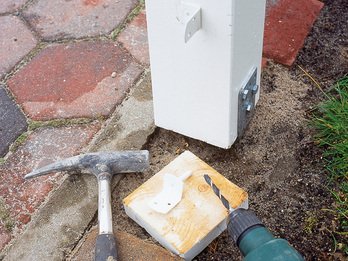
When screwing in, the ratchet with plug nut is helpful. Finally, six screws per post have to be used and this is tedious with a simple wrench.
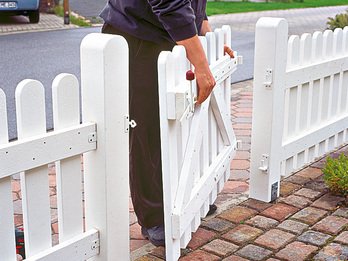
The holes for the L-fittings are also pre-drilled. Board sections serve as a measure. Thus, the holes on all posts sit at the same height.
Wooden fences: Conclusion
- Wooden fences are suitable as decorative frames as well as as safe enclosures.
- The natural material best suits traditional, rural houses.
- Wooden fences can be easily adapted in colour and shape to the other horticulture.
2. Garden fences made of wire mesh or lattice elements
Fences made of wire mesh or lattice mats are certainly not among the favourites from an aesthetic point of view when you choose and build a garden fence, but they have so many advantages that they have become indispensable for most homeowners and garden owners. For plant lovers, mesh wire and lattice fences are ideal as an aid for climbing plants. And there is no more space-saving green screen than an ivy-covered wire fence.
Wire mesh is the first choice everywhere, where long borders have to be fenced securely and cheaply. With matching posts, clamping rods, clamps and wire clamps, it can be processed very well by yourself. The assembly of lattice mats is almost even easier, as the fixed elements only have to be screwed to the posts. Thus, the only disadvantage remains the initially somewhat simple appearance of these fences.
Setting up wire mesh fence: Instructions
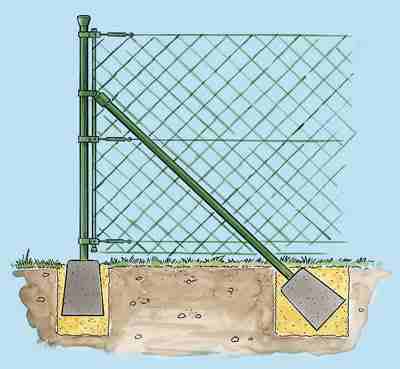
The start and end posts of wire fences must be supported with a diagonal strut, because they have a lot of pull to withstand. After all, the fence has to be tightly tightened. Not only the posts, but also the struts need concrete foundations.
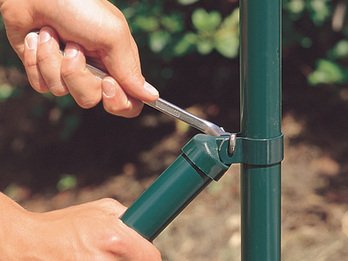
The struts and the posts are screwed together. For this purpose, there is a special clamp as a connecting piece. Only when the clamp is pushed back is the post precisely aligned.

The ends of the clamping wire are threaded into the hole of the pins in the wire tensioner and wound with the key. This is how the wire is stretched. First, the top clamping wire is attached. The meshes of the wire mesh are bent later so that the wire can be inserted. Then close the stitches again.
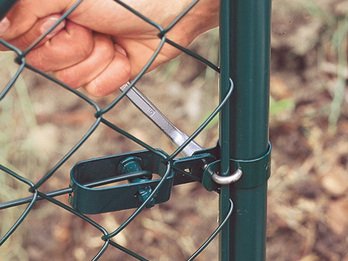
Finally, the clamping rod is guided through the meshes at the edge of the braid and hooked into the hooks. Only now are the screws of the clamps finally tightened.
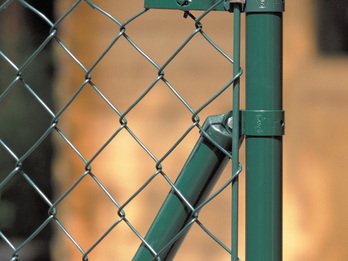
This is what a perfect finish looks like: The clamping rod is stuck on top, middle and bottom of the hook and keeps the wire mesh evenly tight.
Setting up garden fence made of lattice elements: Instructions
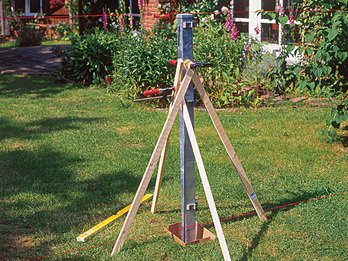
The fence posts are concreted directly in. For this purpose, a square hole is dug, the post is inserted and aligned with the help of four slats. Fix the slats with screw clamps. They support the post until the concrete has been tied off.
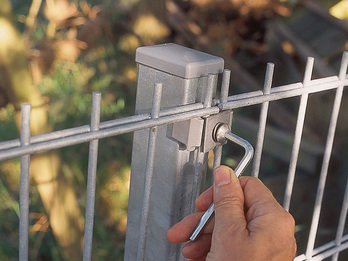
For the fastening of the fence fields there are mounting plates, which are screwed on and clamp both interlocking lattice mats. This works on a straight track (pictured) and on large-angled inner corners. At these corners, the two perpendicular grids are captured by the mounting plate. There are special corner posts for outer corners and inner corners with smaller angular dimensions.
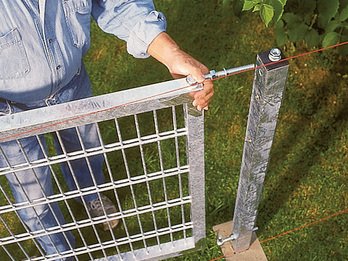
The matching gate is fastened to the top and bottom of the post with a screw-through lob. Plug the lobs through, screw the nut on and adjust the gate so that it hangs exactly parallel to the post. The stop box for the lock is screwed to the opposite posts.
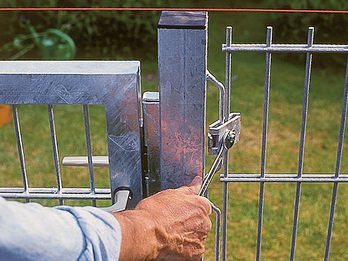
To attach the grid, the end post is provided with welded arcs. Arches and fence mats are connected with special clamps. This is quick and very durable.
Fence made of wire mesh or grid: Conclusion
- Mesh wire fences are a good child- and animal-safe, inexpensive enclosure.
- Grid mat fences have the same advantages, but are even more durable and safer.
- High fences are excellently suited as visual protection with climbing plants.
3. Garden fences made of metal: aluminium or iron
Practically indestructible and also timeless due to their mostly traditional forms, fence fields are as aluminium. The powder coating is considerably more durable than any coat and the care is limited to cleaning the grids occasionally.
Expensive, but as a enclosure for old townhouses most beautiful are fences made of iron. Occasionally you get to buy used elements that only need to be rusted and repainted. New elements require as little care as aluminium fences, as iron is galvanized and powder-coated in the desired color.
Setting up garden fence made of metal: instructions
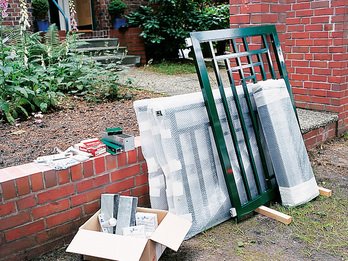
The custom-made fence sections are delivered well packed so that the surface is not damaged.
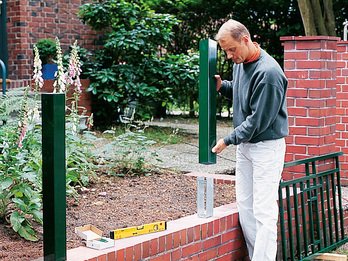
The steel shoes for the posts are screwed onto the base of the wall, the post is pushed over it.
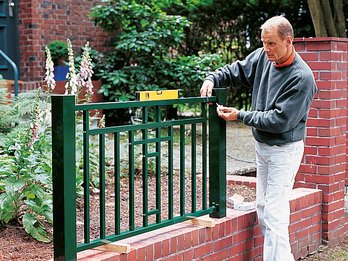
With the help of the spirit level, the fence sections are positioned on a trial basis, then the boreholes are marked for the fastening of the sections.
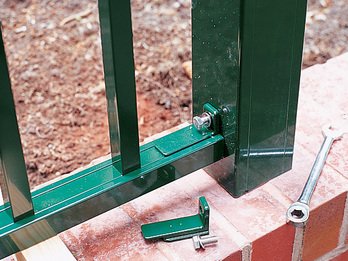
The fence sections are fixed with angles.
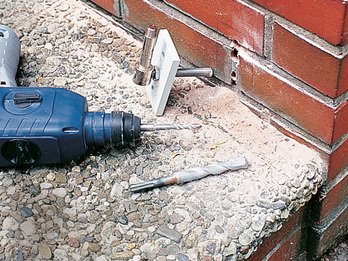
For the gate hinges there are fastening plates with adjustment screw.
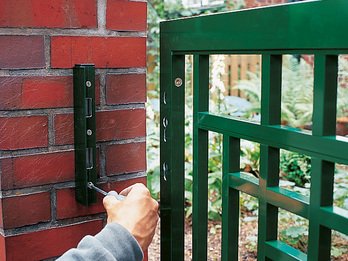
The locking plate is installed as soon as the gate is precisely aligned.
Garden fence made of metal: Conclusion
- Fences made of aluminium or iron are particularly durable and require little care.
- They are the best enclosure for historic houses.
- Instead of posts, brick pillars and plinths are usually used.
 Gerhardt Richter is a writer and a trainer at trade technical colleges, specializing in carpentry, plumbing, mechanics and construction.
