




Comprehensive guide on how to write a business letter step-by-step with easy tips to create every section of the business letter easily. We outline all the essentials of business letter writing, the formal business letter format, different forms of business letter format for salutations and close of business letter.
Regardless of whether you are sending a sales letter, a note of thanks, an offer or a reminder – your business letters are always a calling card for your company. With them you demonstrate how professional and customer-oriented the company works and communicates. Both the content and the layout play a decisive role.
A few questions remain to be answered: How do I design a business letter? Which mandatory information belongs in a business letter? How do I format a business letter correctly? We give tips on how to write a business letter, outline the different parts of business letter formats, and give you complete guidance for each aspect.
How to write a letter for closing a business
CONTENTS
How to write a business letter: design and how to format a business letter
How to write a business letter The mandatory information
How to write a business letter: Tips and strategies
How to write a business letter: design and how to format a business letter
Business letter margins
This starts, for example, with the margins of a typically portrait-format A4 letter for proper business letter formatting. The following dimensions and widths apply to them:
Top margin: 4.5 cm
Side margin below: 2.5 cm
Left margin: 2.5 cm
Right margin: 2 cm (at least 1.5 cm)
Business letter font size and font
The business letter proper format is for the font size in the business letter to be 12 points. If you have a lot of text, you can reduce the letters to 11 points so that the cover letter still fits on one page, but under no circumstances should it be smaller than that to ensure that your letter remains legible without any problems – and with a magnifying glass .
A certain font is not prescribed, but Arial or Times New Roman have established themselves as common types. The font you choose can also affect the font size. Print out a sample copy of your business letter to see how the font will look at the intended size.
Business letter header
Classically, the first thing the reader will look at is the letter header, since it is right at the top of your business letter. This makes it an important figurehead and eye-catcher that should be designed professionally.
Your own address is in the top left as standard, but right-aligned or centered is now also permitted. The first three lines are intended for name, address and telephone number. You can also add your e-mail address here.
The recipient address follows three lines below. This is a maximum of 8.5 centimeters wide. The reason for this are standardized viewing windows in envelopes. In total, however, the contact details must not exceed around nine lines or 4.5 centimeters.
The place and date are usually right-justified and with a blank line space below the address field. However, some companies also position the date in a different position. The place is only mentioned here if it differs from the place of residence (which is rarely the case).
Business letter subject line
After the letterhead, the reader usually goes straight to the subject line to get an overview of what the letter is about. This is usually expressed as “RE: what the letter is about” In your business letters, you should be particularly concise about the content of the letter. However, there are also certain principles that you should adhere to:
- The subject begins two lines below the date if it is in the normal position.
- The subject line may or may not be bold .
- It can be emphasized using a larger font (13 to 14 points).
- The subject can span more than one line, but should not exceed two lines.
- The word “subject” has no place in the subject line.
Business letter salutation
Now the actual content of your business letter begins and the form of address can already influence how it affects the reader, so it is important to have the right salutation for business letter purposes. There are countless ways to address a customer, business partner or employee, but there are also some formal points to consider.
There are exactly two blank lines between the subject and salutation.
Again, there is only a blank line between the salutation and the cover letter.
The neutral salutation is “Dear Sir or Madam, …” However, it is advisable to name the recipient personally and by surname when applying. This underlines your preparations. When it comes to customer relationships, too, the name is an essential part of the salutation to show appreciation.
Business letter text
Of course, there cannot be any specific guidelines for the content of your business letter that you should adhere to. Here you score above all with error-free sentences and a clear structure. It is also advisable not to just start writing on it, but to divide your own text into sections. This not only makes it easier for the reader to understand, but also ensures that the typeface is clear.
Business letter sign-off formula
The sign-off concludes your business letter and, in other words, it is the farewell to the reader. After you have wished well, for example, or noted that you are looking forward to feedback, your business letter ends with a few short words. The classic is a simple “best regards”, but it can be a bit more personal depending on the occasion.
There is exactly one blank line between the letter and the sign-off. There are three lines between the sign-off and the signature – the space for your signature. After that, any attachments are mentioned.
The mandatory information
The mandatory information distinguishes whether your company is in the commercial register or not. Your business letter must contain the following information if you are entered in the commercial register:
Company name and legal form
In addition, the commercial register number and the register court belong in the letter. If your company is a limited liability company, the managing directors and the chairman of the supervisory board (first and last name) should be named.
If it is a stock corporation, you should state the first and last names of the members of the board. The chairman of the board is to be identified. The chairman of the supervisory board should also be named.
Your business letter must contain the following information if you are NOT entered in the commercial register:
First and last name of the owner.
Business address
How to write a business letter
After so much information that characterizes a formally correct business letter, the question still remains: How do you write a good business letter that catches the reader’s attention positively, conveys the most important content, does not seem boring and, in the best case, leads to a quick response or reaction from Written leads? We have outlined all the factors to help you write not only a professional but also a successful business letter.
Be brief.
Remember, your reader’s time and attention is limited. Therefore, you should get straight to the point. As a rule, your business letter should not exceed one A4 page. Use short main clauses rather than long nested sentences.
Choose a meaningful subject line.
The subject is an important point for the reader. Therefore, he should find a brief summary of the content in it. You should not use the word subject, but the proper form for a business letter subject line is to describe what it is about in a concise and specific sentence. For example, when creating an offer, you could write “Your request from DD.MM.YYYY.”
State the most important things first.
In the proper business letter format, it should already be clear to the recipient in the first or second sentence why you are contacting them. He won’t want to wait much longer. If he does not understand the reason for your contact, you will lose his attention and he will not read to the end.
Pay attention to a personal salutation.
“Dear Sir or Madam” – that is the standard salutation and, purely formally, you won’t go wrong with it. However, while such a salutation works, it is also impersonal, cold and distant: who are these ladies and gentlemen? In short: such an address lacks the human touch.
To find out which salutation is the right one for your letter, you should ask yourself two questions: Do you know the name of the recipient? How well do sender and recipient know each other? If your answers are “no” and “not at all”, you will automatically choose “Dear Sir or Madam”. If you know the name of the recipient, but the reason for your letter is official, it is advisable to use the combination “Dear Ms. / Mr. XY”. If the interaction is already more familiar, “Hello” or “Dear” are also a good choice.
Put your recipient first.
In particular, when you make an offer or present your service in your business letter, you should be careful to write in a customer-oriented manner. Before writing the letter, ask yourself: Who is the recipient? What is he interested in? What added value can you offer him? When writing, use the word “you” instead of “we”. It is better to write “You will receive free advice from us” instead of “We offer you free advice”.
Avoid outdated wording.
Salutation such as “Dear Ms. / Mr. XY” or “Dear Ms. / Mr. XY” are no longer used today. This makes your letter look artificial. The same applies to a “Yours faithfully …” But phrases such as “hereby” or “with this letter” also make your letter distant and impersonal.
Be positive.
Instead of “Unfortunately we cannot deliver the product to you”, it is better to formulate the statement as follows: “We have noted your request and will take care of the fastest possible procurement of the desired product”. With the second formulation, your business letter will appear much more professional, positive and customer-oriented.
Offer a contact option.
At the end of your letter, you should give the recipient the opportunity to contact you if they have any questions. At this point you round off your letter. The last sentence gives you the opportunity to say thank you or ask for a specific action (for example an answer by a certain date or a callback).
How to end a business letter: Choose a modern greeting.
There are many good alternatives to the usual “best regards” for a better close of business letter. A looser variant is to write, for example, “Best regards”. Or you can choose an original greeting that is tailored to your company, for example “With culinary greetings” for gastronomy or “With sporty greetings” for sporting goods and fitness centers as more interesting closings to business letters. The greeting at the end is usually well remembered and the closing in a business letter should therefore be chosen with care.
Make use of the postscript.
The PS offers you the option of integrating an addition at the end of the letter. Here you can, for example, refer to a current offer or to your website – and be sure that every reader will be aware of it, because a PS always catches the eye.
How to address a business envelope
So that your letters can be read by machines in the letter centers and thus get to the recipient more quickly, you should note the following in how to address business envelopes:
- write on the front of the envelope only
- The sender’s address is shown at the top left, whether handwritten or printed stationery
- Enter the recipient’s address at the centre to bottom right
- in the upper right corner you can place Postage stamps or some other type of franking
- There should be no sticky notes or imprints on the envelope that could be confused with postal labels or imprints
- Line 1: the Recipient’s Name: Center the address block in the middle of the envelope. Start the address block several lines below the return address. The Postal Service recommends using all capital letters when addressing envelopes.
- Line 2: Person’s Position/Title: If you don’t know the title, use the name of the department instead.
- Line 3: Name of the Company
- Line 4: Street Address of the Company. The Postal Service recommends placing the complete address on one line if possible. If the address is too long, divide the address between two lines and place the suite number or building number on the first address line.
- Line 5: City, state and ZIP code. Use one space between the city and state and two spaces between the state and ZIP code.
Business letter format sample types
Each of the sample business letter formats below has a slightly different style, and we have included those so you can see how you can be flexible to suit your own needs.
Business format letter sample 1

Business letter sample format 2
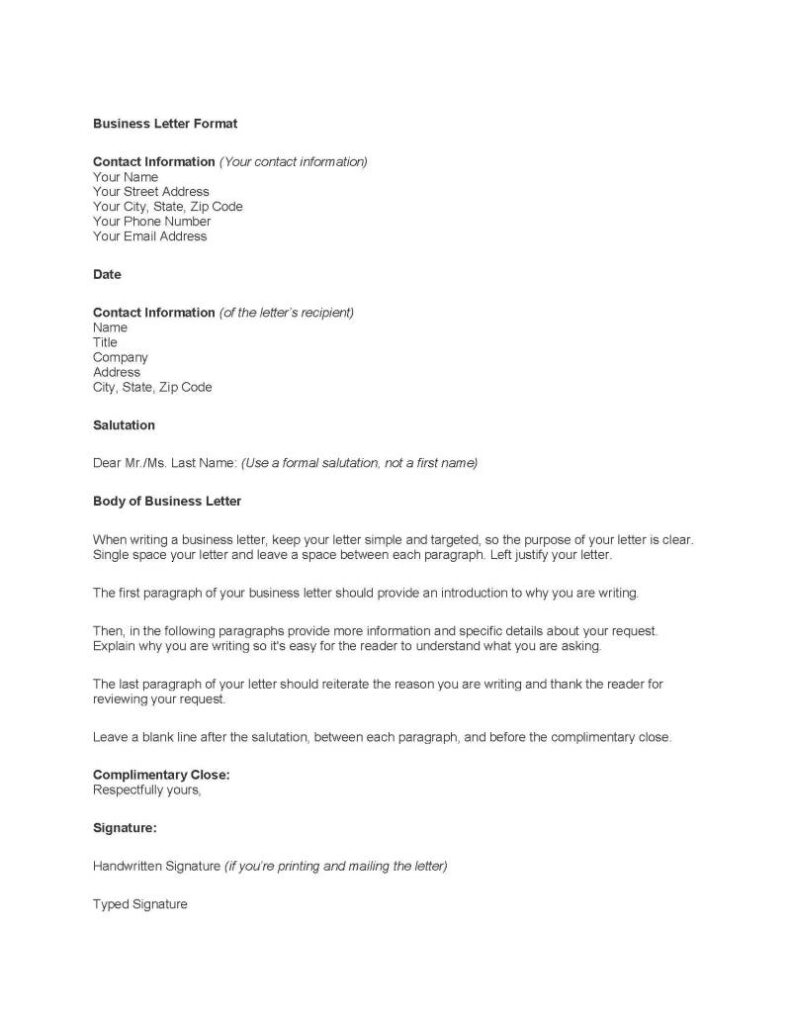
Example business letter format 3

