
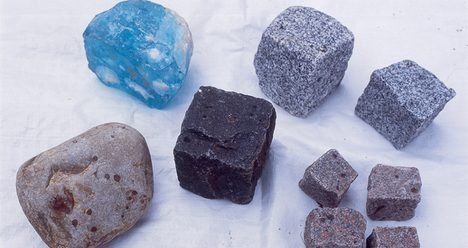



When building a garden path with stones, it means handling and laying different sized stones, so there are a few special things to consider for you as a do-it-yourself maker.
Here and there you have to pull off and compact a sand bed with a 2-percent incline . The height of the sand bed is about 10 to 15 mm above the later height level. Because of this tolerance, the stones will later sink into the sand if you shake it off or compact it.
How to make decorative stepping stones
Build a garden path with stones: Don’t do this
The most common mistake when building a garden path with stones — which means you are laying very uneven stones — is that you press them with the flat side into the sand bed. In this position, however, the stabilizing effect of the sand is lost, the stone will tilt forever. It is correct that the rather elongated stones, whether rounded or edged, to put upright in the sand. The visible area is then smaller, but the stone is rock solid.
For stones of different heights, it is always better to remove sand when setting the stones instead of feeding them. This is the only way the sandbed remains largely compacted and keeps its height. Therefore, you have to subtract the height of the sand bed to match the smallest stone format used.
Build a garden path with stones: step by step
Take away sand
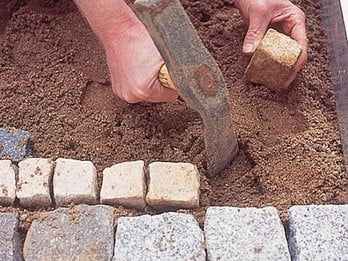
With the paving hammer you just remove as much sand as is necessary to set the stone. For uneven natural stones, look for the visible side so that it fits with the smallest possible joints on the other stones.
Knock in the stone
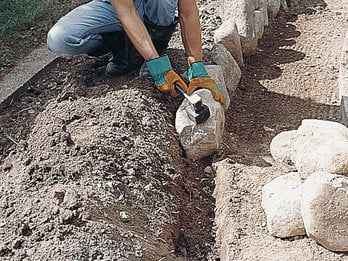
With a few light (!) taps on the stone you lower it to the right height. Laterally you can push some sand against it.
Insert round ones this way
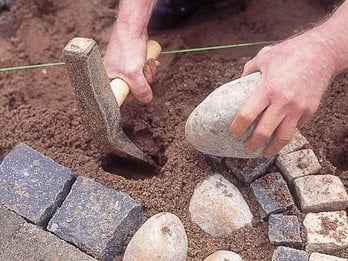
Smallest side up, otherwise it tilts. Dig a large hole with the flat side of the paving hammer.
Compact area
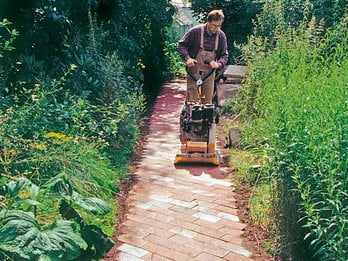
But especially with small areas or transitions, the use of a vibrator is unnecessary. After slurrying the joint sand, compact the surface with a board and a hammer.
Set long stones
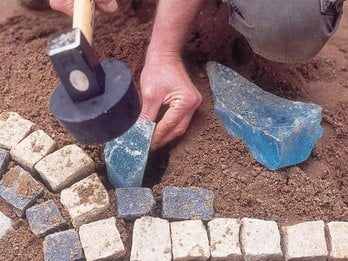
Elongated stones are always placed edgewise in the sand. With your hand you dig a small hole and drive the stone carefully.
Hammers for paving
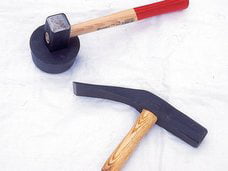
Even if paving stones are not among the soft stones, but they are brittle and quickly destroyed by the clumsy use of unsuitable tools when making a garden path. So you should always use a medium heavy pestle (1000 g) with hard rubber base for tapping or compacting. These hard rubbers can be removed when not in use and use the butt for all other work. The paving hammer is suitable for setting different sized stones, because with the flat side you can spread the sand and fix the stones with light strokes
 Gerhardt Richter is a writer and a trainer at trade technical colleges, specializing in carpentry, plumbing, mechanics and construction.
